On this page
- What Is Ice Damming, and Why Does It Wreck a Roof?
- How Many Times Does an Ontario Roof Freeze and Thaw in One Winter?
- Read Your Own Roof After the First Snowfall
- Why More Roof Vents Usually Will Not Stop Ice Damming
- What Actually Stops It, in the Order That Works
- How Much Does It Cost to Stop Ice Damming in Ontario?
- There Is Already Ice on My Eaves. What Do I Do Now?
- What the Roof Itself Can and Cannot Do
- Book the Attic Work in the Fall
- Frequently asked questions
- Reader reviews
Key takeaways
- Ice damming is a heating problem that shows up on your roof. Warm air leaking into the attic melts the snow, and the meltwater freezes again at the cold overhang.
- A York Region roof crosses the freezing point in both directions about 55 days between December and March. March is the worst month, not January.
- The cheapest diagnosis costs nothing: after the first light snow, look at your roof and note where it melts off first.
- Air sealing and insulation do almost all of the work. Adding roof vents on their own rarely fixes anything.
- Ice and water shield at the eaves stops the leak, not the dam. It is protection, not prevention.
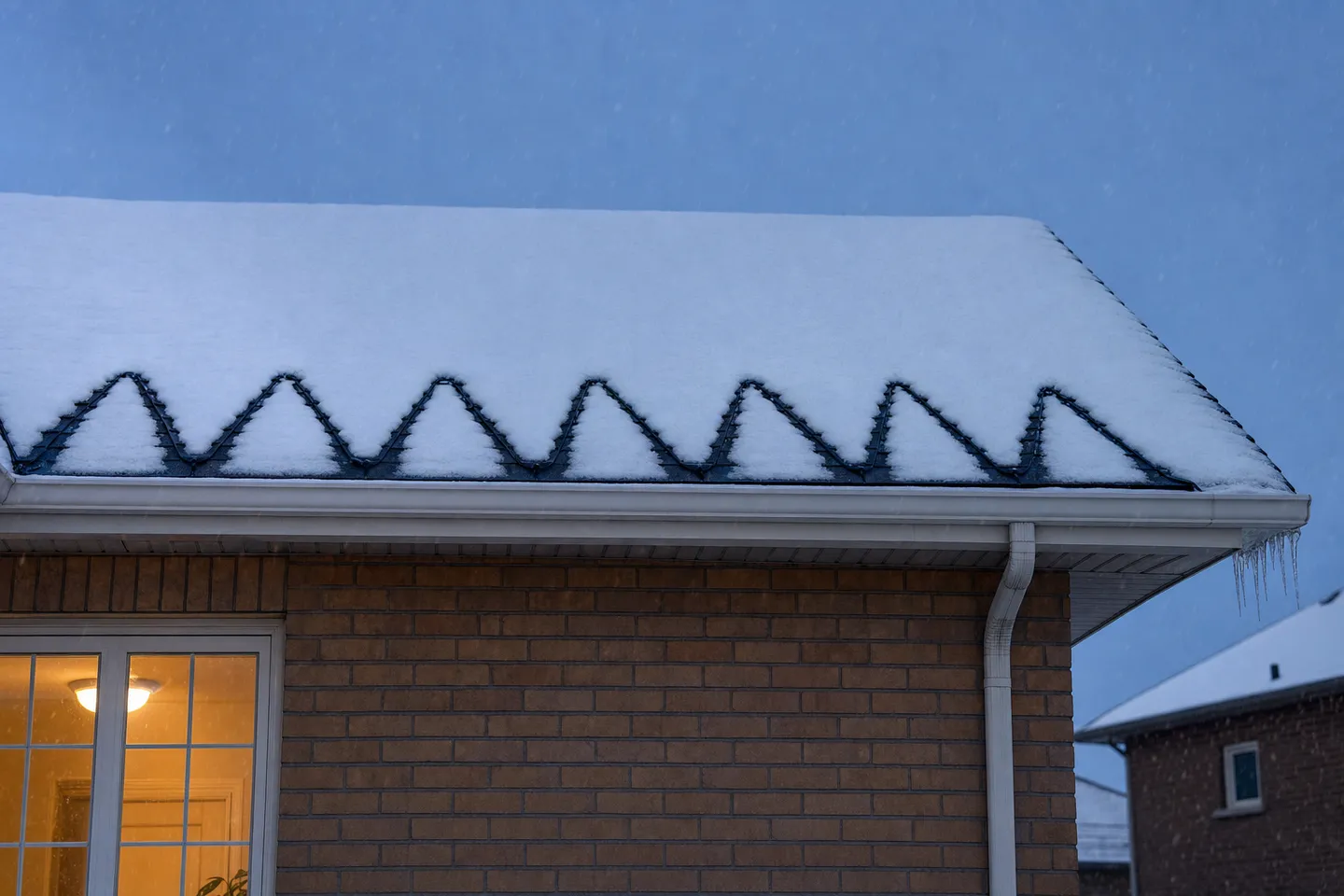
The stain usually shows up in March, in a bedroom ceiling near an outside wall, and there has not been a drop of rain in a week. That is ice damming, and by the time you can see it from the inside, water has been sitting on your roof deck for weeks. Every winter our crews across York Region open up ceilings that were ruined by a ridge of ice sitting quietly over the eavestrough.
Most homeowners have this backwards. An ice dam is not a roofing failure. It is a heating failure that happens to appear on your roof, and the fix is almost always above your bedroom ceiling rather than on top of your shingles.
This is work to book in September, not in February. Below is what causes it, how to read your own roof for the warning signs after the first real snowfall, what actually stops it in the order that works, and what to do if the ice is already up there. Our seasonal maintenance guides cover the rest of the year.
What Is Ice Damming, and Why Does It Wreck a Roof?
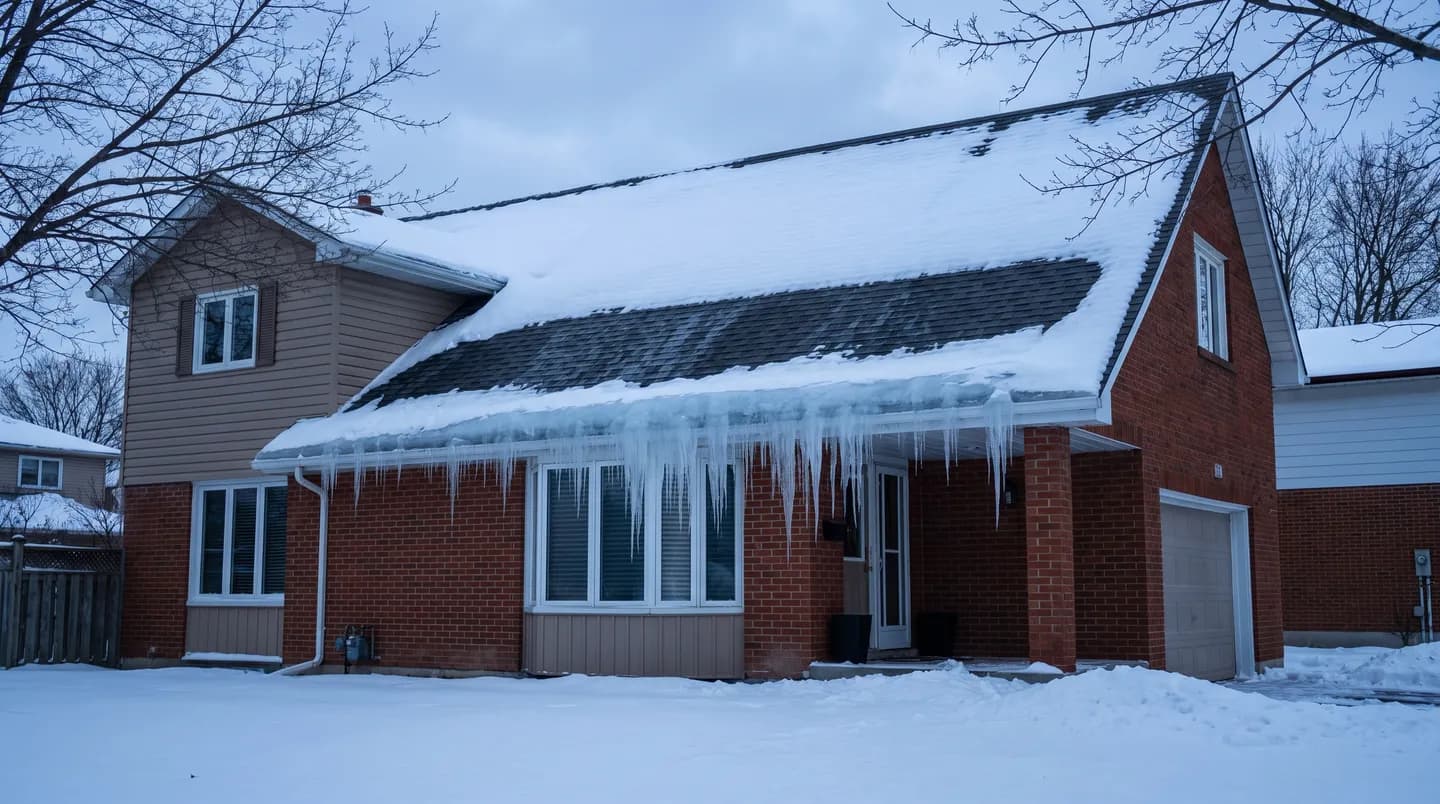
Ice damming is a ridge of ice that builds along the cold edge of a roof when snow higher up melts and the meltwater refreezes at the overhang. The dam then holds standing water on the roof, and shingles are built to shed water running down, not water sitting still or backing up under the courses.
Canada Mortgage and Housing Corporation sets out the mechanism plainly in Attic Venting, Attic Moisture and Ice Dams: if the attic is above freezing it warms the roof sheathing, which melts the snow lying on the shingles. That water runs down the slope until it reaches the overhang, which the attic does not heat and which therefore sits at the temperature of the outside air. If that air is below zero, the water turns to ice, and every melt after it runs into the back of what is now a dam.
The dam grows uphill. Water pools behind it, creeps sideways under the shingle courses, soaks the sheathing, and eventually finds the ceiling. That is why the damage bill is rarely the roof alone. It is drywall, insulation, and paint, and the same job left to run through a winter routinely lands between $1,200 and $4,000 once water has reached the deck.
The clearest proof that this is a heat problem rather than a roof problem sits at the two extremes. CMHC points out that an attic with no insulation at all generally does not get ice dams, because the heat pouring through melts the snow off before it can pile up. A well sealed and well insulated attic does not get them either, because the roof stays cold. The houses that suffer are the ones in the middle, which is most of the housing stock in Ontario.
How Many Times Does an Ontario Roof Freeze and Thaw in One Winter?
More often than most people expect. On Environment and Climate Change Canada's 1991 to 2020 climate normals for Toronto Buttonville Airport in Markham, 55 of the 121 days between December 1 and March 31 rise above freezing and drop back below it. Each of those days is one more chance for meltwater to run down and set.
Here is the part that surprises people. January is not the dangerous month. A normal January at that station has 18 days that never climb above zero at all, so the snow on the roof simply sits there, and only 10 days actually cycle. March cycles 18 times. March is also when we take the most calls about ceiling stains, and the two facts are the same fact.
Deep cold does not build an ice dam. A crossing does. This is why a mild, sloppy Ontario winter can be harder on a roof than a brutally cold one, and why the roofs that get through February untouched are so often the ones that fail in the first week of March.
| Month | Days in month | Never rises above freezing | Thaws and refreezes | Never drops below freezing |
|---|---|---|---|---|
| December | 31 | 12 | 15 | 4 |
| January | 31 | 18 | 10 | 3 |
| February | 28 | 15 | 12 | 1 |
| March | 31 | 7 | 18 | 6 |
Read Your Own Roof After the First Snowfall
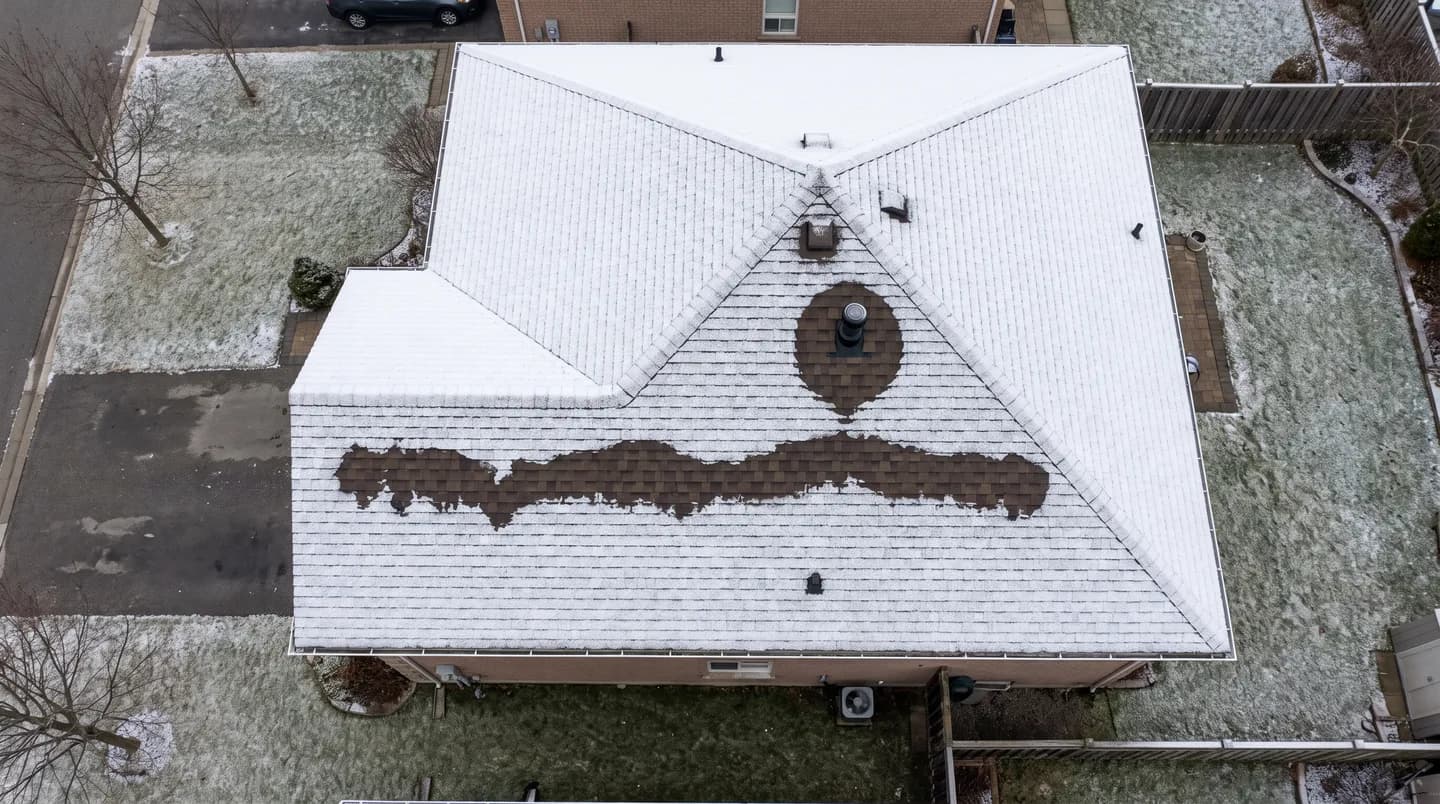
The cheapest ice dam diagnosis in Ontario is free. After the first light snow or the first heavy frost, go outside and look at your roof before the sun gets to it. Wherever the snow melts off first is where heat is leaving your house, and that is where the dam will form in January.
CMHC recommends exactly this, and it works because a thin, even layer of snow is a better thermal camera than most thermal cameras. A roof that melts evenly is fine. A roof with bald patches is telling you what is underneath them.
| What you see on the roof | What is usually underneath it |
|---|---|
| A horizontal melted line partway up the slope | The knee wall of a storey and a half, where the sloped ceiling meets the short wall |
| A melted circle out in the open field of the roof | A bathroom fan ducted into the attic instead of outside, or an unsealed pot light |
| A melted rectangle near the centre of the house | The attic hatch, usually with no weatherstripping and no insulation on the lid |
| A melted strip along the very bottom of the slope | Insulation squeezed thin where the attic floor meets the outside wall |
| Snow gone on one elevation only | A sunlit wall below, warming air up into the eave |
That last row catches people out. Natural Resources Canada notes in Keeping the Heat In that dark siding on a southerly wall, heated by low winter sun, can push warm convection currents up into the eave and cause ice damming above it. If one end of your house dams every year and the other never does, walk around and check which way that wall faces, and what it is clad in, before you blame the roof. Our guide to siding in Ontario covers what sits behind the cladding, which is where the air actually moves.
Why More Roof Vents Usually Will Not Stop Ice Damming
Because ventilation clears heat that has already escaped instead of keeping it in the house. CMHC is blunt about this: reaching for more attic ventilation first is the wrong approach, and extra vents can pull more warm, moist house air up through the ceiling and make the attic wetter than it was.
Ventilation still matters, and the Ontario Building Code still requires it. Roof spaces need unobstructed vent area of at least 1/300 of the insulated ceiling area, with a quarter of the openings high and a quarter low, distributed evenly. What the code does not claim is that vents cure ice damming. They keep the deck dry and the shingles cool, which is why we check them on every roof, but they are the last line of the fix and not the first.
CMHC goes further than most contractors are comfortable with and calls attic ventilation overrated, citing research in which identical attics, one unvented and one vented to code, held much the same temperature and humidity. Take that as a caution about sequence rather than a reason to block your soffits.
The February sales pitch is a row of new roof vents. It is quick, it is visible from the street, and on a house pushing warm air through twenty holes in the ceiling it will not move the needle. Get the order right and the venting you already have is often enough.
What Actually Stops It, in the Order That Works
Four steps, and the order is not negotiable. Seal the air leaks out of the ceiling, insulate the whole attic floor to depth, fix the thin spot where that floor meets the outside wall, then confirm the intake and exhaust venting is clear. The first two do most of the work.
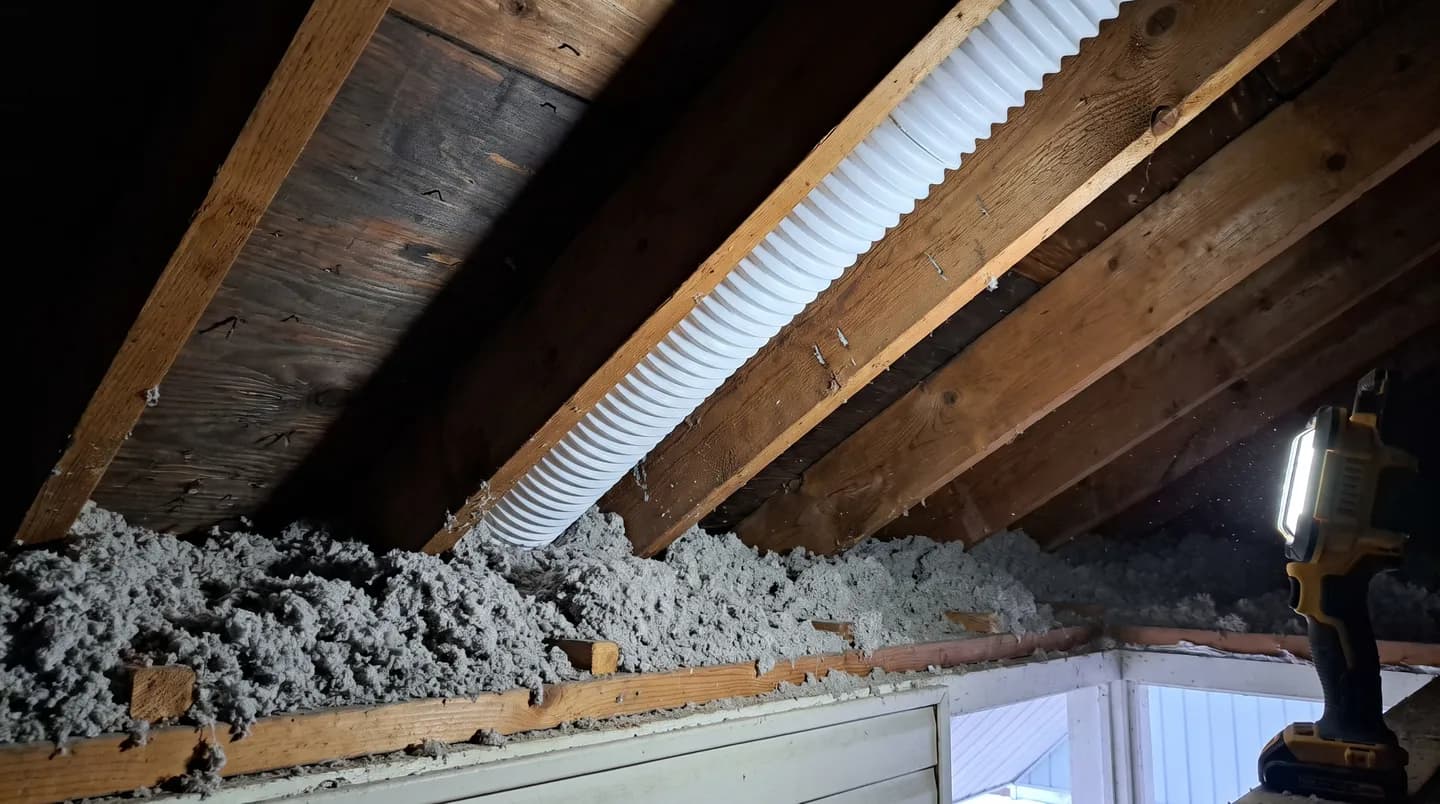
- Air seal the ceiling below the attic. Natural Resources Canada puts it as directly as a government document ever does: the importance of air sealing cannot be overstated, and you should not rely on batt, blown-in or poured insulation to reduce the need for it. Target the attic hatch, plumbing stacks, chimney chases, wiring holes, bathroom fan ducts, and the joint where interior walls meet the ceiling.
- Insulate the whole floor to depth. New builds in Ontario are built to about R-60 in the attic. Older houses are often at half that, and settled loose fill is thinner than it looks.
- Fix the squeeze at the eave. This is the step everyone skips.
- Then check the venting. Clear soffit intake, a working exhaust path, nothing stuffed with insulation.
Step four is the one you can check for yourself, and our guide to soffit and fascia in Ontario sets out how much intake the code asks for and how to read the panel already on your house.
Step three deserves its own paragraph, because it is the one that decides whether the ice forms right where it does the most harm. CMHC notes that once a baffle is holding a ventilation channel open at the eave, there is often only 100 mm of depth left for insulation at that point, and that thin band melts snow just above the overhang. NRCan asks for 38 to 50 mm of clear air between the top of the insulation and the underside of the sheathing, with a baffle in every rafter space, so the answer is not to squash the insulation or to skip the baffle. It is to use the best insulation you can get into that gap and to keep the channel open.
One honest note on scope. We do not install insulation, so we have nothing to sell you on steps one and two, and we will tell you plainly when that is the work your house needs. What we do handle is everything at the roof edge: soffit and fascia that actually breathes, eave protection membrane when the roof comes off, eavestrough that is not being torn off its fascia every March, and our guide to eavestrough repair and the six faults behind it covers what it costs to put a run right after a winter like that, and the roof repair when water has already got in.
Not sure whether it is your attic or your roof?
We will look in the attic, check the venting and the deck, and tell you which trade you actually need. Free, and no obligation.
How Much Does It Cost to Stop Ice Damming in Ontario?
Air sealing plus a blown-in top-up to R-60 runs roughly $1,500 to $3,500 on a typical Ontario attic, and the provincial Home Renovation Savings Program pays $1,000 to $1,250 back on attic insulation with no energy assessment required. That makes the permanent fix cheaper than two seasons of emergency ice removal.
The figures below are Ontario market ranges for 2026, not a Sherak quote, since most of this work belongs to an insulation contractor rather than a roofer.
| Work | Typical Ontario range | What it does about ice damming |
|---|---|---|
| Air sealing the attic floor | $600 to $1,200 | Stops the warm air that melts the snow. The single biggest lever |
| Blown-in top-up to R-60 | $1.50 to $2.50 per sq ft | Slows whatever heat is left |
| Both together, typical attic | $1,500 to $3,500 | The fix that holds for the life of the house |
| Steam removal of an existing dam | $400 to $1,200 per visit | Buys you this winter and changes nothing about the next one |
| Eave protection membrane | Priced inside a re-roof | Stops the leak when a dam forms anyway |
Two of those lines are worth comparing directly. Two winters of steam removal costs about the same as air sealing and insulating the attic once, except that one of them is still working in 2040. If your roof is also near the end of its life, price the two jobs in the same month and read our roof replacement cost guide before you sign anything, because there is no roofing rebate in Ontario and the insulation money is the only rebate in this story.
There Is Already Ice on My Eaves. What Do I Do Now?
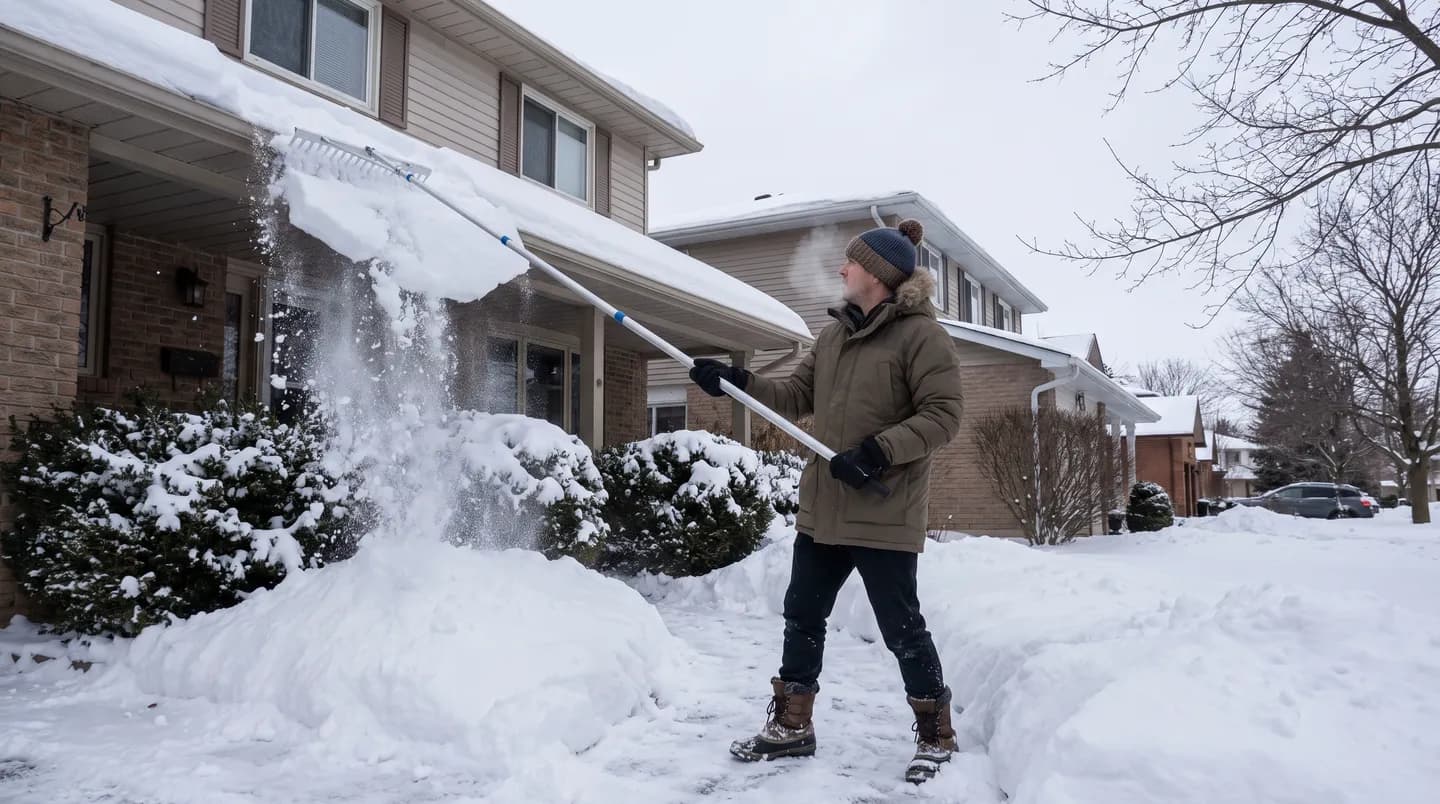
Pull the snow off the lower roof with a roof rake from the ground, and if the dam is already thick, book steam removal. Do not climb up, do not chip at it, and do not throw salt on your shingles. The dam is the symptom, so deal with the cause once the thaw arrives.
A roof rake with an extension pole clears the bottom metre or so of the slope from the driveway, and no snow at the eave means no ice at the eave. Rake after each significant snowfall, keep both feet on the ground, and watch for the overhead wires. This is the one winter job on the list that a homeowner can safely do alone.
Steam is the only removal method that does not cost you shingles. If the ice has already pulled the trough, fascia or roof edge open, that is one of the four situations worth a night call. It melts the ice out without heat high enough to damage the roof, and it runs $400 to $1,200 a visit through the GTA depending on how much ice there is and how bad the access is.
What not to do, and CMHC is unusually direct on all four:
- An axe, a hammer, or an ice pick. A good way to shorten the life of your shingles, and a good opportunity to fall off a ladder.
- Salt or ice-melt pucks in the trough. Corrosion of the eavestrough and the flashing, plus runoff into whatever is planted below.
- Heating cables as the cure. They melt a channel through the ice rather than removing the cause, draw real power all winter, and look like what they are. Installed before the snow on one spot you cannot fix at the source, a cable has a narrower job, and our guide to roof heat cables sets out when that is and what it costs to run.
- Taking the eavestroughs off. They are not the cause, and they are what keeps roof water away from your basement.
If water is already coming through a ceiling, that is a different phone call and a faster one. Our roof leak guide covers what to do in the first hour, and our crews run 24/7 emergency roof repair across York Region and the GTA through the winter.
Water coming through the ceiling?
24/7 emergency roof repair across York Region, Simcoe, Kawartha, and the GTA. $5 million liability insurance and a 10 year workmanship warranty.
What the Roof Itself Can and Cannot Do
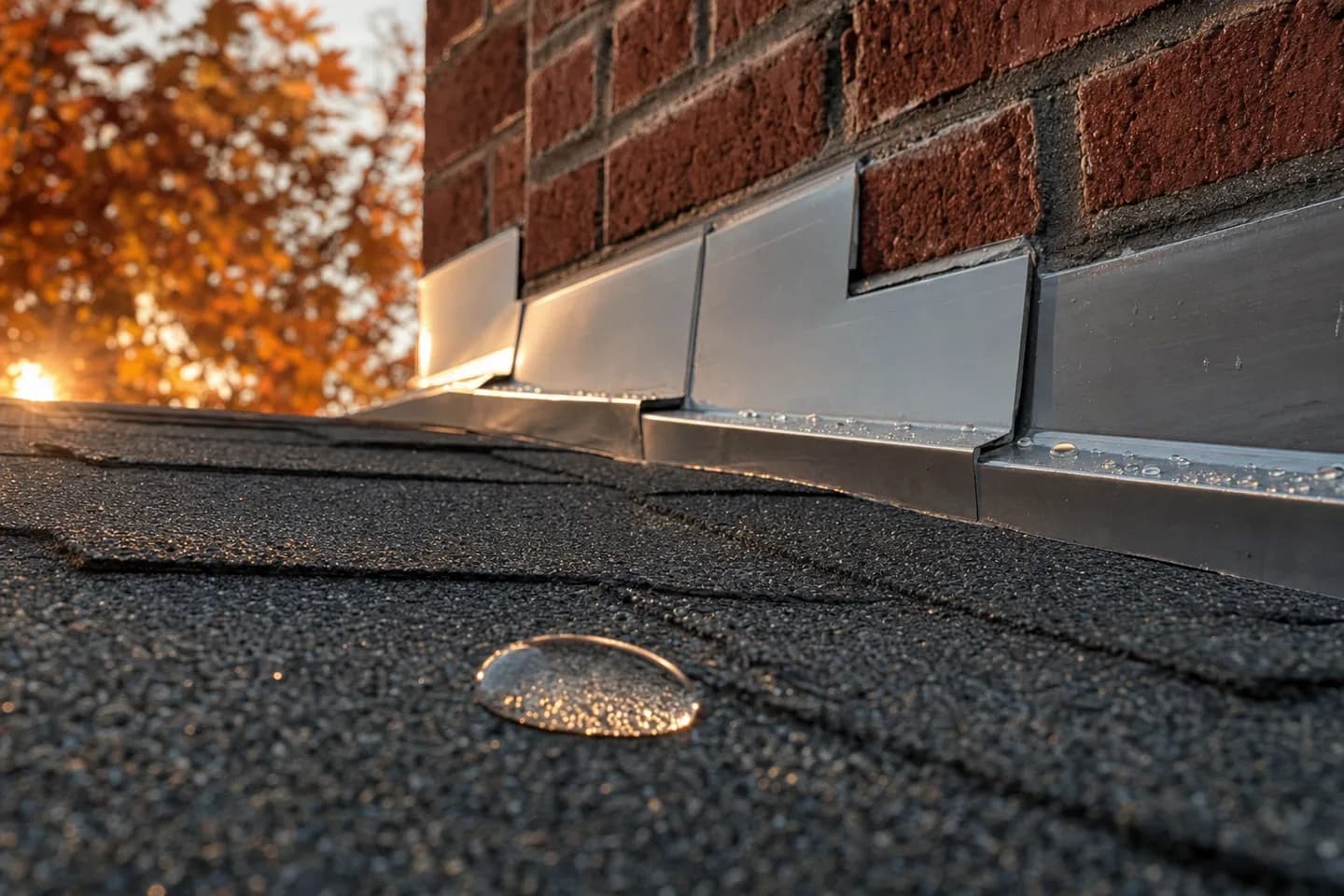
Eave protection membrane, a metal roof, and a sound eavestrough all reduce what an ice dam costs you. None of them prevents one. CMHC is explicit that a self-sealing membrane under the shingles does not stop ice dams, it only stops the water backing up behind one from getting through the sheathing.
That distinction is worth holding onto, because eave protection is sold as an ice dam solution constantly. The Ontario Building Code requires it on shingle roofs from the roof edge up the slope to a line at least 300 mm inside the inner face of the exterior wall, and we run it at the eaves and the valleys as standard. It is the difference between an ugly winter and a ruined ceiling, which is a real difference, but the dam still forms.
Metal helps more, and still does not cure it. A smooth standing seam plane sheds snow before the melt-freeze cycle can get going, which is why metal roofs see fewer ice dams than shingle roofs on the same street. We have still pulled ice off metal roofs sitting over badly sealed attics, and the standing seam cost guide makes the same point: the material reduces the symptom, the attic cures the disease.
Your shingle warranty has an opinion too. Water entry caused by ice damming is a written exclusion on the products we install, alongside damage from inadequate attic ventilation, which is covered in our guide to the best asphalt shingles for Ontario. Nobody is coming to pay for this on a warranty claim.
The eavestrough takes the physical damage. On Lake Drive in Jackson's Point in March 2025 we replaced a system that an ice dam had pulled clean off the house, which turned into new eavestrough, soffit, fascia, siding, and leaf guard, because once the trough goes it takes the fascia with it. Our seamless eavestrough comparison explains why the sectional runs give up first, and our review of what a gutter guard can and cannot do covers which types make a February eave worse rather than better. Going into winter with the trough still loaded makes all of this worse, because leaves left in November freeze into a solid plug along the eave, which is why our guide to eavestrough cleaning puts the last clear of the year in late November rather than October.
Book the Attic Work in the Fall
Ice damming is a September problem that people treat as a February emergency. In February the attic is full of snow-damp insulation, every insulation crew in the GTA is booked, and the only thing anyone can sell you is a truck with a steamer on it. In September the same work is calm, cheap, and permanent.
Our summer and fall maintenance checklist has the two attic checks worth doing before the snow arrives, and if you want a second opinion on what your roof is telling you, we will come and look. Homeowners in Newmarket, Aurora, and Richmond Hill call us every spring about the same stains, and almost all of it was preventable in the fall.
At Sherak we are based in Gormley and work across York Region, Simcoe, Kawartha, and the GTA, including the Georgian Bay shore around Wasaga Beach, where a roof carries better than twice the annual snowfall of one in York Region. Around Innisfil the yearly total is only about a third higher than York Region, but it arrives on twice as many days, and repetition is harder on an eave than any single dump. Every quote is free and itemised, we carry $5 million liability insurance, our workmanship is backed by a 10 year warranty, and you pay the last 10 percent only once you are satisfied. Get a free quote and we will tell you honestly whether the answer is a roofer or an insulator.
Sherak Ltd, Head Office
12275 Woodbine Avenue, Gormley, ON L0H 1G0
Phone: +1 905 490 8800
Email: info@sherak.ca
Frequently asked questions
What causes ice damming on a roof?
Will adding more roof vents stop ice damming?
Does ice and water shield prevent ice dams?
Is it safe to knock ice off my roof myself?
Does a metal roof stop ice damming?
How much does it cost to fix ice damming permanently in Ontario?
Written by
Emad Alikhanpour
Roofing & Exterior Specialist
Emad has 15 years of hands-on experience across roofing and every exterior service Sherak offers, from shingle and metal roofs to siding, eavestroughs, soffit and fascia, and custom flashing.
15 years in the trade · Roofing and exterior services
View profileReader reviews
Loading reviews...