On this page
- Start at the Water, Not at the Trough
- The 6 Faults Behind Nearly Every Eavestrough Repair
- How Do You Tell Which Fault You Have?
- Why Eavestrough Sealant Fails, and Then Fails Again
- How Much Does Eavestrough Repair Cost in Ontario?
- Eavestrough Repair or Replacement: Which One Do You Actually Need?
- Where the Crossing Point Actually Falls
- What an Ontario Winter Does to a Repair
- The Repairs That Are Not Eavestrough Repairs
- How We Quote an Eavestrough Repair
- Frequently asked questions
- Reader reviews
Key takeaways
- Six faults cover nearly every eavestrough repair: a joint that has opened, a hanger that has let go, a run with no fall left, a blocked or undersized outlet, split metal, and a downspout discharging at the wall. Each one leaves the water somewhere different.
- Ontario market rates in 2026 run about $150 to $400 for a joint reseal or a rehang, $200 to $600 to swap a damaged ten foot length, and $150 to $500 for a downspout. Almost every contractor carries a minimum call-out of $150 to $300.
- A 40 foot aluminium run is 14 to 15 mm longer on a 30 degree July afternoon than on a minus 20 January night. No house eavestrough has an expansion joint, so the sealant in the lap absorbs all of it.
- Repair when the failures are contained and replace when they are spread. Count the failure points on one elevation, not the years on the system.
- Water pooling at the foundation while the trough runs clean is not a trough fault. Federal flood guidance puts the discharge at least 2 m from the wall, and that fix costs less than anything else on this page.
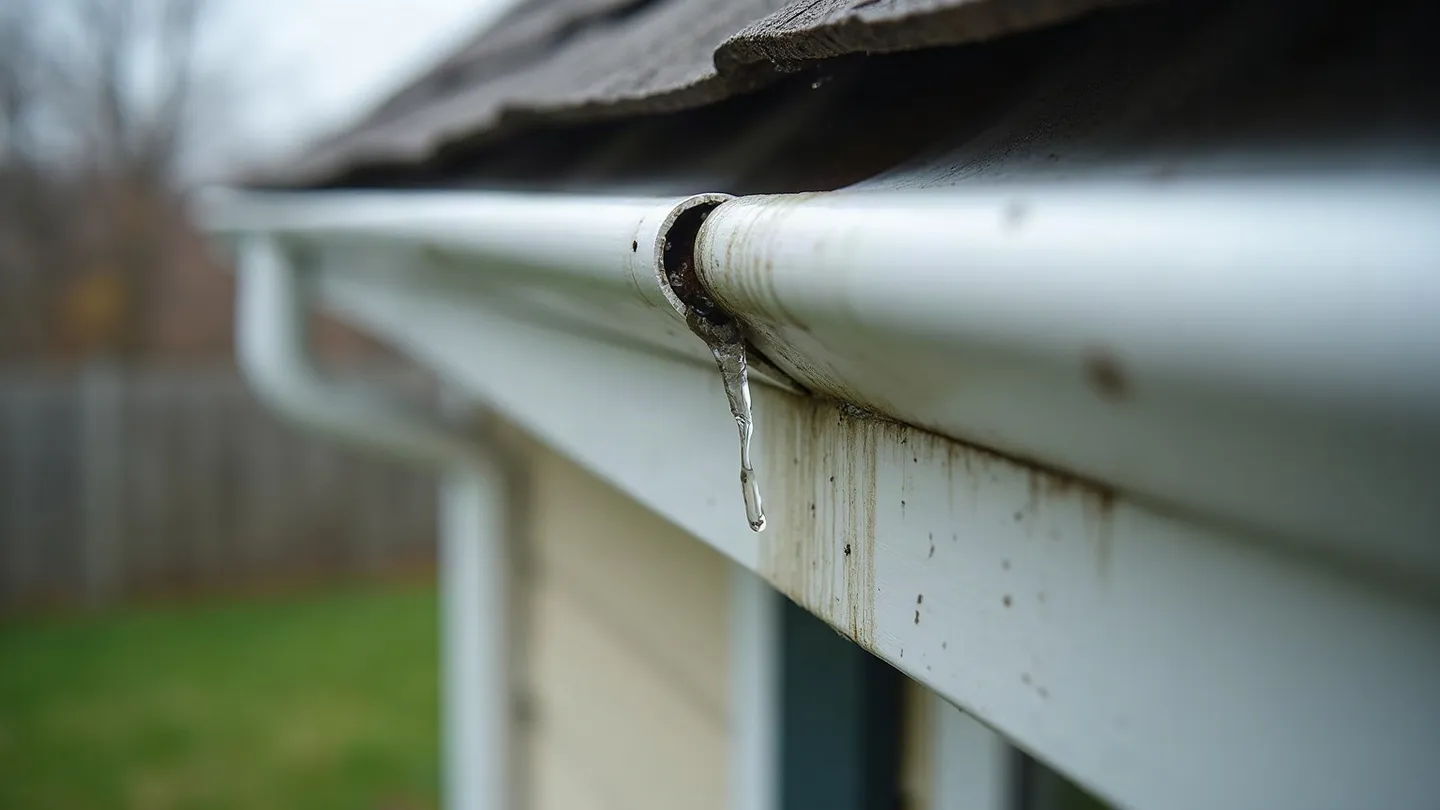
The fascia tells you before the trough does. A grey streak under one seam, a green line down the siding below it, a strip of driveway that stays wet two days after the rain stopped. That is an eavestrough repair announcing itself, and on most houses it has been announcing itself for a season or two before anybody looks up.
Nearly every leaking trough we are called to comes down to one of six faults, and the six are not equally expensive. One is twenty minutes with a caulking gun. One means the run comes down. What separates them is not the age of the aluminium, it is where the water is getting out, which is the question our comparison of seamless and sectional eavestrough stops short of and this article picks up.
So this is the diagnostic in the order we run it on the ladder: where the water shows, what that place means, what the fix is, what it costs at 2026 Ontario rates, and the point where patching stops being the cheaper answer. Most of the time that point has not been reached, and we will say so.
Start at the Water, Not at the Trough
An eavestrough repair is priced by where the water is getting out, not by how old the trough is. Water over the front lip, water behind it at the fascia, a drip at one seam, a puddle tight to the wall: each of those is a different fault, with a different fix and a different bill.
Five minutes outside in the rain settles most of it. Homeowners phone and say the eavestrough is leaking, but what they have actually seen is a symptom in one specific spot, and that spot is most of the diagnosis.
Access decides the rest. On Highway 27 in Nobleton on the last day of March 2025 and the first of April, we put up scaffolding and then set a ladder on the scaffold to reach a roofline nobody could work safely from the ground. Soffit, fascia, eavestrough and downspouts all needed attention on that house, and the trough itself was the smallest part of the job. Getting to a fault is often why a small repair carries a real price, and it is the first thing we look at before we form and hang seamless eavestrough or price a patch on what is already there.
There is a second reason to find the water first. Two of the six faults are not leaks at all. A trough can be watertight end to end and still put water exactly where you do not want it.
The 6 Faults Behind Nearly Every Eavestrough Repair
Six faults account for nearly every eavestrough repair we are called to in Ontario: a sealed joint that has opened, a hanger that has let go, a run with no fall left in it, an outlet that is blocked or undersized, metal that is split or dented, and a downspout that discharges against the foundation.
| Where the water shows | What it actually is | The fix |
|---|---|---|
| A drip and a grey stain under one seam | The sealed lap has worked open | Strip the old bead, clean the metal, re-lap and reseal |
| Overflow over the front lip mid-run, trough sitting low | A spike or hanger has let go | Rehang on hidden hangers into sound fascia |
| Standing water in the trough on a dry day | The run has lost its fall | Rehang to about a quarter inch of fall every ten feet |
| Overflow at one corner in every heavy rain | The outlet is blocked or undersized | Clear it, or add an outlet and upsize the downspout |
| Wet fascia behind the trough, dry ground below | No drip edge, or the trough hangs low for the roof plane | Fit drip edge and reset the trough height |
| A soaked strip of ground tight to the wall | The downspout is discharging at the foundation | Extensions or a re-route, well clear of the wall |
Two of those deserve more than a row. The one misdiagnosed most often is water behind the trough. Homeowners see a wet fascia board and assume the trough is overflowing backwards, and it almost never is. Water is leaving the last inch of shingle and getting in behind the back of the trough because nothing is kicking it forward, which makes it a custom flashing and drip edge job rather than an eavestrough one. Reseal that trough as often as you like and the fascia keeps rotting.
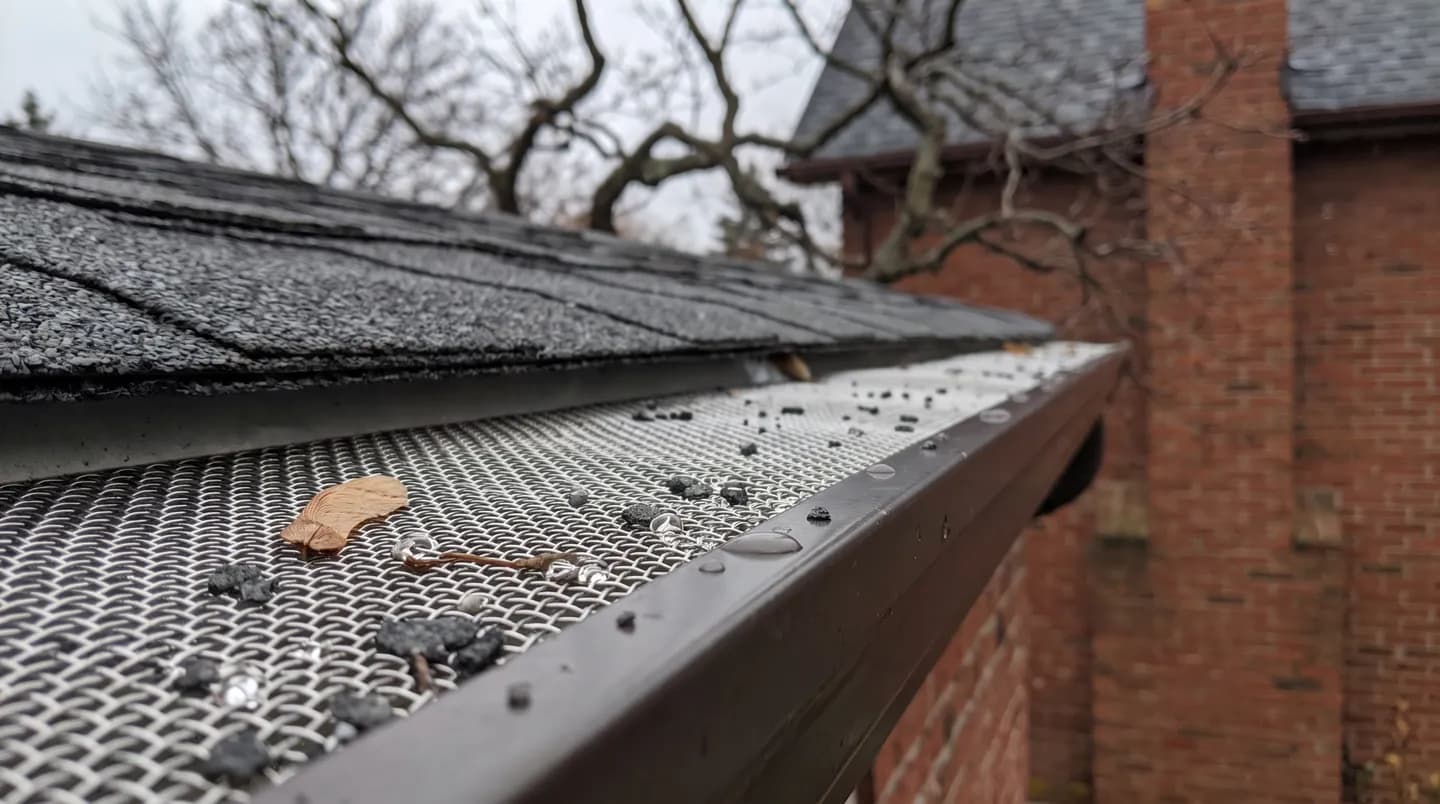
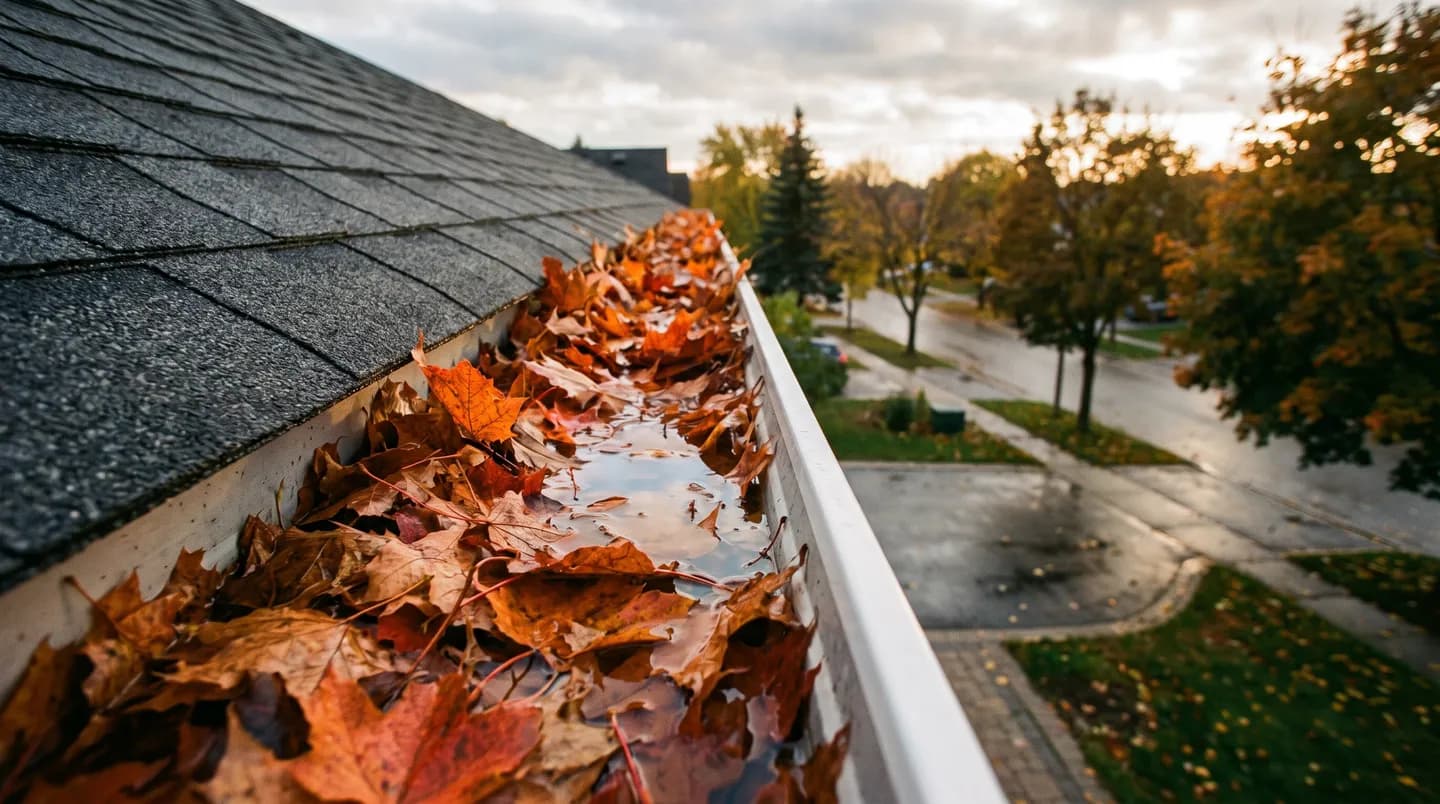
The other is the blocked outlet, because the blockage is rarely where you look for it. Debris packs at the outlet rather than along the run, so a trough that reads clear from a ladder can still be holding water at the one point that decides everything. If yours is on its third clear of the year it is telling you about something other than leaves, and a leaf guard matched to the trees overhead usually costs less than the call-outs it saves.
How Do You Tell Which Fault You Have?
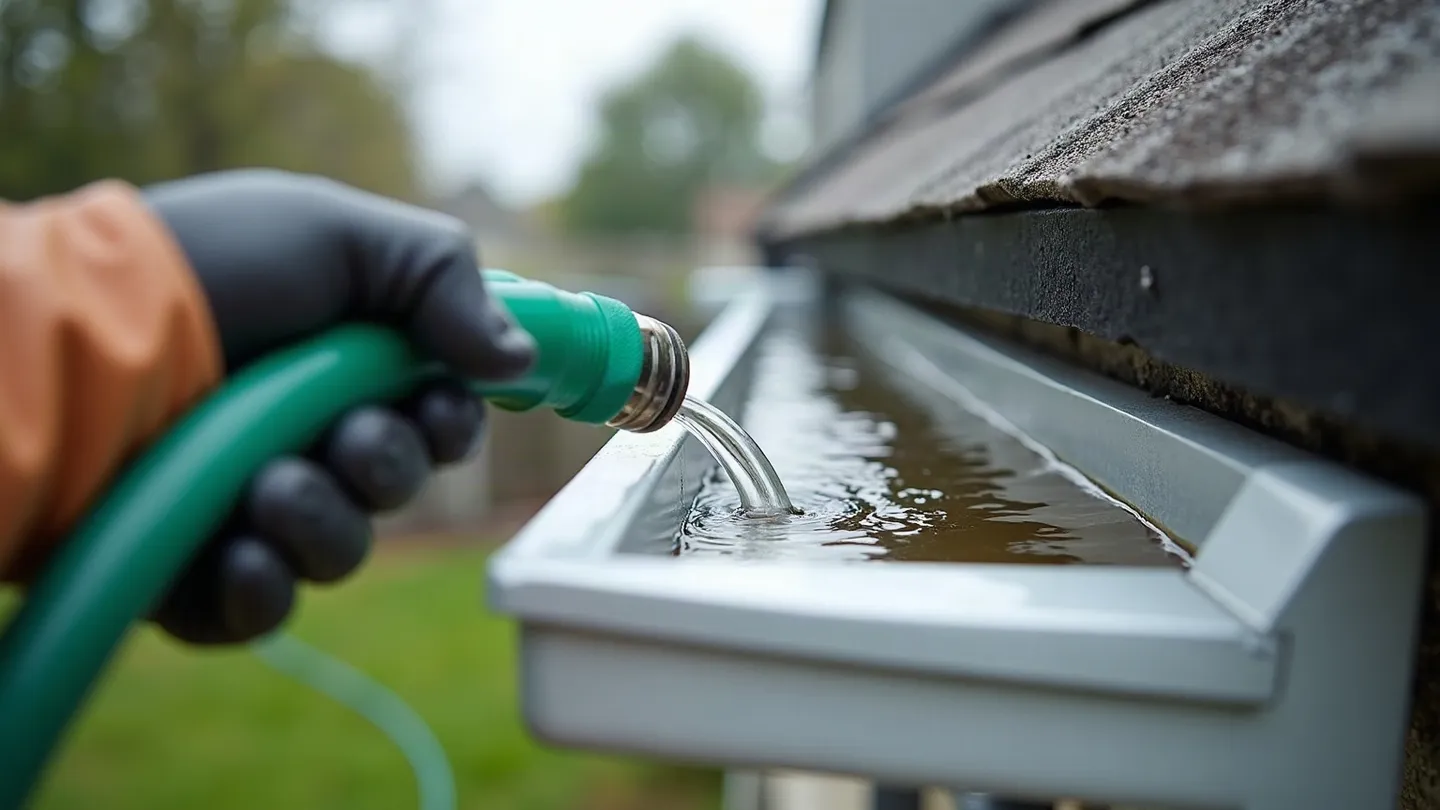
Run water through it. Twenty minutes with a garden hose at the far end of the run tells you more than an hour of looking up from the driveway, because every one of the six shows itself under water and only two of them can be spotted on a dry day.
The order matters, so here is the test as we run it:
- Start the hose at the end of the run furthest from the downspout, at garden pressure rather than full blast.
- Watch the water travel. It should reach the outlet steadily and leave nothing behind. Water standing in pools is a fall problem, and no amount of sealant fixes one.
- Walk the fascia underneath while it runs. A weeping joint shows inside a minute, as a bead on the underside rather than a run down the front.
- Check the outlet last. A downspout that gurgles, trickles or backs up while the hose is going is blocked below the outlet, usually at the first elbow.
- Then find where the water lands. If it soaks in within a metre of the wall, the trough did its job and the downspout did not.
That last step is the one everybody skips. Federal guidance on eavestroughs and downspouts asks for discharge at least 2 m from your own foundation and your neighbours', and puts one downspout every 6 to 12 m of trough. Both quietly disappear during a re-landscape, a deck build or a driveway job.
We run the same test before quoting, which is why we will not price an eavestrough repair over the phone from a photograph. Book a free assessment and somebody puts water through the system before a number goes on paper.
Not sure which of the six you are looking at?
We will run water through the system, find the fault, and price only what it needs.
Why Eavestrough Sealant Fails, and Then Fails Again
Sealant does not fail because it got old. It fails because it has been stretched and squeezed several millimetres a year, every year, since the day it went on. Aluminium grows 23 to 25 millionths of its length per degree Celsius, and nothing in a house eavestrough is built to take that movement up.
Do the arithmetic on your own roofline. The National Research Council's table of thermal and moisture deformations in building materials puts aluminium at 14 millionths of its length per degree Fahrenheit, which works out to 25 per degree Celsius, and the modern figure for gutter coil sits just under that at 23. Either way a 40 foot run changes length by 14 to 15 mm between a 30 degree July afternoon and a minus 20 January night, and a single ten foot sectional length moves about 4 mm on its own. Every millimetre of that has to go somewhere, and in a residential system the only thing soft enough to absorb it is the bead of sealant in the lap.
Commercial sheet metal work solves this openly. The SMACNA Architectural Sheet Metal Manual breaks long gutter runs with a purpose-built expansion joint every 40 to 50 feet. Residential eavestrough has none, on any house in Ontario. The sealed lap is the expansion joint, which is a great deal to ask of a bead of caulk on a north wall in February.
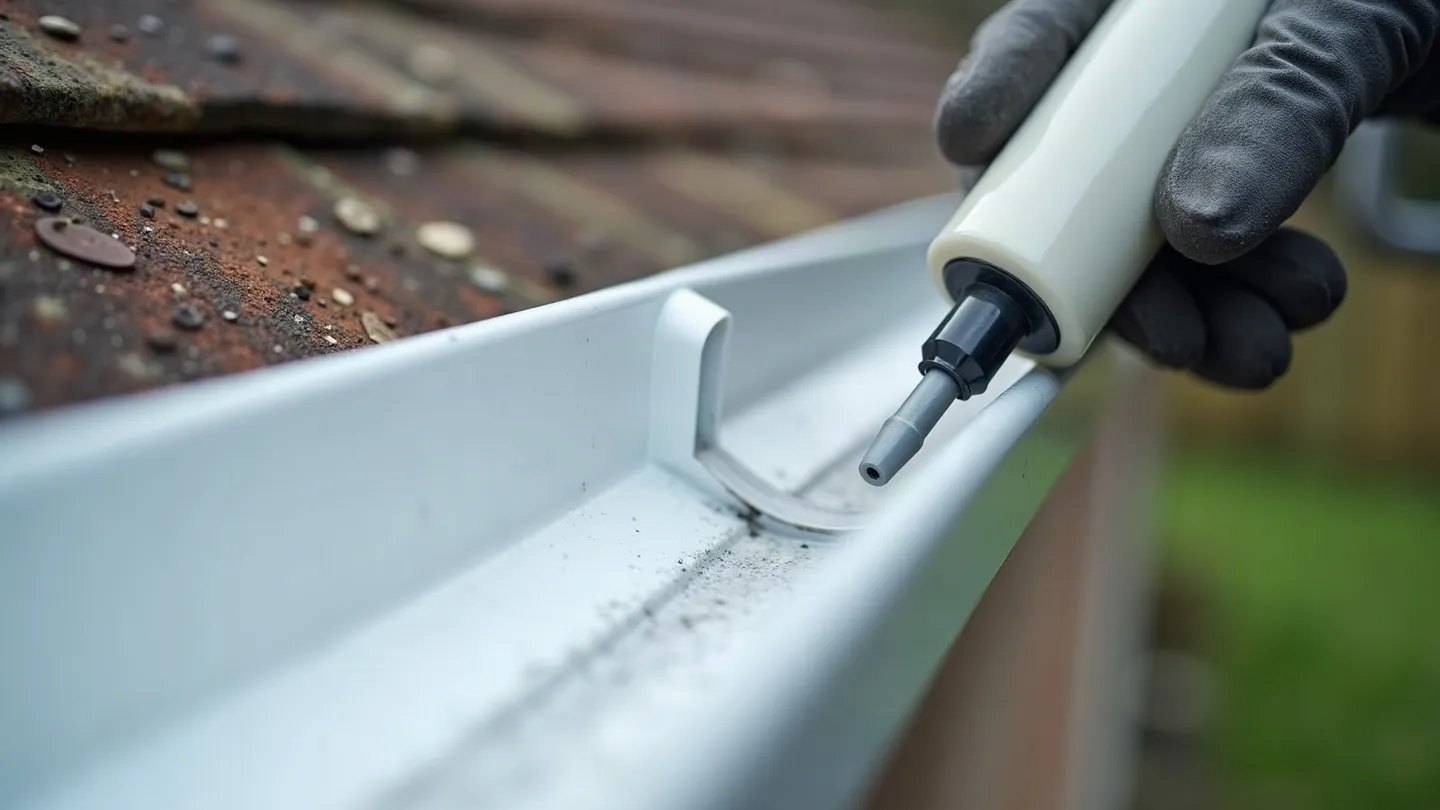
Resealing is still a real repair with a real service life, as long as it is done properly:
- Strip the old bead out. Sealant laid over sealant is the most common reason a joint reopens the following spring.
- Clean and dry the metal, wire brush then a solvent wipe. The inside of a trough is full of shingle grit, and grit is what adhesion loses to.
- Use a gutter grade sealant, butyl or tripolymer, which stays flexible cold and bonds to painted aluminium. Federal flood guidance suggests silicone for small cracks, and on a hairline split in a downspout that is fine. A lap joint that moves 4 mm a year is a different problem.
- Seal from the inside, where the water actually is, and only on a dry day above about 5 degrees.
How Much Does Eavestrough Repair Cost in Ontario?
Ontario market rates in 2026 put a joint reseal or a rehang at roughly $150 to $400 a visit, a damaged ten foot length at $200 to $600, and a new downspout at $150 to $500. Most single eavestrough repairs land under $700, and almost every contractor carries a minimum call-out charge of $150 to $300.
Those are market bands rather than a price list. They are here so you can tell a fair quote from a poor one before anybody is standing on your driveway.
| The repair | Ontario market rate, 2026 | What moves it inside the band |
|---|---|---|
| Reseal a leaking joint or corner | $150 to $400 | How many joints, and whether the old bead has to be stripped |
| Rehang a sagging run and reset the fall | $150 to $400 | Length of run, and whether the fascia behind it is sound |
| Replace a damaged ten foot length | $200 to $600 | Matching an older profile and a faded colour |
| New downspout, elbows and outlet | $150 to $500 | Storey height, and any underground connection |
| Minimum call-out before any work | $150 to $300 | Distance and access |
Three things move a repair price more than the repair itself. Height is the obvious one. Access is the Nobleton job above, where the scaffold went up before a tool came off the truck. Colour match is the one that catches people out, because twenty years of sun has moved the old trough away from every colour on the current chart, so a repair that is perfect on paper can end up looking worse than the fault did.
We see that last one constantly on the lakeshore. Around Georgina a trough on an exposed north elevation ages at a different rate from the same trough on the front of the house, and a colour match that works on one wall is off on the other.
Eavestrough Repair or Replacement: Which One Do You Actually Need?
Repair when the failures are contained, replace when they are spread. Two leaking joints on an otherwise sound elevation is a repair, every time. Staining under half the seams, visible sag between hangers, or soft fascia behind the trough is a system at the end of its life, and patching that just moves the leak one joint along.
Count failure points, not years. A twenty year old system with one bad corner is a corner job. A twelve year old system with five weeping joints along the back is telling you the back elevation is finished. Age is a poor guide because the two long walls of a house rarely wear at the same rate: the north side and the wall under a valley go first, and the front of the house often looks new while the back has given up.
The arithmetic deserves to be done out loud, because contractors usually get accused of the opposite. A full 160 foot system in five inch seamless aluminium runs $1,800 to $3,000 installed in Ontario with tear-off and disposal included. Set repeat repairs against that number and the crossing point is further away than most sales pitches admit.
| Call-out | What that visit costs | Running total | Against replacing the system for $1,800 to $3,000 |
|---|---|---|---|
| 1. Reseal two leaking joints | $150 to $400 | $150 to $400 | still under what a new system costs |
| 2. Rehang a sagging run | $150 to $400 | $300 to $800 | still under what a new system costs |
| 3. Swap a split ten foot length | $200 to $600 | $500 to $1,400 | still under what a new system costs |
| 4. New downspout and outlet | $150 to $500 | $650 to $1,900 | reaches into what a new system costs |
| 5. Reseal the corners again | $150 to $400 | $800 to $2,300 | reaches into what a new system costs |
Where the Crossing Point Actually Falls
For the first three call-outs, repairing is plainly the cheaper answer and anybody telling you otherwise is selling a system rather than solving a leak. It is around the fourth and fifth visit that the running total reaches into what a new system costs, and by then you have also paid four separate times for the same ladder, the same drive and the same hour of setup.
One shortcut cuts through all of it. If the fascia behind the trough is soft, the decision has already been made for you, because there is nothing solid left to fasten a repair to. That is the fault that turns an eavestrough job into a roofline job, and it is why we look behind a trough before quoting the front of it.
We find it more often on exposed lots than inland ones. In Wasaga Beach, where a roof carries 2.2 times the snow a York Region roof does, wind drives rain flat at the fascia instead of letting it fall, and the board behind the trough takes a beating the trough itself never shows.
What an Ontario Winter Does to a Repair
Ice is why a repair that held all summer opens in February. A trough packed with ice weighs many times what it does full of water, and that load hangs on the hangers, the fascia and every sealed joint at once.
The Building Code has already conceded the point. Article 9.26.5.1 of the Ontario Building Code requires eave protection at the roof edge, carried to a line at least 300 mm inside the exterior wall, which is the Code stating plainly that meltwater backs up at the eave in this climate. The trough hangs below all of that and cannot fix what happens above it.
On River Street in Sutton in March 2025 we replaced a gutter system an ice dam had wrecked, and repaired the soffit the backed-up water had found on its way past. The trough was the visible casualty. It was not the cause. If you are seeing ice at the eaves every winter, the real work is up in the attic, which our guide to preventing ice damming before winter sets out in full. Repair the trough and leave the attic alone and you have bought one season.
Timing matters as much as diagnosis. We do not reseal joints below about 5 degrees, because the bead will not wet cold metal properly and the repair lets go on the first thaw. A leak found in December gets a temporary fix and a spring date, and we say so rather than charging for the same joint twice. Around Innisfil, where snow falls on 64 days a year and freezing rain on another 7.9, that is a conversation we have most Decembers.
The Repairs That Are Not Eavestrough Repairs
Some of the jobs we are called out for as eavestrough repairs turn out to be something else once water goes through the system, and three of them come up again and again. Quoting any of the three as trough work would be the wrong answer.
The fascia behind it. Years of quiet overflow rot the board from the back, and by the time paint bubbles on the front there is nothing left to screw a hanger into. On Simcoe County Road 88 in Bradford in April 2025 we took out only the damaged sections to reach what was behind them, repaired what could be repaired, and left the sound material alone. That is the usual outcome rather than a full soffit and fascia replacement, and our guide to what soffit and fascia actually do covers how to tell a board worth capping from one worth cutting out.
The roof edge. When water is getting inside the house, the trough is rarely the first cause. Start with what to do about a roof leak and work down to the drainage rather than up from it.
The ground. Water pooling at the foundation while the trough runs clean is a discharge problem, and it is both the cheapest fix on this page and the one that prevents the most expensive damage.
One more thing worth saying, because it shows up on quotes as a line item that should not be there. On Concession Road 4 in Loretto in March 2025 we replaced the soffit, fascia, eavestrough and downspouts on a house and took the existing leaf guards off, kept them, and refitted them to the new trough. Guards that suit the trees overhead are worth reinstalling. Charging to replace them because they came off the old system is a charge nobody needs.
How We Quote an Eavestrough Repair
Three things go on paper before a number does: which of the six faults you have, how many failure points sit on each elevation, and what the fascia behind the trough is like. A quote missing those is a guess with a price attached.
- The fault, named, and the fix that matches it.
- How many joints, hangers, outlets or feet of trough the fix actually touches.
- What we found behind the trough, and what it costs if it has to be dealt with.
- Whether the colour will match, and what it will look like if it will not.
- What we are deliberately not doing, and why.
At Sherak we are based in Gormley and our crews work across York Region, Simcoe, the Kawarthas and the GTA, on repairs as readily as on full systems. Every job carries our 10 year workmanship warranty, $5 million liability insurance, and terms where the last 10 percent is due only once you are satisfied. The rest of our drainage writing sits in the eavestroughs and drainage guides.
Sherak Ltd, Head Office
12275 Woodbine Avenue, Gormley, ON L0H 1G0
Phone: +1 905 490 8800
Email: info@sherak.ca
Get the fault fixed, not the whole system sold to you
We will find which of the six you have, tell you whether it is worth repairing, and put it in writing either way.
Get a Free QuoteFrequently asked questions
How much does eavestrough repair cost in Ontario?
What is the best sealant for an eavestrough joint?
How do I know whether to repair or replace my eavestrough?
Why does my eavestrough overflow when it is not blocked?
Can I reseal a leaking eavestrough joint myself?
Does a leaking eavestrough actually damage the house?
Do gutter guards stop the repairs?
Written by
Emad Alikhanpour
Roofing & Exterior Specialist
Emad has 15 years of hands-on experience across roofing and every exterior service Sherak offers, from shingle and metal roofs to siding, eavestroughs, soffit and fascia, and custom flashing.
15 years in the trade · Roofing and exterior services
View profileReader reviews
Loading reviews...