On this page
- Start With the Verdict, Not the Brochure
- The Two Ways Every Gutter Guard Fails
- What Actually Lands on an Ontario Roof, and How Big Is It?
- Which Debris Gets Through Which Gutter Guard?
- The Catch Nobody Puts in the Brochure
- The 5 Types, and What Each One Is Actually For
- Do Gutter Guards Mean You Never Clean the Eavestrough Again?
- Will a Gutter Guard Stop Ice Dams?
- What Does a Gutter Guard Cost in Ontario?
- How We Choose One On the Ladder
- Frequently asked questions
- Reader reviews
Key takeaways
- Every gutter guard sold in Ontario fails in one of two ways. Either the openings are wide enough that grit and needles wash in, or they are fine enough that pollen and shingle dust blind the surface and the rain runs off the front.
- IKO grades the granules on its shingles from 0.425 mm up to 1.7 mm. A 1/8 inch perforated aluminum cover has 3.2 mm holes, so every one of those granules goes straight through it.
- Eastern white pine, Ontario's own provincial tree, drops needles 0.7 to 1 mm thick and up to 10 cm long. Nothing coarser than a micro-mesh keeps them out of a trough.
- Sherak fits leaf guard systems for $500 to $1,500 on a full house. The heavily advertised premium micro-mesh systems sit in a different bracket at $15 to $30 a foot.
- No guard stops an ice dam. Ice damming starts in the attic, and a guard sits well below where the problem begins.
The salesman is standing on your driveway in Aurora with a sample of gutter guard in his hand, bending it back and forth, telling you this is the last time you will ever think about your eavestrough. He is half right. It will keep the maple leaves out. What he will not mention is everything small enough to drop straight through the sample he is holding.
We fit leaf guard systems across York Region every autumn, and every spring we take a few off again on houses where somebody was sold the wrong one. The difference between those two outcomes is almost never the brand. It is whether the openings in the guard are bigger or smaller than the things that land on that particular roof.
So this article does what the brochures will not. It puts the published opening size of each type of guard on the same millimetre scale as the measured size of Ontario roof debris, and lets you read off the winner. Every number below is either a manufacturer's published figure or something we have pulled out of a trough by hand.
Start With the Verdict, Not the Brochure
Yes, a gutter guard works, but only against one half of the problem. Every type on the Ontario market keeps whole leaves and twigs out of the trough. Not one of them keeps out shingle granules, pine needles and roof grit, which is what silts up a guarded eavestrough three or four winters later.
Here is what that looks like on a real roof. Last May we lifted the guards off a 2009 two-storey in Richmond Hill so the owner could see underneath. The mesh on top was spotless. The trough below held close to an inch of wet black grit with the consistency of coffee grounds, running the whole length of the rear elevation. Nothing had blocked. The fall had simply gone out of the run, because the sediment lay deepest at the outlet end.
That house did not need a better guard. It needed the trough emptied once and rehung with proper fall, which is a different job and a much smaller bill. A guard is a filter. The only question worth asking is what size of particle your filter actually stops.
If your trough is still bare and you are weighing a guard against doing nothing, start with our guide to how often an Ontario eavestrough really needs clearing. Twice a year and no drama means a guard buys you convenience. Clogging every eight weeks means a guard is a bandage on something else.
The Two Ways Every Gutter Guard Fails
A gutter guard has one dimension that decides its life, the width of its openings, and both of its failure modes fall out of that single number. Make the openings wide and fine debris washes through and silts the trough. Make them fine and pollen, dust and shingle grit blind the surface until rain sheets off the front.
Those two failures look nothing alike from the ground, which is why homeowners misdiagnose them so often.
- It lets the wrong things in. The guard stays clean and the trough fills anyway. You see no overflow for years, then the run starts weeping at a seam, or water backs up at the outlet, or a downspout that used to roar in a storm now trickles. Screens, brush inserts and coarse perforated covers all fail this way.
- It sheds water it was meant to catch. The guard collects a skin of pollen, roof film and fine grit. Surface tension does the rest: rain that should drop through beads on that skin and runs over the lip into the garden bed. You get overflow in a downpour with a bone-dry trough underneath. Fine micro-mesh fails this way.
Every product on the market is just a position on that trade-off, and each manufacturer advertises only the failure it happens to be good at. Read a guard's marketing and you can usually work out which of the two it suffers from, because that is the one it never mentions.
What Actually Lands on an Ontario Roof, and How Big Is It?
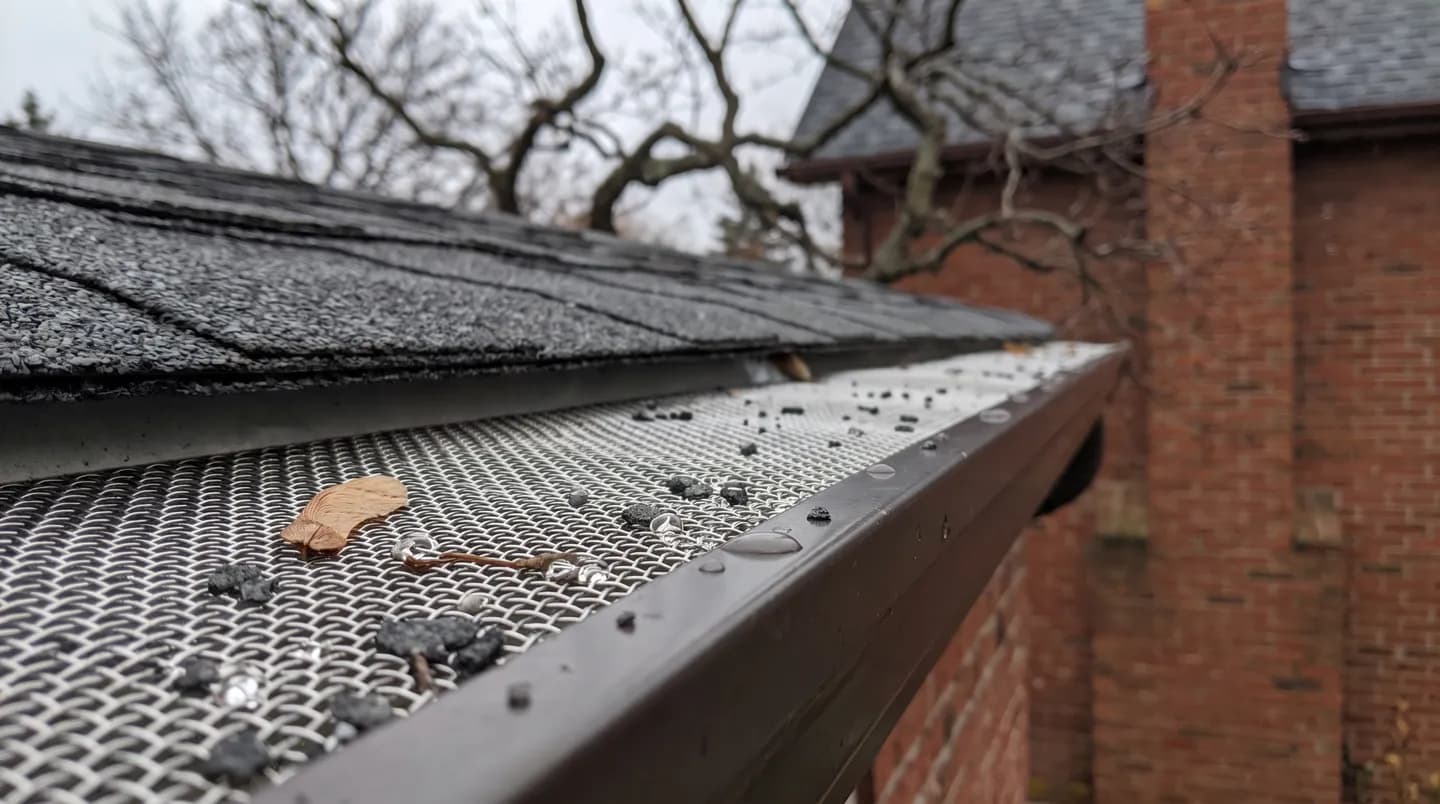
Four things fill an Ontario eavestrough, and only one of them is a leaf. Shingle granules run 0.425 to 1.7 mm, eastern white pine needles are 0.7 to 1 mm thick, a Norway maple key measures 3 mm through the seed, and wet leaves are flat, so they mat on the surface rather than pass through it.
These are not our estimates. IKO, whose shingles we install, publishes the gradation of the granules it uses: crushed and screened stone running from very fine particles at 0.425 mm up to 1.7 mm. Roofing granules are graded by sieve under ASTM D451, so those figures are a specification rather than a guess. Every asphalt roof in Ontario sheds them, heavily in its first few months and then again as it ages past fifteen years.
The trees are measured too. Eastern white pine, the arboreal emblem of Ontario since 1984, carries needles in bundles of five that the botanical description puts at 6 to 10 cm long and 0.7 to 1 mm thick. A Norway maple key, the seed that covers half the driveways in the GTA every June, is a disc 10 to 15 mm across and 3 mm thick with a wing 3 to 5 cm long.
| What lands on the roof | The measurement that decides it | How it beats a guard |
|---|---|---|
| Shingle granule | 0.425 to 1.7 mm | Washes through anything coarser and silts the trough |
| Eastern white pine needle | 0.7 to 1 mm thick, 6 to 10 cm long | Threads through an opening end first, then mats on top |
| Norway maple key | 3 mm through the seed, wing 3 to 5 cm | Slips edge on through a wide screen and germinates in the trough |
| Wet maple or oak leaf | flat, no thickness worth measuring | Mats across the surface and sheds rain over the front lip |
| Pollen, dust and roof film | well under 0.1 mm | Blinds a fine mesh so water beads and runs off it |
Notice what that table does to the usual sales pitch. A guard advertised as stopping leaves is being judged on the easiest item in the list.
Which Debris Gets Through Which Gutter Guard?
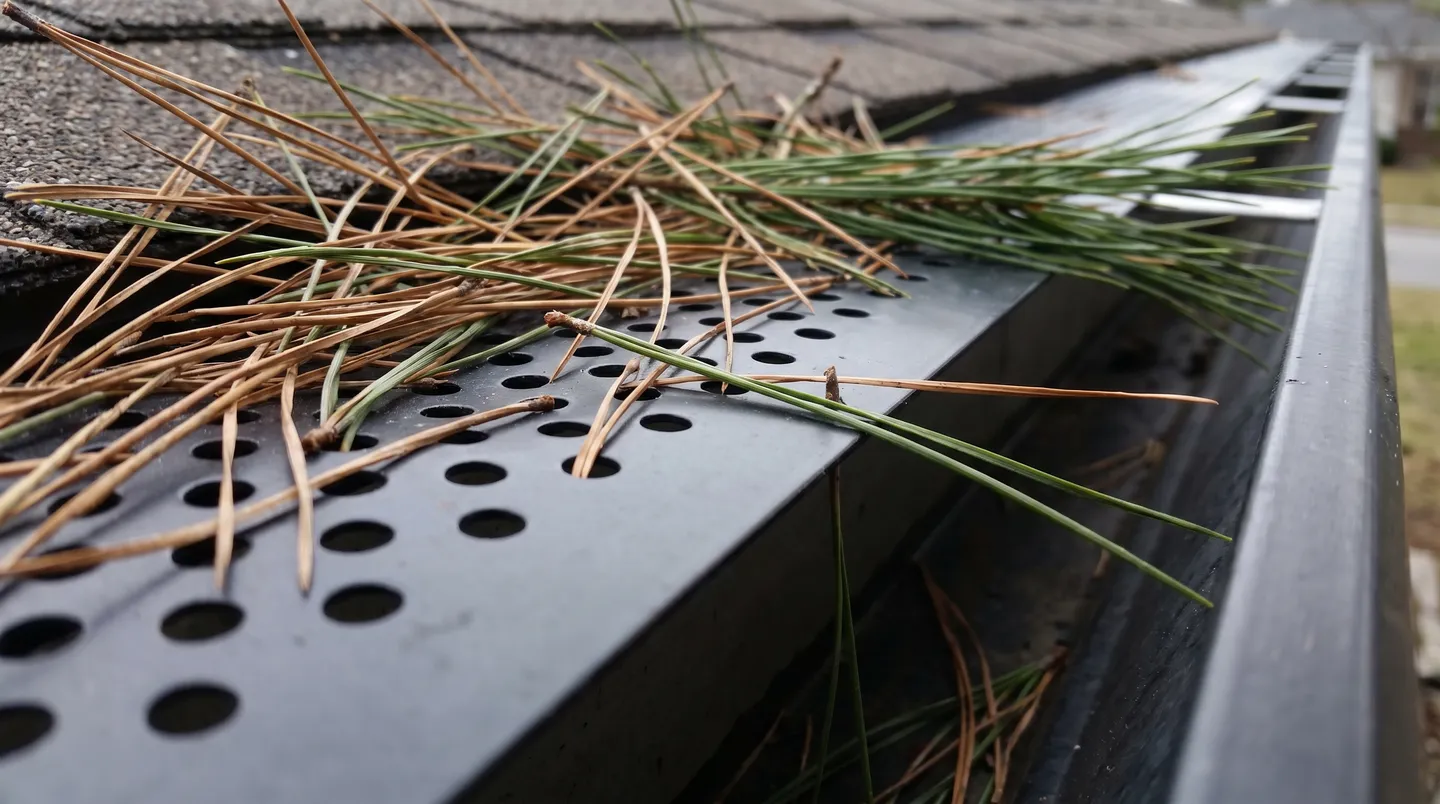
Set the published opening sizes beside those measurements and the answer falls out on its own. A 50 micron micro-mesh holds all four back. At 440 microns the finest shingle grit is already through. A 1/8 inch perforated aluminum cover, the most common one sold in Ontario, stops none of them.
The drawing below is every screen on the same millimetre ruler. The bar is the width of the opening, the dashed lines are the debris, and a filled marker means that item is smaller than the opening and washes into the trough.
| Screen | Opening | fine shingle granule (0.425 mm) | white pine needle (0.7 mm) | coarse shingle granule (1.7 mm) | Norway maple key (3 mm) |
|---|---|---|---|---|---|
| Micro-mesh, 50 micron | 0.05 mm | held on the surface | held on the surface | held on the surface | held on the surface |
| Micro-mesh, 440 micron | 0.44 mm | washes through | held on the surface | held on the surface | held on the surface |
| Perforated aluminum, 1/16 in | 1.6 mm | washes through | washes through | held on the surface | held on the surface |
| Perforated aluminum, 1/8 in | 3.2 mm | washes through | washes through | washes through | washes through |
| Screen mesh, 1/4 in | 6.4 mm | washes through | washes through | washes through | washes through |
The Catch Nobody Puts in the Brochure
Read the drawing again and the trap is obvious. The screen that stops everything is also the screen with the least open area, and open area is what carries a downpour. That is the trade-off in one picture: the finer you go, the more completely you solve failure one, and the more exposed you become to failure two.
Stainless micro-mesh is sold anywhere from 50 microns up to about 440. Anything marketed as micro-mesh above roughly 500 microns is a standard mesh with a premium name, so ask for the opening size in microns before you sign, and treat a salesperson who cannot produce it as an answer in itself.
One family does not appear on that scale at all. A reverse curve guard is not a sieve. It is a solid cover with a slot at the front nose, commonly 3/8 inch and running from 1/4 inch to a full inch across brands, and it works on surface tension: water clings around the curve into the slot while leaves carry on over the edge. Judge it on how much water the slot can swallow and how quickly that slot fouls, not on any mesh size.
The 5 Types, and What Each One Is Actually For
Five families of gutter guard are sold in Ontario: micro-mesh, perforated aluminum, screen, reverse curve and brush. None is best in general. Each one is a straight answer to a specific roof, a specific tree line, and how old the shingles above it happen to be.
| Type | Published opening | Holds back | Lets past | Where it earns its keep in Ontario |
|---|---|---|---|---|
| Micro-mesh, stainless | 0.05 to 0.44 mm | leaves, needles, keys, nearly all granules | pollen film, which blinds the surface | Heavy pine or spruce cover, or a shingle roof past fifteen |
| Perforated aluminum | 1.6 to 6.4 mm | leaves and twigs | granules, needles, maple keys | Open lots, a maple or two, shingles under ten years old |
| Screen or expanded mesh | about 6.4 mm | whole leaves | everything smaller, and keys edge on | A stopgap on a trough already due for replacement |
| Reverse curve | 3/8 in nose slot, typical | leaves that ride over the nose | grit, needles, and it ices at the slot | Steep roofs with a heavy leaf load and no conifers |
| Brush insert | no opening at all | large debris on the bristle tops | needles and grit, which pack in and stay | Short low runs where lifting it out is a five minute job |
Sherak installs mesh, reverse curve and brush systems, and the honest reason we carry three is that no single one suits every street. A house backing onto a pine stand in Simcoe and a house on an open new build lot in Newmarket want opposite ends of that table.
One rule cuts through all of it. Match the guard to the smallest thing your roof actually produces, not the largest. Everybody buys for the maple leaf they can see and gets caught by the needle they cannot.
Do Gutter Guards Mean You Never Clean the Eavestrough Again?
No, and any company that promises it is selling you the sentence rather than the system. A good gutter guard changes the job instead of ending it. Scooping wet leaves out of an open trough twice a year becomes rinsing a surface and checking the outlets, roughly every second or third year.
That is still a large win. It is not the win that gets advertised.
What changes with a guard fitted:
- The trough stops filling with the bulk material, so the twice-yearly scoop goes away.
- Fine sediment keeps arriving through anything coarser than micro-mesh, and it consolidates instead of washing out, so it needs digging rather than flushing when you finally get to it.
- The surface needs a rinse. Pollen and roof film build a skin, most noticeably on a fine mesh under an oak or a pine.
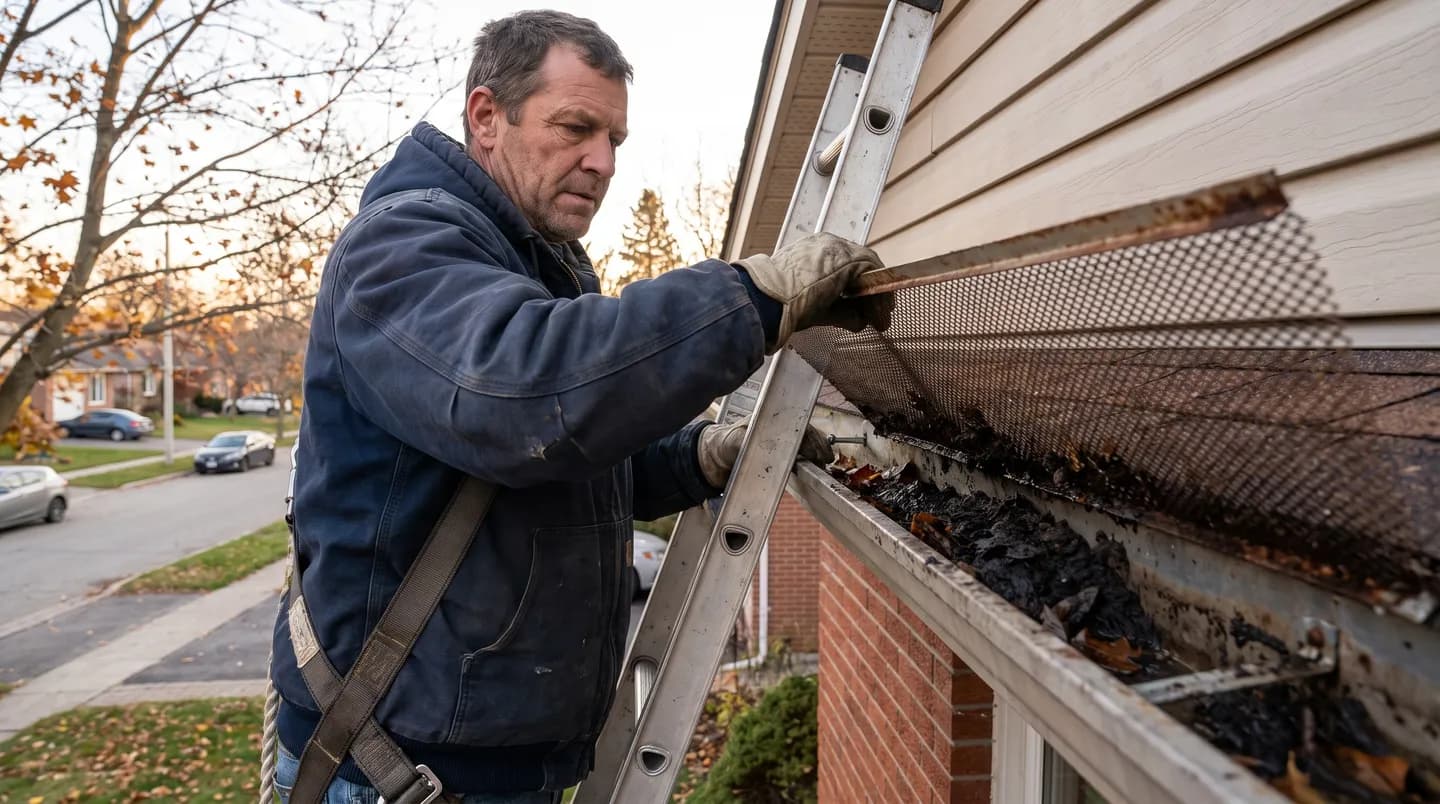
- Every panel has to come off to service the trough underneath, which is why a guard fixed with roofing nails through the shingle course is a decision you will regret. Fasten under the shingle or to the trough lip, never through the field of the roof.
We fold that check into a seasonal roof and exterior walk-round rather than treating it as its own call-out. While you are up there, look at the fascia behind the trough. Years of quiet overflow off a blinded guard rots fascia board from the back, and by the time paint bubbles on the front you are into soffit and fascia work rather than a rinse.
Not sure whether yours is filtering or just hiding the problem?
We will get on the ladder, lift a panel, and tell you what is actually in the trough. Free, and no obligation.
Will a Gutter Guard Stop Ice Dams?
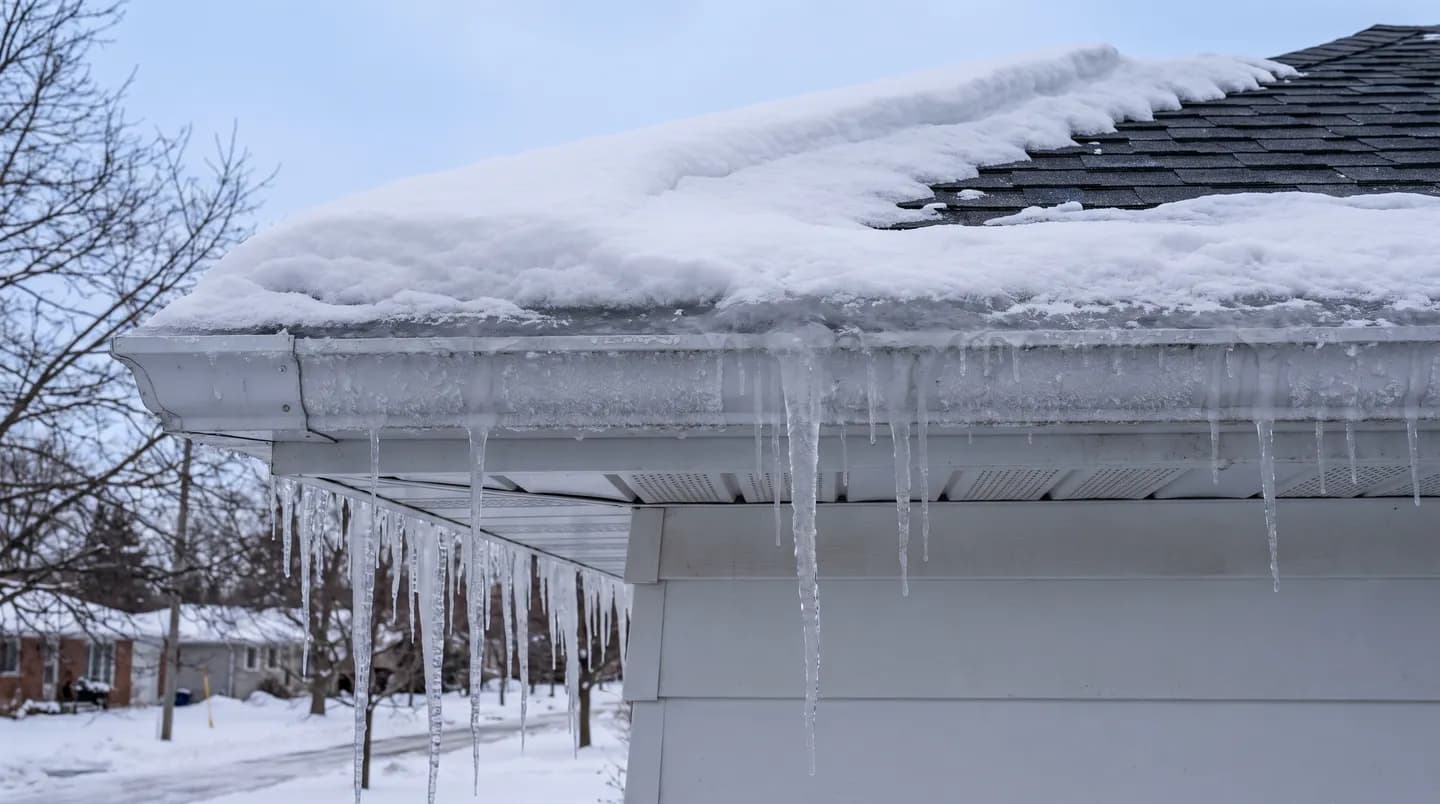
No. An ice dam is made in the attic, not in the eavestrough. Warm air leaks into a cold attic, melts the snow on the roof deck above it, and the meltwater refreezes when it reaches the cold overhang. The trough is simply where the ice ends up. Guarding it changes nothing upstream.
Worth knowing because guards get sold on this claim every November in Ontario. Some of them make the winter slightly worse rather than better. A reverse curve guard freezes at the nose slot first, and once that narrow opening glazes over there is nowhere for meltwater to go, so it runs over the front and hangs as icicles off the fascia. A brush insert holds a wet sponge of needles at the eave, which is the last place you want water sitting when the temperature drops through zero.
A micro-mesh handles a freeze better than either, mostly because it has no slot to seal and sheds a snow load off a sloped surface. It still does not stop the dam. If you are seeing ice at the eaves each winter, the fix is air sealing and insulation in the attic, which we set out in full in our guide to preventing ice damming before winter. Spend the money there first and the guard question gets easier afterwards.
What Does a Gutter Guard Cost in Ontario?
A gutter guard costs $3 to $30 a foot installed in Ontario in 2026, and the spread is real rather than a haggling range. Screens and brush inserts sit at the bottom, aluminum covers and reverse curve in the middle, and branded premium micro-mesh at the top. On a typical 130 foot house that is roughly $400 at one end and $3,900 at the other.
| Guard type | Installed, per foot | On a typical 130 ft house |
|---|---|---|
| Snap-in screen | $3 to $6 | $400 to $800 |
| Brush insert | $4 to $8 | $500 to $1,000 |
| Perforated aluminum cover | $6 to $12 | $800 to $1,600 |
| Reverse curve | $8 to $18 | $1,000 to $2,300 |
| Branded premium micro-mesh | $15 to $30 | $2,000 to $3,900 |
Our own leaf guard installations land between $500 and $1,500 for a full house, which puts Sherak in the screen, brush and aluminum brackets rather than the premium micro-mesh one. We would rather fit a well matched mid-range guard on a trough hung properly than a $4,000 system on a run with no fall in it.
That last point is the one that saves people the most money. A guard on a bad trough is an expensive lid. If you want the number for your own roofline instead of a range, get a free quote and we will measure the run, count the outlets, and price the guard against what is actually up there. If the run leaks at its joints or sags between hangers, read our comparison of seamless and sectional eavestrough before you spend a dollar on a cover, because seamless eavestrough plus a $600 screen will outlast a premium guard bolted onto a failing sectional run every time.
How We Choose One On the Ladder
Five minutes at the eave settles it, and the questions are always the same ones.
- What is growing within twenty metres? Pine, spruce or cedar means micro-mesh or nothing. A maple or an oak on its own means an aluminum cover is plenty.
- How old are the shingles? Past fifteen years an asphalt roof sheds granules in earnest, so a coarse guard is filling your trough with the roof itself. Our guide to choosing asphalt shingles for Ontario covers what that shedding tells you about the roof's remaining life.
- Does the trough have fall and enough outlets? Fix that first, always. A guard cannot create drainage that was never hung into the run.
- Can somebody get back up there? A guard you cannot service on a two-storey walkout is a guard you will never service.
We are based in Gormley and we work across York Region, Simcoe, the Kawarthas and the GTA, and we quote the guard as part of the eavestrough rather than as an add-on, because that is how it has to perform. Every job carries our 10 year workmanship warranty, $5 million liability insurance, and the last 10 percent is only due once you are satisfied. More on the whole system in our eavestroughs and drainage guides.
Sherak Ltd, Head Office
12275 Woodbine Avenue, Gormley, ON L0H 1G0
Phone: +1 905 490 8800
Email: info@sherak.ca
Get the guard matched to your roof, not to a sales target
We will look at your trees, your shingles and the fall in your trough, then quote the guard that suits all three.
Get a Free QuoteFrequently asked questions
Do gutter guards work on pine needles?
Will a gutter guard damage my shingles or affect the roof warranty?
Can I put a gutter guard on an old eavestrough?
Do gutter guards make ice dams worse?
Which gutter guard is best for a house under maples?
How much does a gutter guard cost in Ontario in 2026?
Written by
Emad Alikhanpour
Roofing & Exterior Specialist
Emad has 15 years of hands-on experience across roofing and every exterior service Sherak offers, from shingle and metal roofs to siding, eavestroughs, soffit and fascia, and custom flashing.
15 years in the trade · Roofing and exterior services
View profileReader reviews
Loading reviews...