On this page
- What Comes Out of an Ontario Eavestrough, and When
- How Often Should You Clean Eavestroughs in Ontario?
- Why October Is the Worst Month to Have a Full Trough
- How to Clean an Eavestrough Safely From a Ladder
- The 3 Times to Stop and Call Someone
- What Does Eavestrough Cleaning Cost in Ontario?
- Why We Do Not Sell You a Cleaning
- What Does a Trough That Keeps Clogging Actually Need?
- Talk to Us About the Eavestrough, Not the Cleaning
- Frequently asked questions
- Reader reviews
Key takeaways
- Twice a year is the honest answer for most Ontario homes: once in late spring after the maples finish throwing keys, once in the last week of November after the leaves are down.
- October is the month it rains most often in York Region. Toronto Buttonville averages 13.2 days of rain in October, more than any other month, and that is the same four weeks the trough fills.
- Richmond Hill collects yard waste weekly from October 13 to December 11 in 2026, which is the town's own measurement of how long leaves keep falling. A Thanksgiving weekend clean is two months early.
- At an 18 ft two-storey eave the ladder foot has to stand 4 ft 6 in out from the wall and you need almost 22 ft of rail. That is where most homeowners should stop.
- Sherak clears troughs as part of a repair, a replacement or a leaf guard job, never as a standalone cleaning call. A trough that blocks every eight weeks has a fault, not a chore.
You are standing on the lawn in late October looking up at a dark line of soaked leaves sitting proud of the trough, and the water is coming off the front lip instead of out the downspout. Eavestrough cleaning is the job every Ontario homeowner puts off, then does once, in a hurry, on the wrong weekend.
Sherak does not sell a standalone cleaning. We clear troughs as part of an eavestrough repair, a replacement, or a leaf guard installation, because the clearing is the easy half of the problem. What we can tell you is exactly what is in there, when it got there, and the point at which a ladder stops being a sensible tool.
Hold onto one idea before you climb anything. A trough that needs clearing twice a year is normal. A trough that needs clearing every eight weeks is not a chore, it is a symptom, and the fix is usually above the trough rather than in it.
What Comes Out of an Ontario Eavestrough, and When
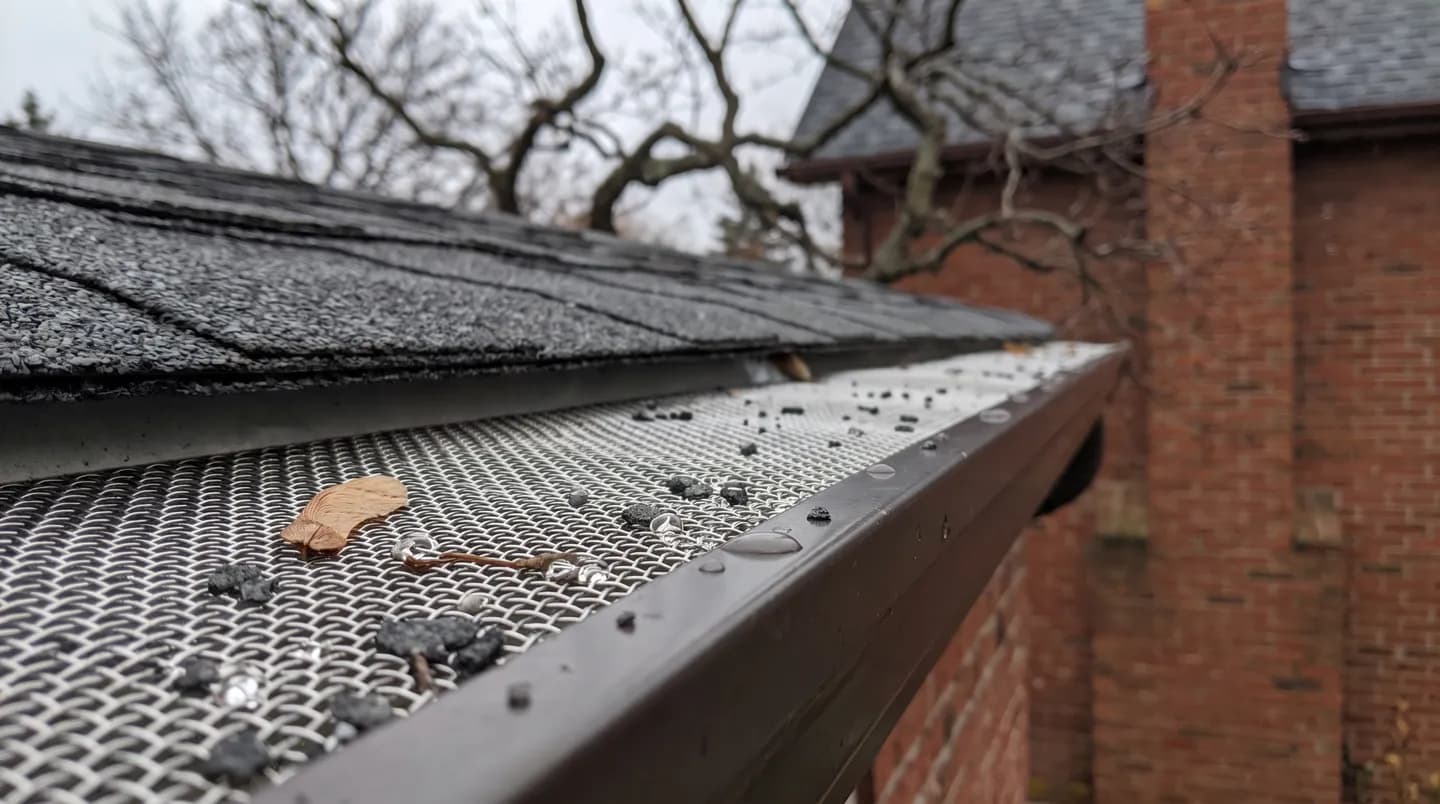
Four kinds of debris fill an Ontario eavestrough and they arrive at four different times of year: maple keys in late spring, fine leaflets and needles through the summer, whole leaves from mid October into December, and shingle granules the whole year round. Each one points at a different fix.
Start with the trees on your street, because they decide the job. The City of Toronto's 2018 tree canopy study counted 614,227 street trees and ranked the top ten species. Norway maple alone is 13.5 percent of them. Honey locust is 6.2 percent, blue spruce and littleleaf linden 3.8 percent each, silver maple and crab apple 3.2 percent. Suburban planting across York Region follows much the same list.
That mix matters more than the number of trees does. Maples throw winged keys in a heavy two or three week burst, then drop leaves months later, so they hit the trough twice. Honey locust sheds thousands of leaflets barely bigger than a fingernail, which is why a coarse screen over the trough does almost nothing about it. Spruce and cedar give up fine material steadily all year instead of in one tidy season.
| What you pull out | Where it came from | When it arrives | What it is telling you |
|---|---|---|---|
| Winged keys | Silver, Freeman and Norway maple | Late May into June, then again in September | One cleaning a year is not enough |
| Tiny leaflets | Honey locust | September into October | A coarse screen guard passes them straight through |
| Needles and scale | Blue spruce, white cedar | All year, heaviest in autumn | The guard needs fine mesh, not a brush |
| Whole wet leaves | Every deciduous tree on the street | Mid October to early December | Normal, and the reason for a November clear |
| Grey grit | Your own shingles | All year | Fine on a new roof, a warning on an old one |
| Black sludge | All of the above, composted | Any time | Nobody has been up there in over a year |
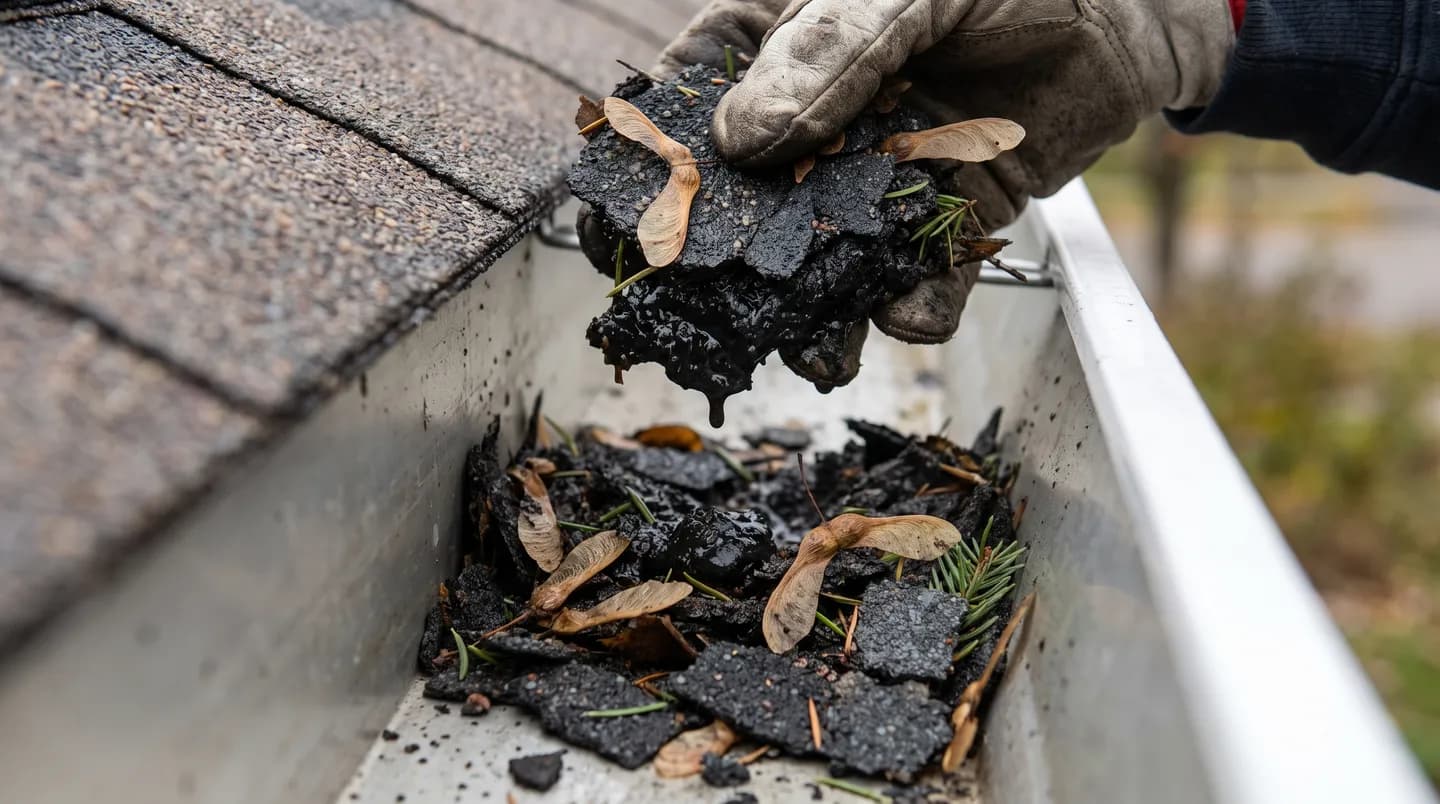
The grey grit deserves its own paragraph, because homeowners panic about it for the wrong reasons. IKO's bulletin on excess roofing granules explains that shingles leave the plant carrying loose hitchhiker granules that were never firmly embedded, and those wash off over the first few years and land in the trough. That is normal and it costs the shingle nothing.
The same bulletin is just as clear about where normal ends: granule loss only matters once bare spots of coating asphalt are showing on the shingle face. A cup of grit under a five year old roof means nothing. The same cup under a twenty year old roof, with dark shiny patches you can pick out from the driveway, is the opening of a roof replacement conversation.
How Often Should You Clean Eavestroughs in Ontario?
Twice a year for most Ontario homes. Once in late May or June, after the maples have finished throwing keys, and once in the last week of November, when the leaves are finally down. Add a third clear in early September if a spruce, pine or cedar hangs over the roof.
The classic mistake is the single Thanksgiving weekend clean. It feels responsible, the weather is usually good, and it is roughly two months too early.
Ask the municipality when the leaves actually stop, because the municipality has to pay for the answer. Richmond Hill runs yard waste collection every second week from April 14 in 2026, then switches to weekly from October 13 right through to December 11. No town buys eight extra weekly pickups for the fun of it. That window is a measurement of how long leaves keep coming down in York Region, and the back half of it lands after almost everybody has already done their one annual clean.
The spring clear is the one that surprises people. Silver and Freeman maples release their keys in a short, concentrated burst in late May and early June, and a trough that was spotless in April can be half full before school lets out. On the Richmond Hill and Markham streets planted heavily with maple, that spring load is what blocks the downspout outlet, not the autumn leaves everyone worries about.
Oaks are the exception at the other end of the year. They colour and drop late, and younger ones hold brown leaves well past the first snow, so a house sitting under one either gets its last clear pushed into December or gets a guard instead.
Put the spring clear on the same list as the rest of your summer roof maintenance and it stops being a separate trip up the ladder.
Why October Is the Worst Month to Have a Full Trough
October is the month it rains most often in York Region. Environment and Climate Change Canada's 1991 to 2020 normals for Toronto Buttonville Airport in Markham record 13.2 days of rain in October, more than any other month of the year, along with 70.1 mm of it. The trough fills and the rain arrives in the same four weeks.
October is not the wettest month by volume. June is, at 86.7 mm. October simply rains more often, in smaller amounts, and that is precisely the pattern that finds a blockage. One big downpour overtops a clogged trough and is gone by evening. Thirteen wet days keep a plug of leaves saturated, heavy and sitting exactly where it landed.
Run the arithmetic on your own roof and the numbers stop being abstract. Buttonville averages 728.9 mm of rain a year, so a house with a 1,500 sq ft footprint sheds roughly 101,000 litres of water annually, all of it meant to leave through two or three downspouts. The wettest October day on record at that station, 43.0 mm, puts close to 6,000 litres over the roof edge inside a single day.
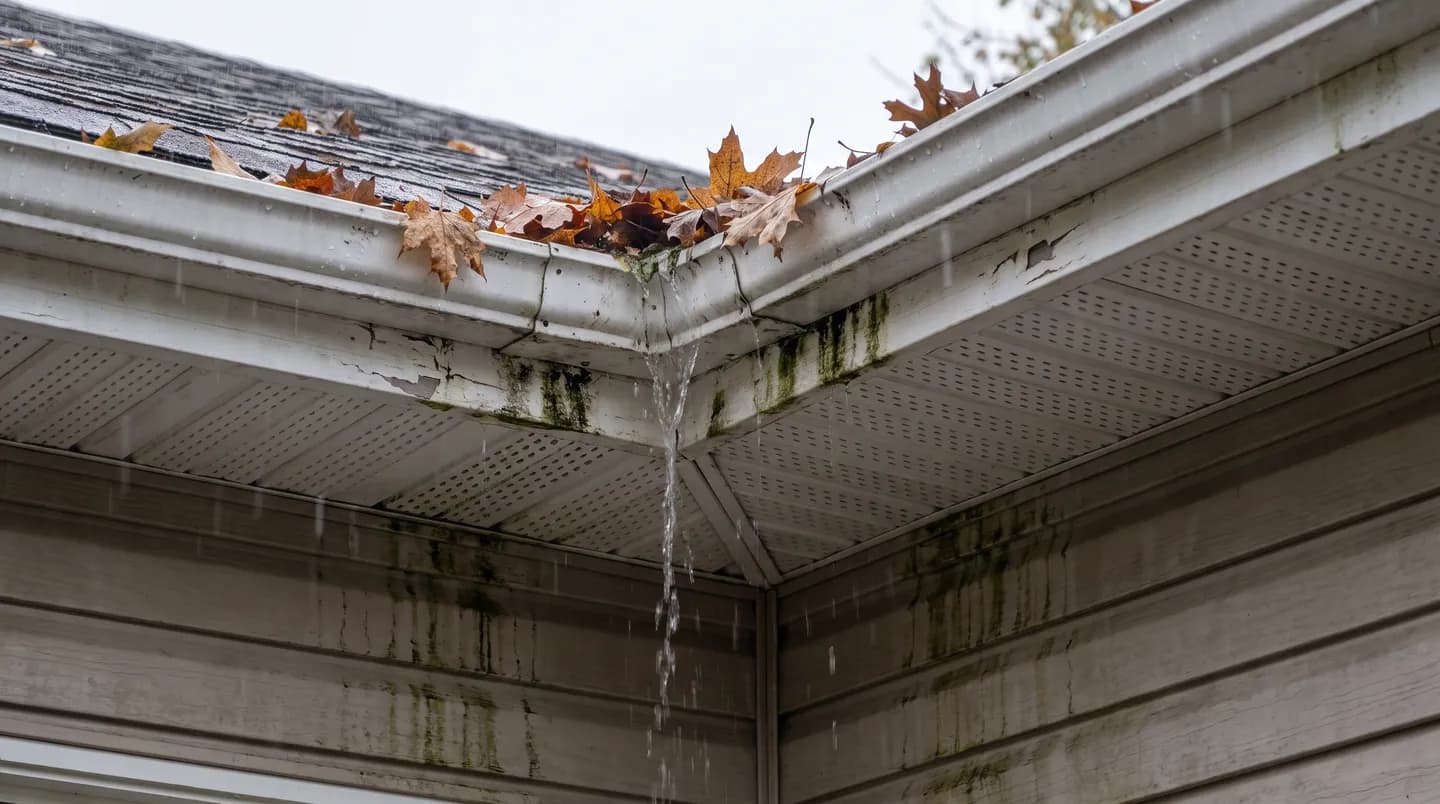
When the trough cannot take that, the water does not politely go over the front. It backs up behind the trough, runs down the face of the fascia, and soaks into the soffit and fascia that the whole system hangs off. Come January the same standing water at the eave is one of the things that feeds ice damming.
Ontario Building Code article 9.26.18.2 governs the last stage of the trip: where downspouts are not tied into a sewer, extensions have to carry the water away from the building in a way that prevents soil erosion. A plugged outlet defeats that rule before the water ever reaches the extension.
How to Clean an Eavestrough Safely From a Ladder
Scoop the debris into a bucket instead of flushing it toward the downspout, clear the outlet by hand, then run a hose from the far end so you can watch the water travel. Never lean the ladder on the trough itself, and never work from the top three rungs. The order matters more than the effort does.
Here is the sequence that works, and it is not the one most people use.
- Bag it, do not flush it. Scoop into a bucket hooked on the ladder.
- Work in short sections and move the ladder instead of reaching sideways.
- Clear the downspout outlet by hand and check the plug drops away.
- Flush from the end furthest from the downspout and watch the water travel.
- Tap down the downspout for a dull thud, then check the water leaves at the bottom.
- Look properly at the roof edge while you are up there.
Two of those earn more than a line. Hosing a loaded trough toward the downspout is how an outlet gets properly plugged, and a plugged outlet is a far worse afternoon than a full trough. Step four is a free diagnosis: anywhere the water pools rather than runs is a fall or a hanger problem, and you have found it without paying anybody.
Step six matters because a ladder is the only time most homeowners ever see their own roof edge. Lifted drip edge, fascia that gives under a thumb, curling shingle edges and bare dark patches are obvious from three feet away and invisible from the lawn.
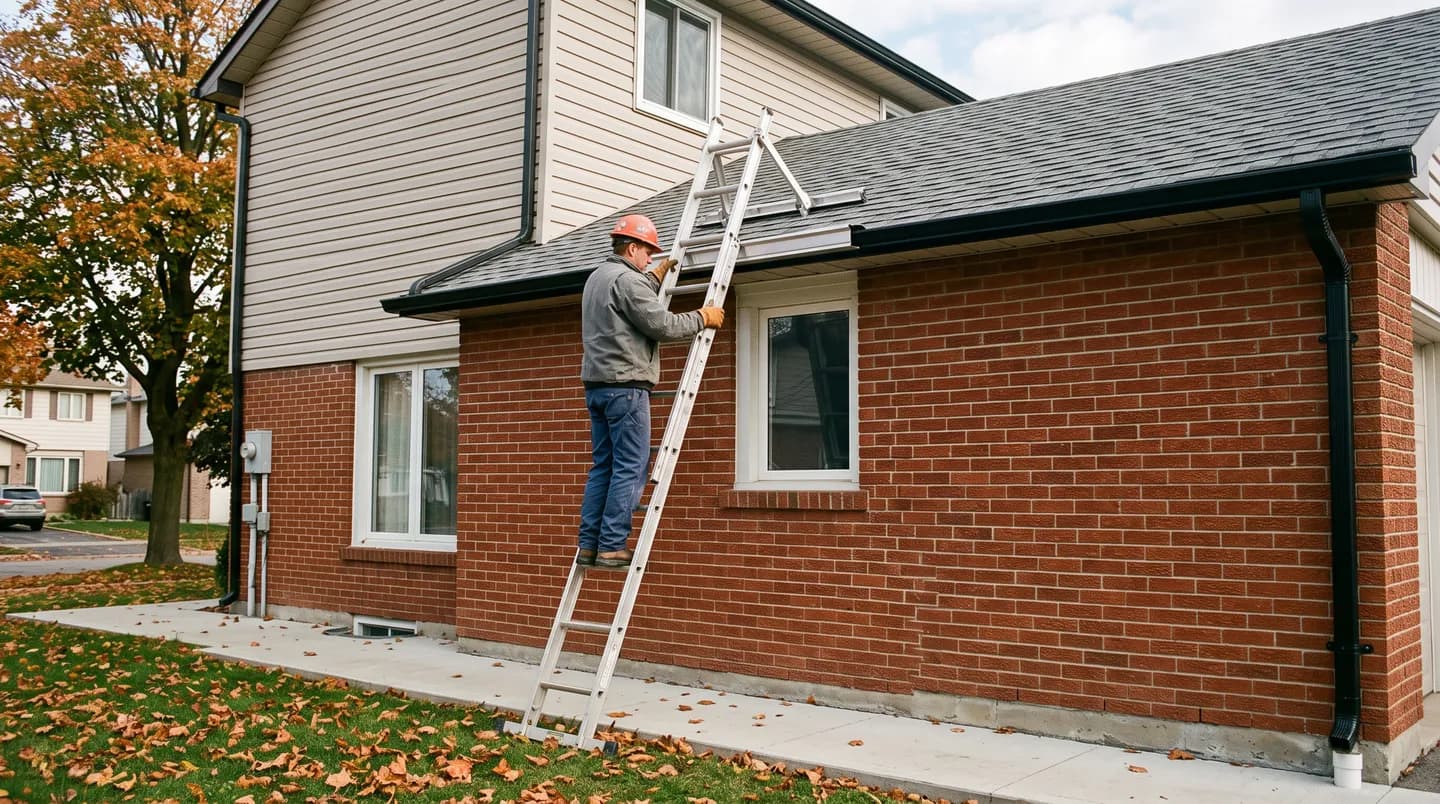
Now the ladder. The Canadian Centre for Occupational Health and Safety sets out the geometry in its portable ladder guidance: one foot out from the wall for every four feet of height, which stands the ladder at about 75 degrees, three point contact going up and down, and no working from the top three rungs. Rungs sit a foot apart, so that last rule quietly adds three feet to the ladder you need to own.
That is where the geometry stops being advice and starts being arithmetic.
| Where the eavestrough is | Eave height above ground | Ladder foot, out from the wall | Rail length needed |
|---|---|---|---|
| Bungalow, front eave | 10 ft | 2 ft 6 in | 13 ft 4 in |
| Backsplit or raised bungalow | 14 ft | 3 ft 6 in | 17 ft 5 in |
| Two-storey, front eave | 18 ft | 4 ft 6 in | 21 ft 7 in |
| Two-storey over a walkout | 24 ft | 6 ft | 27 ft 9 in |
The 3 Times to Stop and Call Someone
Stop if the eave is more than about twelve feet up, if the trough still holds water after you have cleared it, or if anything at the roof edge moves when you press it. None of the three is about nerve. Each one is the point where the job has stopped being a cleaning and turned into a repair.
The eave is high, or the ground under it is not flat. The drawing above is the reason. At an eighteen foot two-storey eave the ladder foot has to stand four feet six inches out from the wall, on ground that in late October is wet lawn, a slope, or a garden bed, and you need almost twenty two feet of rail to get there. Carrying, raising and footing that on your own is a different activity from cleaning a bungalow, and the fall is a different height too.
The trough holds water after you have cleared it. Standing water in an empty trough means the run is not falling toward the outlet, or a hanger has let go and it has sagged in the middle. Cleaning fixes neither. That is a call for eavestrough repair, and it is the single most common thing we are asked to look at after somebody has spent a Saturday on a ladder.
Something at the roof edge moves. Drip edge that lifts, fascia that gives under a thumb, shingle edges that crumble in your hand. A board that soft is almost never the board's fault, and our guide to soffit and fascia in Ontario sets out the four things upstream that put the water there. Water has been sitting in that edge long enough to get into the timber, and the next real rain goes into the roof instead of over it. At that point you want a roof repair inspection, not another clean, because the stain that follows shows up inside and behaves exactly like a roof leak.
Not sure whether it is a clean or a repair?
We will get on the ladder, find out why it keeps blocking, and price the fix. Free and no obligation.
What Does Eavestrough Cleaning Cost in Ontario?
Ontario market rates for eavestrough cleaning in 2026 run roughly $150 to $250 on a bungalow, $200 to $350 on a two-storey, and $300 to $450 where the roofline is cut up or the back of the house sits over a walkout. Priced by the foot most quotes land between $1 and $2.
Those are market rates rather than our price list, because Sherak does not sell a standalone cleaning. They are here so you can tell a fair quote from a bad one.
| Home | Roughly how much trough | Ontario market rate, 2026 |
|---|---|---|
| Bungalow, single storey | 120 to 160 linear ft | $150 to $250 |
| Two-storey, simple roofline | 160 to 200 linear ft | $200 to $350 |
| Two-storey, cut-up roof or a walkout | 200 linear ft and up | $300 to $450 |
Three things move a quote inside those bands: how high the eave is, how long it has been, and whether there are guards to lift off and refit. A trough nobody has touched in three years is not twice the work of an annual one, it is closer to four times, because composted sludge has to be dug out rather than scooped.
Set that against what the same money buys once. A seamless eavestrough run with proper fall and enough outlets, or a guard matched to the debris your street actually produces, takes the annual bill off the table instead of paying it every autumn for the next twenty years.
Why We Do Not Sell You a Cleaning
Sherak clears eavestroughs as part of work we are already doing: an eavestrough repair, a full replacement, a leaf guard installation, or a roof. We do not run a standalone cleaning service, and we would rather say so plainly than send a truck to do something the next October undoes.
Being on the ladder twice a year is not a problem worth solving. Being on it six times a year is, and that is the call our crews take most often across York Region, Simcoe and the Kawarthas: a homeowner who has cleared the same run three times since August and wants to know what is wrong with it.
Usually something is. At Sherak we would sooner price the fault than the symptom, so the quote you get from us for a chronic clogger is for the trough, the outlets, the hangers or the guard, and not for a visit. The rest of our writing on eavestroughs and drainage works through the same logic.
Every quote is free and itemised, we carry $5 million liability insurance, our workmanship is backed by a 10 year warranty, and the last 10 percent of the price is not due until you are satisfied with what you can see from the ground.
What Does a Trough That Keeps Clogging Actually Need?
A trough that blocks more than twice a year almost always has one of five faults: too little fall, too few outlets, a hanger that has let go, joints that catch debris, or a guard that does not match the trees overhead. Cleaning treats all five as though they were simply leaves.
Too little fall. A run wants a slight, steady drop toward the outlet. Flat or running backwards, and even a light load of needles stops moving and starts composting where it sits.
Too few outlets, or too small a trough. Five inch trough on a big or steep Ontario roof is undersized before a single leaf lands on it. Six inch carries roughly 40 percent more roof area per downspout, which we work through properly in the seamless versus sectional comparison.
A hanger that has let go. One failed spike drops the run in the middle and everything collects in the dip. The hose test finds this in about a minute.
Joints. Sectional gutter carries a sealed joint every ten feet, and every joint is a small ledge for debris to catch on. This is the quiet argument for seamless that has nothing to do with leaks.
A guard that does not match the trees. A coarse screen under a honey locust or a spruce is a guard in name only. Matching the mesh to the debris is most of what a proper guard job is, and it is exactly the part that cheap guards skip. We put every guard type's openings on the same scale as real Ontario debris in our answer to whether gutter guards actually work.
None of that can be diagnosed from the driveway. If your trough is on its third clear of the year, get a free quote and we will tell you which of the five it is. What each one costs to put right is in our guide to eavestrough repair and the six faults behind it.
Stop cleaning it. Fix it.
Sherak installs and repairs seamless eavestrough, soffit, fascia and leaf guard across York Region, Simcoe, the Kawarthas and the GTA.
Get a Free Eavestrough QuoteTalk to Us About the Eavestrough, Not the Cleaning
We are based in Gormley and our crews work throughout York Region, Simcoe County, the Kawarthas and the GTA, from Newmarket and Aurora to Vaughan, Barrie, Peterborough and Toronto. If your trough overflowed last October, we will come and find out why it did, and tell you honestly whether the answer is a repair, a resize, or a guard.
Sherak Ltd, Head Office
12275 Woodbine Avenue, Gormley, ON L0H 1G0
Phone: +1 905 490 8800
Email: info@sherak.ca
Frequently asked questions
How often should eavestroughs be cleaned in Ontario?
Can I just flush the eavestrough with a hose instead of scooping it out?
Do leaf guards mean I never have to clean the eavestrough again?
Is it safer to clean the eavestrough from the roof instead of a ladder?
What does eavestrough cleaning cost in Ontario in 2026?
Does Sherak clean eavestroughs?
Written by
Emad Alikhanpour
Roofing & Exterior Specialist
Emad has 15 years of hands-on experience across roofing and every exterior service Sherak offers, from shingle and metal roofs to siding, eavestroughs, soffit and fascia, and custom flashing.
15 years in the trade · Roofing and exterior services
View profileReader reviews
Loading reviews...