On this page
- Which eavestrough is on your house right now?
- What is a seamless eavestrough?
- Why do sectional eavestroughs leak at the joints?
- Seamless vs sectional at a glance
- How much does a seamless eavestrough cost in Ontario?
- 5 inch or 6 inch: the question most quotes skip
- What an Ontario winter does to an eavestrough
- When sectional eavestrough is actually the right call
- Repair or replace? How we decide on the ladder
- What a good eavestrough quote should list
- Frequently asked questions
- Reader reviews
Key takeaways
- On a 160 foot system, sectional eavestrough carries about 20 sealed joints. Seamless carries 8, at the corners and downspout outlets only.
- Seamless aluminium runs $8 to $13 per linear foot installed in 5 inch and $13 to $17 in 6 inch, so a full 160 foot system lands around $1,800 to $4,000 in Ontario.
- Aluminium eavestrough lasts 20 to 25 years in Ontario. Vinyl sectional lasts 10 to 20, and it is the sealant at the joints that fails first, not the metal.
- Sizing beats seam count on a big or steep roof: 6 inch trough carries roughly 40 percent more roof area per downspout than 5 inch.
- Sectional is still the right answer on short runs, garages and sheds, and patch repairs to an existing sectional system.
Stand at the end of your driveway and look along the eavestrough under your roofline. If you can pick out a faint vertical line every ten feet or so, you are looking at a sectional system, and each of those lines is a sealed joint with a finite life. A seamless eavestrough has none of them along the run. That one difference, roughly 20 sealed joints against 8 on the same house, decides most of the eavestrough replacements our crews quote across York Region.
Here is the comparison as we see it from the ladder: what seamless actually means, what each system costs per foot installed in Ontario in 2026, how long each lasts through freeze-thaw, and the sizing question most quotes skip entirely. If your troughs are already overflowing and staining the fascia, the clean-out steps in our summer roof maintenance checklist come first, before you decide to replace anything.
Which eavestrough is on your house right now?
Look along the trough from the ground. A sectional system shows a faint vertical seam and a slight bulge roughly every ten feet, often with a grey stain on the fascia below one of them. A seamless eavestrough runs corner to corner as one unbroken piece, so its only joints sit at the corners and the downspout outlets.
Three checks, none of which need a ladder:
- Walk the long side of the house and count the vertical lines along the trough. Ten feet apart means sectional.
- Look at the fascia and siding directly under each line for grey or green staining, the fingerprint of a joint that has been weeping for a season or two.
- Check the corners last. Both systems have a mitred corner joint, so a seam at a corner on its own tells you nothing.
Sectional was the default on older housing stock, and plenty of those systems are still hanging on the fascia across Newmarket, Aurora, and Barrie. Anything a contractor installed in recent years is far more likely to be seamless, because a forming machine is now standard kit on an eavestrough truck.
What is a seamless eavestrough?
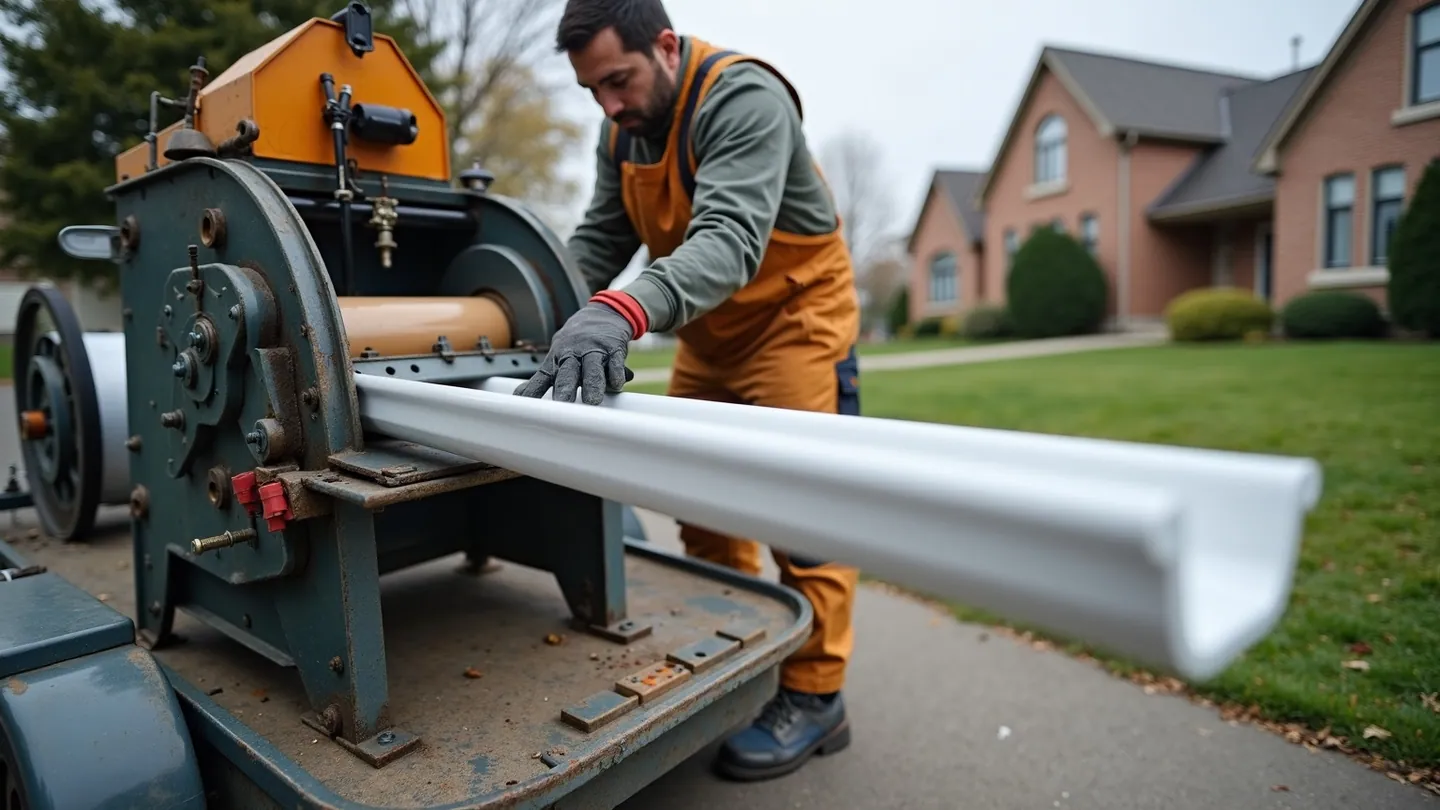
A seamless eavestrough is formed on your driveway. A roll-forming machine on the truck pulls flat aluminium off a coil and shapes it into finished trough at whatever length the run needs, so a 40 foot side of the house arrives as one 40 foot piece with no joint anywhere along it.
Seamless gutters and seamless eavestrough are the same product under two names. The federal government's guidance on eavestroughs and downspouts draws the only real distinction: an eavestrough catches water from the eave, the part of the roof that overhangs the wall, while a home built without eaves has gutters instead. Both do the same job, and every supplier in Ontario will quote you either word.
The stock is coated aluminium in .027 or .032 gauge, with a baked-on finish in the colour you pick, so there is nothing to paint and nothing to rust. Heavier .032 gauge costs a little more per foot and takes ladder knocks and ice load better, which is why we default to it on north-facing runs and anywhere a roof valley dumps into the trough.
A seamless eavestrough installation is really a manufacturing job carried out on your driveway, and at Sherak we form every run on site rather than fitting pre-cut lengths. On a full exterior job on District Avenue in Vaughan in May 2025, that meant new seamless aluminium eavestrough, downspouts, soffit, and fascia going on in one pass, with the trough cut to each elevation instead of the elevation being made to fit stock lengths. You can see that job and others in our portfolio of completed exterior projects.
Why do sectional eavestroughs leak at the joints?
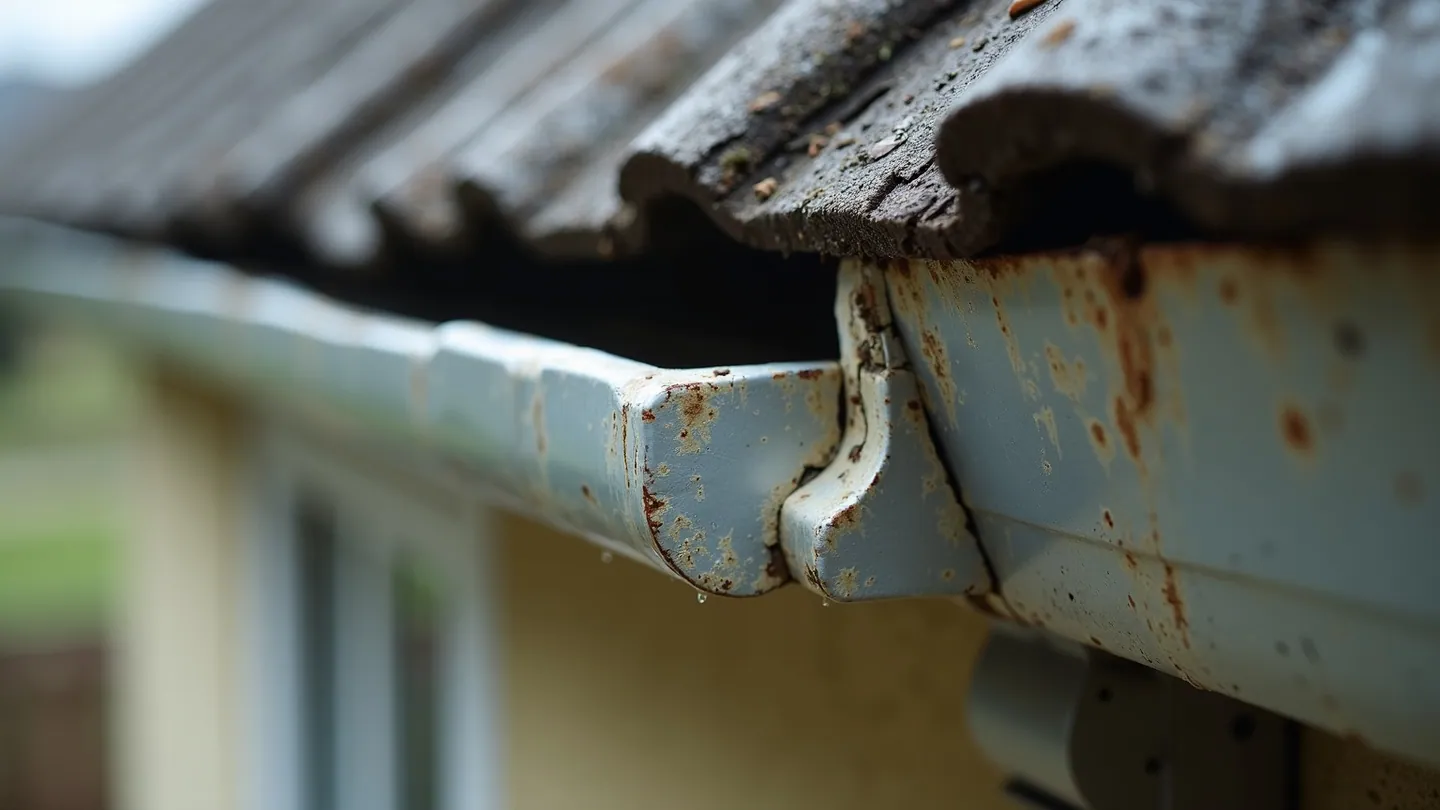
Because every joint is a sealed lap, not a welded one. Two lengths overlap, a bead of sealant fills the gap, and a slip connector holds them together. Ontario's freeze-thaw cycle works that seal loose over a few winters, and once it opens water runs down the fascia instead of the downspout.
The arithmetic is worth doing on your own house. Take a two-storey with about 160 feet of eavestrough in four 40 foot runs. Sectional stock comes in 10 foot lengths, so each run needs four pieces and three slip joints, which is 12 joints before you add the four mitred corners and four downspout outlets. That is 20 sealed joints. The same house in seamless has zero joints along the runs, leaving only the four corners and four outlets: 8.
Aluminium also moves. A trough that sits at 35 degrees on an August afternoon and minus 20 in January expands and contracts through every one of those laps, and sealant is the part that gives up first. Joints collect debris as well, so the clog usually starts at a seam and the overflow follows. The Canadian Roofing Contractors' Association recommends a twice-yearly review of the roof and its drainage, which on a sectional system means looking at every joint, not just the downspouts.
On Fairnbairn in Queensville in October 2024 we were called out to a system leaking at its connections rather than anywhere along the metal. Our crew reinforced and resealed the compromised sections, which bought that homeowner several seasons. The joints are still the parts that will fail again.
| Category | Value |
|---|---|
| Seamless, formed on site | 8 joints |
| Sectional, 10 ft lengths | 20 joints |
Seamless vs sectional at a glance
Every difference between the two systems traces back to how they are made. One is manufactured at your house to fit the wall; the other is assembled from stock parts on a ladder.
| Seamless | Sectional | |
|---|---|---|
| Joints on a 160 ft system | 8, at corners and outlets | About 20 |
| How it is made | Rolled on site from one coil | Pre-cut lengths joined in place |
| Usual material | .027 to .032 coated aluminium | Vinyl, light aluminium, or steel |
| Service life in Ontario | 20 to 25 years | 10 to 20 years for vinyl |
| Installed cost, 5 inch | $8 to $13 per foot | $5 to $10 per foot |
| Typical first failure | Sealant at a corner or outlet | Sealant at a mid-run slip joint |
| Repair method | Cut out and re-form a length | Swap a section, reseal the lap |
| Who can install it | A contractor with a forming machine | Handy homeowner or contractor |
The cost column is the only one where sectional wins, and it wins by less than most homeowners expect once the old system has to come down and go to the dump either way.
How much does a seamless eavestrough cost in Ontario?
Expect $8 to $13 per linear foot installed for 5 inch seamless aluminium in Ontario, and $13 to $17 for 6 inch. On a typical 160 foot two-storey that works out to roughly $1,800 to $3,000 for a complete 5 inch system, including taking the old troughs down, new downspouts, corners, hangers, and disposal.
The per-foot number and the full-system number are not the same thing, which is where eavestrough replacement quotes get confusing. Per-foot pricing covers the trough on the wall. A full replacement also carries tear-off and disposal, downspouts and elbows, mitred corners, hidden hangers, and any fascia repair the old system was hiding.
| System | Installed, per linear foot | Complete 160 ft system |
|---|---|---|
| Vinyl sectional | $5 to $10 | $1,000 to $2,000 |
| Seamless aluminium, 5 inch | $8 to $13 | $1,800 to $3,000 |
| Seamless aluminium, 6 inch | $13 to $17 | $2,600 to $4,000 |
| Leaf guard, added to either | $3 to $9 | $500 to $1,500 |
Four things move a quote inside those ranges: how many storeys the ladder has to reach, how many corners and downspouts the roofline needs, whether the fascia behind the old trough is sound, and the gauge and colour you choose. A steep or complex roofline with eight corners costs more per foot than a clean rectangle, because corners are slow work and every one of them is a joint we have to make watertight.
A leaf guard fitted at the same time is the cheapest it will ever be, since the crew, the ladders, and the access are already on site. Which of the five gutter guard types belongs on your roof is a separate question, and it depends far more on your trees than on your trough. We quote it as a line item so you can see it and decide, rather than folding it into a single number. If your troughs are overflowing every heavy rain, book a free eavestrough quote and we will measure the whole system before recommending anything.
Want the real number for your roofline?
We measure every run, count the corners and downspouts, and put it in writing. Free, with no obligation.
5 inch or 6 inch: the question most quotes skip
Five inch is the Ontario default and suits most suburban roofs. Six inch carries roughly 40 percent more roof area per downspout and pairs with a 3 by 4 inch downspout instead of a 2 by 3, which about doubles the outlet. Steep roofs, long unbroken runs, and valleys that dump into one trough need the larger size.
Run the water volume and the reason becomes obvious. One millimetre of rain on one square metre of roof is one litre of water. A 25 millimetre summer storm on a house with a 150 square metre roof footprint drops about 3,750 litres, and all of it arrives at the eaves inside an hour or two. Environment and Climate Change Canada's climate normals show how routine that kind of rainfall is across southern Ontario.
Pitch matters as much as area. A steep roof throws water at the trough with real speed instead of letting it trickle in, so a 5 inch trough on a steep 12/12 can overshoot while the same trough on a shallow bungalow copes easily. Valleys concentrate two slopes into one point, and that point overwhelms a small outlet long before the trough itself fills.
Federal flood-prevention guidance puts a downspout every 6 to 12 metres, or 20 to 40 feet, of eavestrough, and that matches how we lay out a system: one at each end of a long run, plus an extra wherever a valley concentrates flow. The same guidance gives you a plain test for sizing. If your troughs still overflow in a heavy rain after they have been cleared, the system is too small rather than too dirty. On a full exterior job on Lake Ridge Road in Georgina in December 2023, the home was getting a new metal roof, and a standing seam metal roof sheds water far faster than asphalt, so the eavestrough went on at 6 inch rather than 5. The trough size followed the roof, not the price list.
What an Ontario winter does to an eavestrough
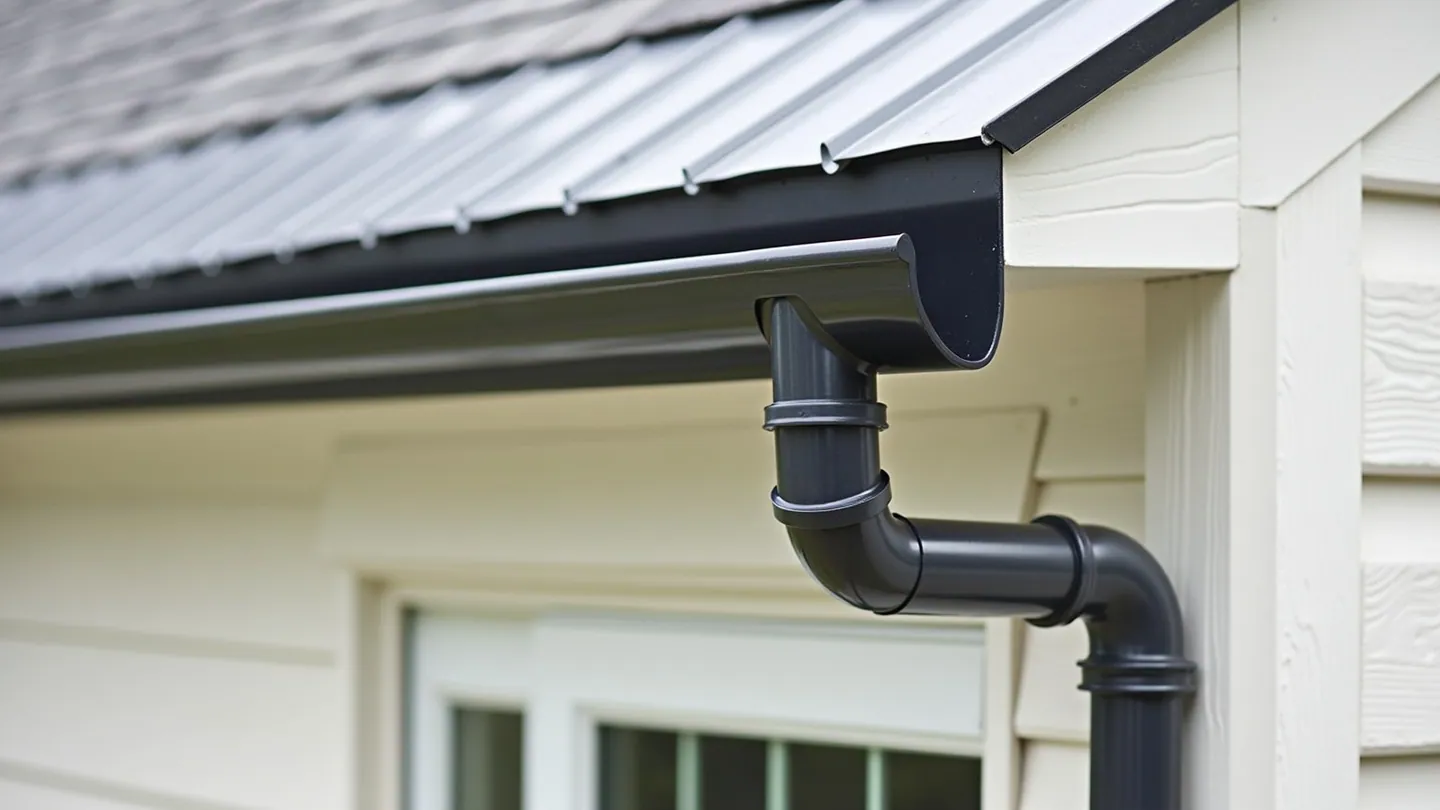
Winter attacks an eavestrough three ways: freeze-thaw works the sealant out of every joint, ice load pulls the trough off the fascia, and meltwater backing up under the shingles finds any gap at the roof edge. None of those are shingle problems, and all of them land on the drainage system.
Ice is heavier than most homeowners picture. A trough packed with ice weighs many times what it does full of water, and that load hangs off whatever is holding it to the house. Spikes driven through the trough into the rafter tails work loose under that weight. Hidden hangers screwed into sound fascia every two feet do not, which is why we use them on every install.
On Lake Drive in Jackson's Point in March 2025 we replaced a system that had been pulled to the ground by an ice dam, the kind of damage our guide to preventing ice damming before winter is written to head off. That job needed new eavestrough, soffit, fascia, siding, and leaf guard, because once the trough came down it took the roof edge with it. When a re-clad gets folded into a job like that, our breakdown of which siding material to put back on the wall is where we start that conversation. On Wildwood Avenue in Richmond Hill the same month, we went the other way and ran a gutter heater along the full perimeter with the new troughs, so the ice never gets a chance to build.
The fascia behind the trough decides whether any of this holds. Soft or rotted board will not take a hanger screw, so a proper quote covers soffit and fascia repair where it is needed instead of screwing new metal to old wood. Where the water lands matters too. The Ontario Building Code requires a site graded so water does not accumulate at or near the building, and a downspout that discharges at the foundation defeats that grading entirely. Federal guidance is more specific: run the extension out at least 2 metres, or 6 feet, from the foundation, toward ground that actually drains. Worth checking your municipality too, because downspouts connected to the sanitary or storm sewer are now prohibited in parts of the GTA, and some municipalities help cover the cost of disconnecting them.
When sectional eavestrough is actually the right call
Sectional still wins in three narrow cases: a short run under about 20 feet where the joint count barely matters, a detached garage or shed where the trough does not justify a truck roll, and a patch repair on an existing sectional system where matching the existing profile beats replacing a whole elevation.
We say this to homeowners regularly, because the honest answer on a 16 foot garage wall is that one slip joint will not decide anything. The money is better spent on the main house.
What sectional never fixes is a slope problem. A trough hung dead level, or worse, falling away from the downspout, will pond and overflow no matter how few joints it has. We set a fall of about a quarter inch every ten feet toward the outlet, and that single detail causes more overflow complaints than seams do when it is skipped.
One more caution on vinyl. It is the cheapest system to buy and the least suited to this climate, because vinyl goes brittle in deep cold and a January ladder knock can crack a length that aluminium would only dent.
Repair or replace? How we decide on the ladder
Replace when the failures are spread across the system, and repair when they are contained. Two leaking joints on an otherwise sound run is a repair. Staining under half the seams, sagging between hangers, or a trough that has separated from the fascia is a system at the end of its life, and patching it just moves the leak to the next joint. That is the point where an eavestrough replacement costs less than the repairs you would otherwise keep paying for.
Five signals push a job from repair to replacement:
- Staining or dripping at more than two joints on the same elevation
- Visible sag between hangers, which means the trough is holding standing water
- Soft or rotted fascia behind the trough, so there is nothing solid to fasten to
- Any run that has pulled away from the house after an ice load
- Chronic overflow at one corner that clearing and resealing has not solved
The repair-first path is real, though. Water pooling at the foundation on Mortimer Avenue in East York in October 2024 turned out to be a drainage layout problem rather than a worn-out trough, and the fix was a properly routed system carrying water clear of the house. If water is already getting inside, read our guide on what to do about a roof leak first, because the eavestrough may be the symptom rather than the source. Before you write a run off entirely, rule out the ordinary explanation too: our guide to eavestrough cleaning sets out how often a healthy trough should need clearing, and what it means when yours needs it far more often than that.
What a good eavestrough quote should list
A quote that says "eavestrough replacement" and a single number tells you nothing you can compare. Ask for the linear footage, the trough size and gauge, the number of downspouts and corners, whether tear-off and disposal are included, and what happens if the fascia underneath turns out to be rotten. That last one decides more eavestrough jobs than the trough does, and our guide to soffit and fascia in Ontario covers how to tell a board worth capping from one worth replacing. Our guide on how to choose a roofing contractor covers the rest of the vetting.
At Sherak we form seamless eavestrough on site across York Region, Simcoe, the Kawarthas, and the GTA, including exposed shoreline lots at Wasaga Beach, and we quote it the way it is installed: measured run by run, with the downspouts and corners itemised. Every job carries a 10 year workmanship warranty, $5 million liability insurance, and terms where the final 10 percent is due only once you are satisfied.
We are adding to our eavestrough and drainage guides through the year, covering leaf guards, cleaning, and downspout layout. Book a free eavestrough measure and we will tell you honestly whether your system needs replacing this year or has a few seasons left.
Sherak Ltd, Head Office 12275 Woodbine Avenue, Gormley, ON L0H 1G0 Phone: +1 905 490 8800 Email: info@sherak.ca
Get your eavestrough measured and quoted, free
We measure every run, recommend the right trough and downspout size for your roof, and put it in writing. 10 year workmanship warranty, $5M insurance, and 10 percent due only when you are satisfied.
Book Your Free MeasureFrequently asked questions
Is seamless eavestrough worth the extra cost?
How long does a seamless eavestrough last in Ontario?
Can seamless eavestrough be fitted to any house?
Do I need 5 inch or 6 inch eavestrough?
Can a seamless eavestrough be repaired, or does the whole run get replaced?
Is there any difference between an eavestrough and a gutter?
Written by
Emad Alikhanpour
Roofing & Exterior Specialist
Emad has 15 years of hands-on experience across roofing and every exterior service Sherak offers, from shingle and metal roofs to siding, eavestroughs, soffit and fascia, and custom flashing.
15 years in the trade · Roofing and exterior services
View profileReader reviews
Loading reviews...