On this page
- What Does a Roof Heat Cable Actually Do?
- When a Heat Cable Is the Right Call, and When It Is Not
- Watts: Self-Regulating or Constant Wattage?
- Feet: Measuring an Eave for Heat Cable
- Amps: Are Roof and Gutter Heat Cables Safe?
- Degrees: The Control That Sets the Bill
- Dollars: How Much Does It Cost to Run a Roof Heat Cable in Ontario?
- Which Price Plan Suits a Heat Cable?
- How Do You Know a Heat Cable Is Working?
- What a Cable Does to Shingles, Steel and Eavestroughs
- How We Install Heat Cables at Sherak
- Frequently asked questions
- Reader reviews
Key takeaways
- A heat cable keeps a drain path open through the ice. It does not clear snow off the roof, and it is not meant to melt a dam that has already formed.
- Self-regulating cable turns its own output down as it warms and can cross itself. Constant wattage cable draws the same power on any day and comes in fixed lengths.
- Every heat cable circuit needs ground-fault protection, never an extension cord. New outdoor wiring in Ontario means an ESA notification or a licensed electrical contractor.
- Left on around the clock at Ontario's November 2026 time-of-use prices, every 1,000 W of cable costs about $85 in electricity per 30 days, before delivery and HST.
- For a cable that never switches off, the Ultra-Low Overnight plan costs more than standard time-of-use. A moisture and temperature controller is the real saving.
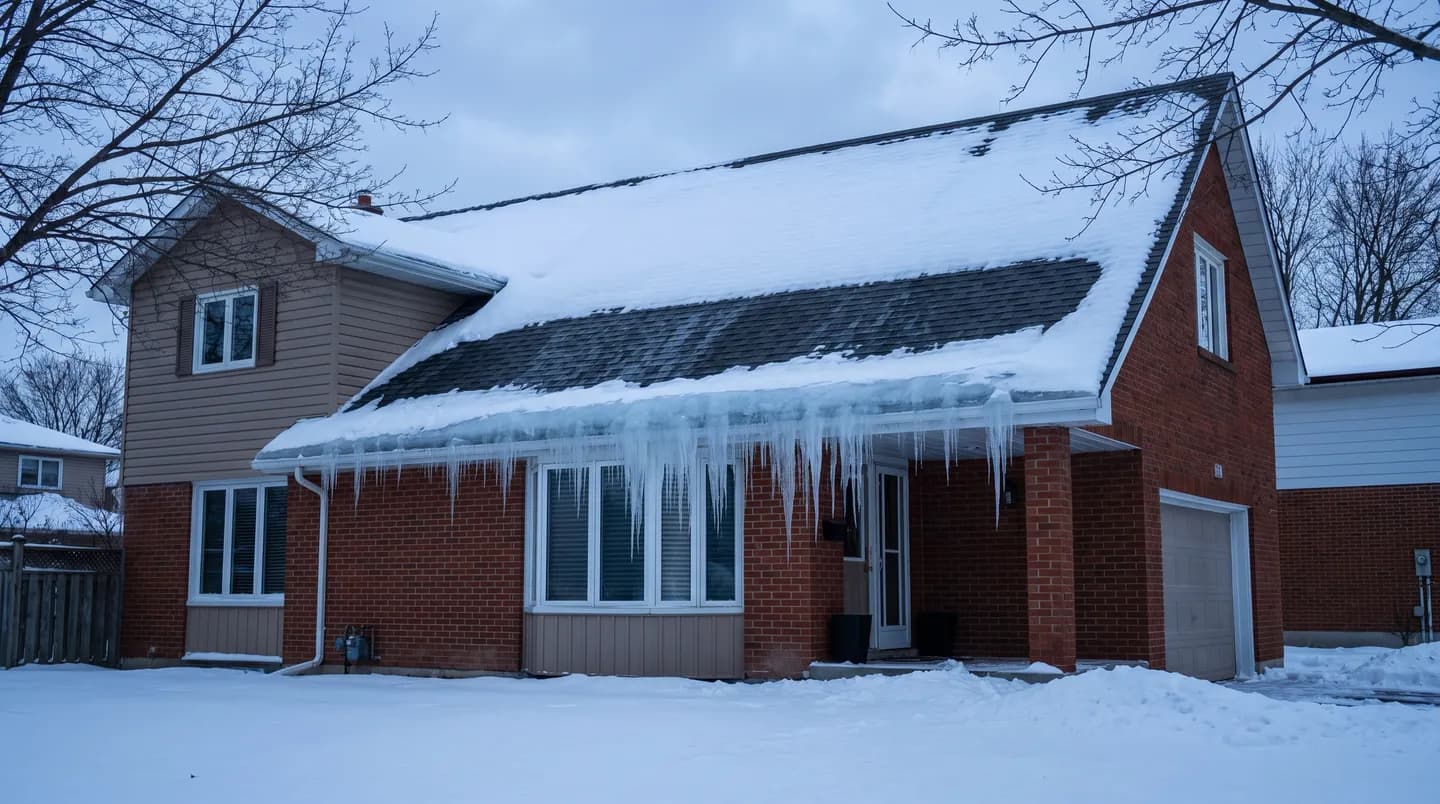
A roof heat cable plugged in on November 1 and left on until spring is a second appliance on your hydro bill, and a big one. Run 200 feet of it around the clock and it uses more electricity in a month than the Ontario Energy Board's typical household does. On the right roof that is money well spent. On the wrong one it melts a tidy channel through a problem that lives in the attic.
At Sherak we install roof and eavestrough heat cables, most often with new eavestrough, and we tell homeowners when not to buy one. Below: what a cable does, which type suits which roof, how much an eave needs, Ontario's electrical rules, and the cost to run one at the prices the OEB set from November 1, 2026.
If ice forms along your eaves every winter, read our guide to preventing ice damming before winter first. A cable is the second answer to that problem, not the first.
What Does a Roof Heat Cable Actually Do?
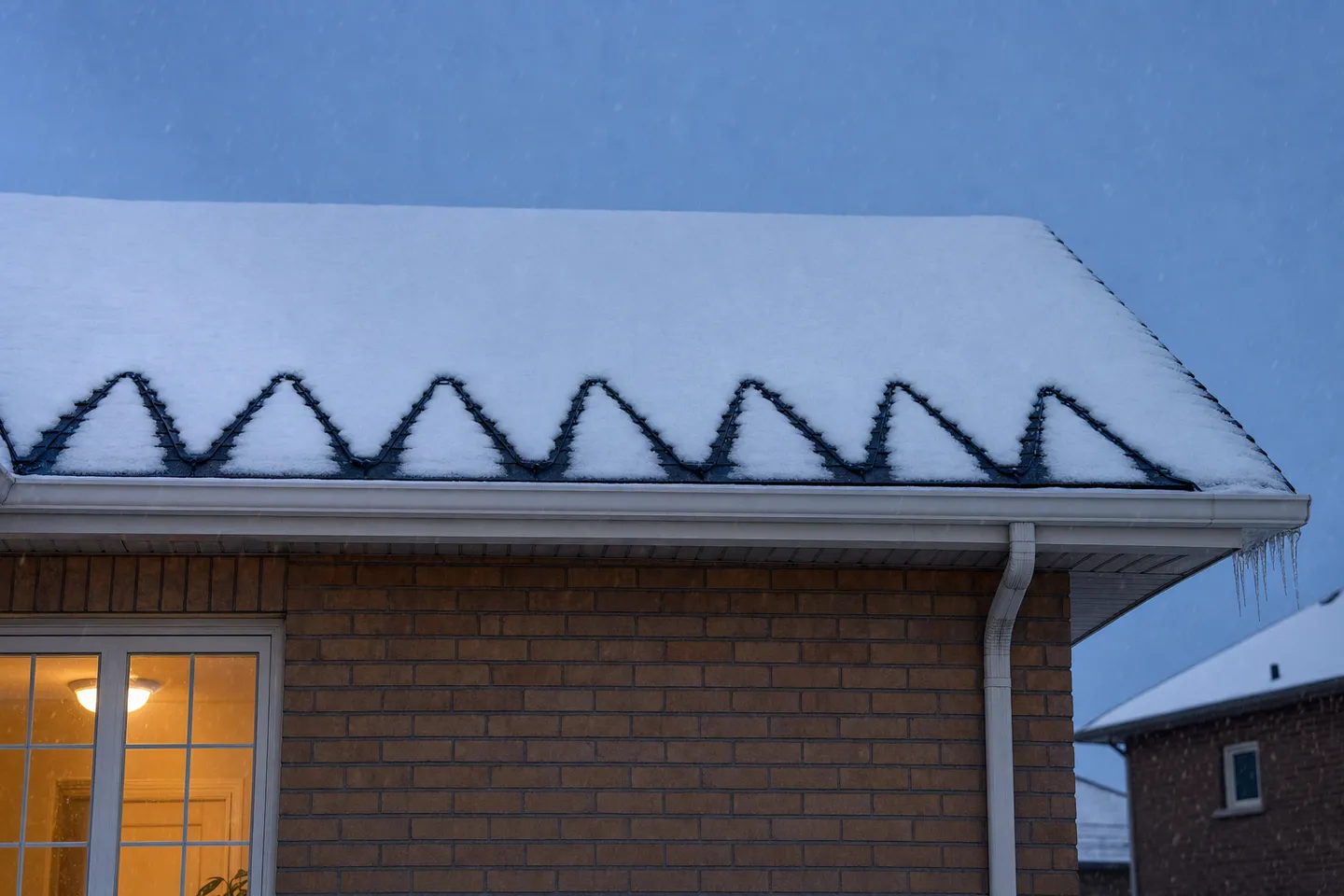
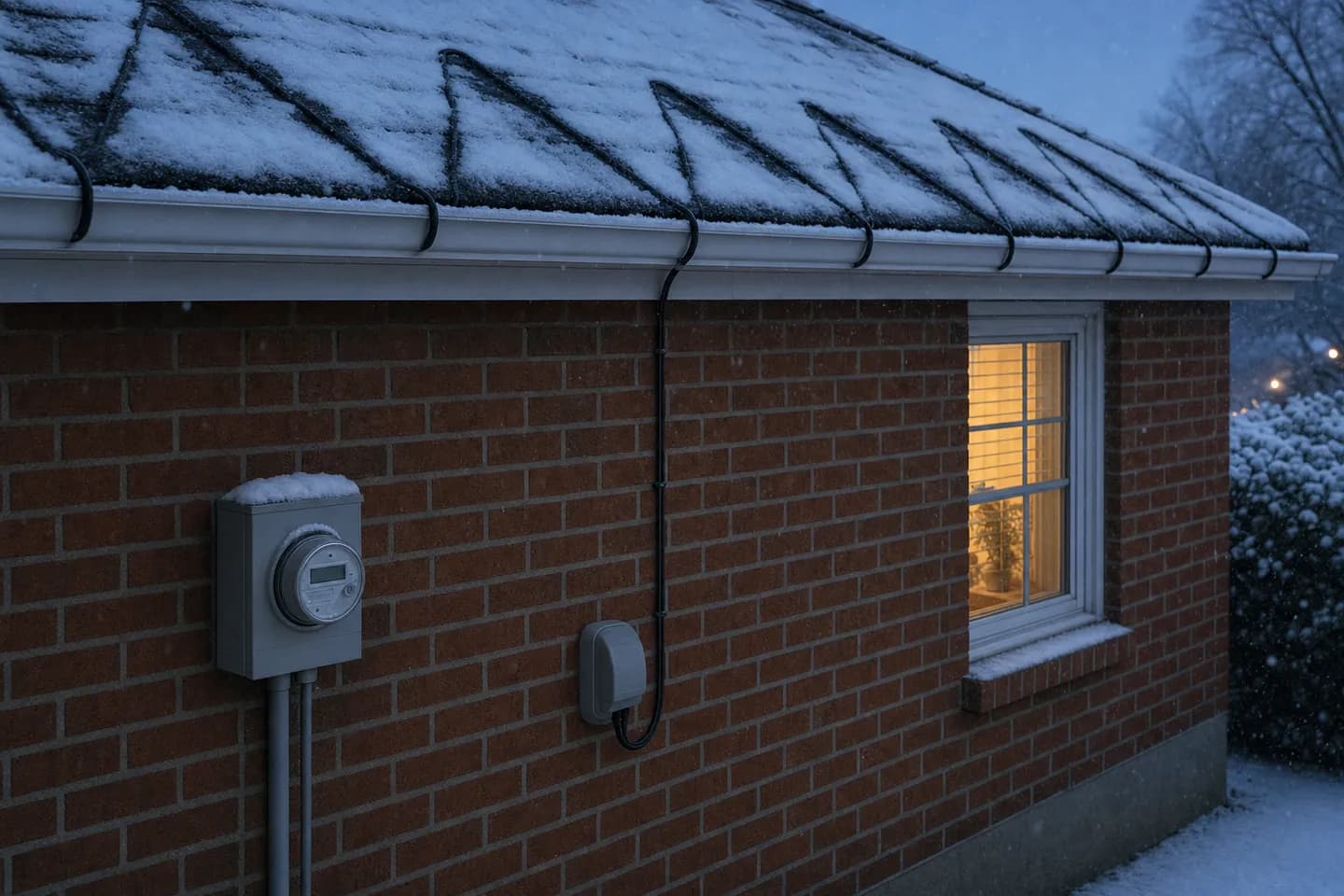
A roof heat cable warms a narrow path from the roof edge, through the eavestrough and down the downspout, so meltwater drains away instead of refreezing into a dam. It is a drainage tool. Raychem's own manual says its FrostGuard cable is designed to remove melt water, not accumulated snow.
The IceStop installation manual puts it the same way: as long as a heated path from the roof to a safe discharge area is maintained, ice dams will not form. The cable never has to melt the whole eave. Its job is one continuous channel, open all the way to the ground.
So loops on the roof with no cable in the trough do little, because the water refreezes in the gutter instead, and every maker's sizing method counts each downspout to the ground.
What it will not do matters as much. EasyHeat tells ADKS buyers not to use the cable to melt snow and ice that has already formed, and Raychem adds that it will not keep snow or ice from sliding off the roof. A cable goes in before winter, not in the middle of it.
When a Heat Cable Is the Right Call, and When It Is Not
Buy a heat cable for a known trouble spot you cannot fix at the source: a low-slope addition, a valley that dams every year, the eave under a skylight, or a downspout that freezes shut. Do not buy one instead of sealing and insulating an attic that leaks heat along the whole roof.
Canada Mortgage and Housing Corporation is blunt about the order. Its guide to removing ice on roofs puts stopping attic air leaks and adding insulation first, and calls heating cables and other de-icing techniques the last resort. Attic work removes the cause. A cable manages the symptom, and bills you every month it runs.
Where a cable earns its place:
- A roof you cannot get at from the attic. Cathedral ceilings, low-slope additions and finished half-storeys often leave no room to seal or insulate without opening the ceiling.
- One recurring spot. A valley, the eave below a skylight, or the corner where two roofs meet, on a roof that otherwise behaves.
- A trough or downspout that freezes shut. The IceStop manual says that where the roof itself does not dam, cable in the gutters and downspouts alone may be enough.
It is the wrong buy when ice forms along the whole eave of a two-storey with an open attic above it. That is heat loss on every foot of roof, and a cable to match is the 200 foot example below, running all winter. The cheaper fix is in the attic and at the soffit, and our guide to soffit and fascia shows how much intake air an eave needs. If a dam is already pushing water through a ceiling, call for 24/7 emergency roof repair, not a cable.
Not sure if your eave needs a cable or an attic fix?
We will look at where the ice forms, check the attic, the trough and the downspouts, and tell you which fix pays. Free, and no obligation.
Watts: Self-Regulating or Constant Wattage?
Self-regulating cable changes its own heat output with the temperature around it, can be overlapped without hot spots, and in hard-wired systems is cut to length on site. Constant wattage cable puts out the same power on a mild afternoon as in a cold snap, and it comes in fixed lengths that cannot be cut, spliced or shortened.
The IceStop data sheet explains the difference: a conductive polymer core between two bus wires regulates its own output in response to ambient conditions, which eliminates hot spots. A constant wattage cable such as EasyHeat's ADKS draws its 5 watts a foot whether the eave is packed with ice or the sun is out.
| Cable | Heat and length | Power, roofs and warranty |
|---|---|---|
| EasyHeat ADKS | Constant wattage: 5 W per foot, always. Fixed kits, 20 to 240 ft | Plug on a 6 ft cord. Sloped tab-shingle roofs, gutters and downspouts; not metal, never flat. 2 year limited warranty |
| Raychem FrostGuard | Self-regulating: 800 W per 100 ft in ice and snow. Fixed kits, 6 to 100 ft | Lighted plug on a 6 ft cord. Shake, shingle, rubber, tar, wood, metal and plastic roofs. Warranty not stated in the install manual |
| Raychem IceStop | Self-regulating: 12 W per foot in ice or snow. Cut to length on site | Hard-wired with connection kits. The same roofs as FrostGuard. 10 years if registered within 30 days |
Sources: EasyHeat ADKS catalogue pages (Emerson, 2017), Raychem FrostGuard installation instructions (2016), and the Raychem IceStop data sheet (2026) and installation manual.
We name these three because their specifications are published in full, not because they are the only cables worth buying. Two details decide a lot of jobs: ADKS kits are not approved for metal roofs, and IceStop runs at most 100 feet on a 15 amp circuit at a 0°C start-up, 135 feet on 20 amps and 200 on 30. A long hard-wired eave is a dedicated circuit, not an outdoor plug.
Feet: Measuring an Eave for Heat Cable
Measure the eave, not the house. On a shingle roof with a 12 inch overhang, the makers' layouts call for roughly 2.8 to 4 feet of cable per foot of eave, depending on whether the run in the trough is counted, plus a run down every downspout to the ground. A 15 foot eave with one downspout takes about 80 feet.
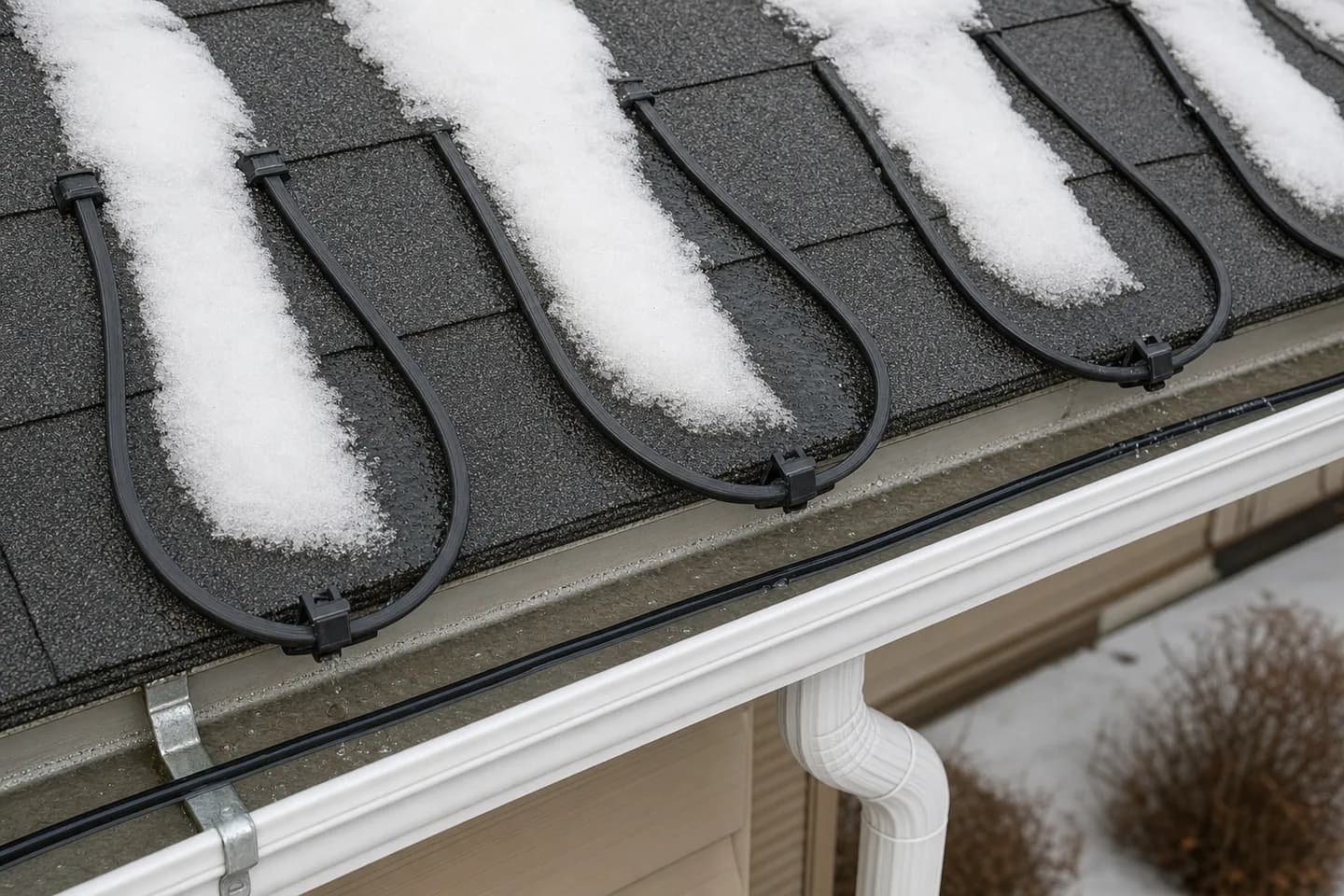
Each loop climbs from the eave to about 12 inches past the line of the outside wall, where the warm house meets the cold overhang, and comes back down into the trough. Deeper overhangs need taller loops: the IceStop table rises from 3.2 feet of cable per foot of roof edge at a 12 inch overhang to 5.2 feet at 36 inches.
Two makers publish worked examples:
- Raychem, a 15 foot eave. 12 inch overhang, one 15 foot downspout: 42 feet of loops (15 × 2.8), 7.5 feet of roof extension, 15 feet in the trough and 16 down the downspout. That is 80.5 feet, so the 100 foot FrostGuard kit.
- EasyHeat, a 32 foot eave. 12 inch overhang with a gutter, a dormer 30 feet around, one valley, two 10 foot downspouts: (32 × 4) + 30 + 6 + (2 × 10 × 2) = 204 feet, so the 200 foot ADKS kit.
- Gutter only. EasyHeat sizes it at twice the gutter length plus twice every downspout, and Raychem asks for two runs in a 5 to 6 inch gutter.
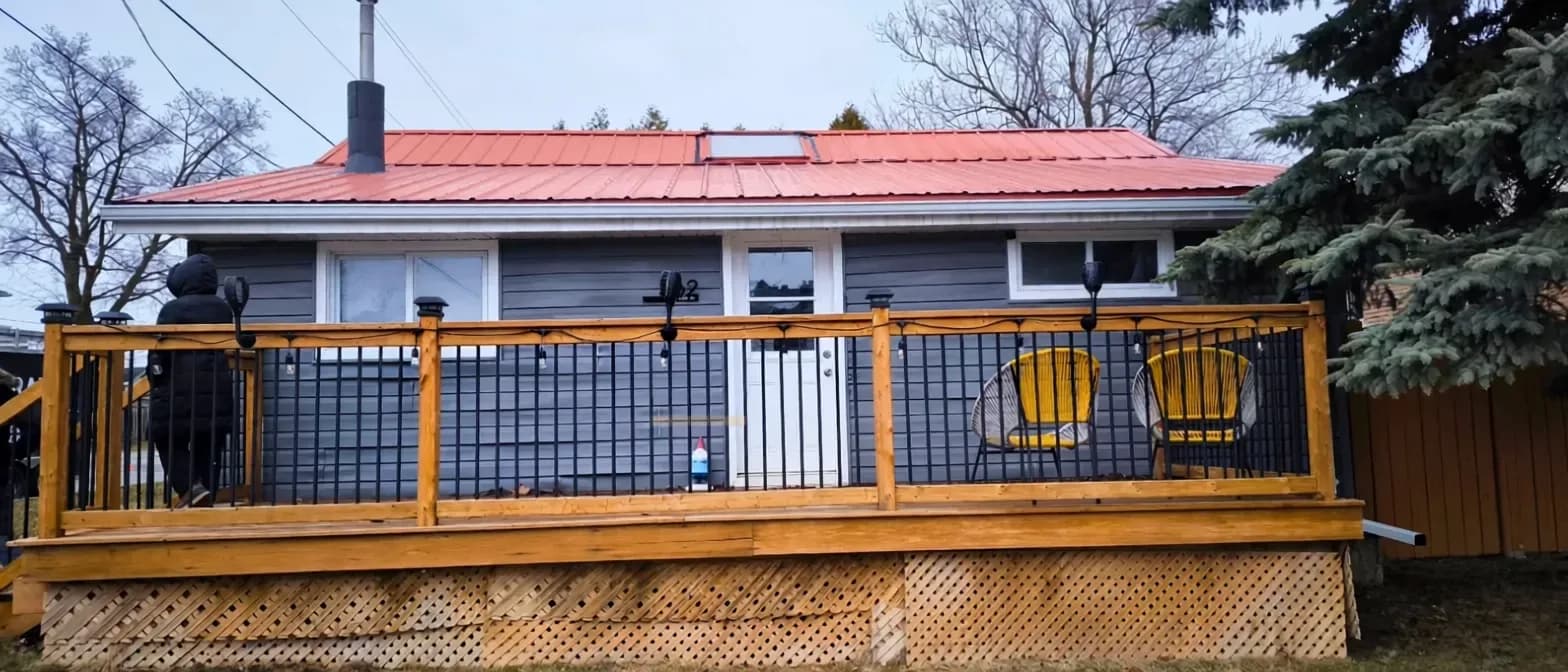
Gutter only is what we ran on Wildwood Avenue in Richmond Hill in March 2025: a bungalow under a ribbed metal roof, where we replaced every length of eavestrough and laid a heat cable in all of it, in a single day. The Wildwood Avenue job is in our portfolio.
Valleys and dormers push the total up fastest, at 6 feet a valley in EasyHeat's method plus the full distance around every dormer.
Amps: Are Roof and Gutter Heat Cables Safe?
Yes, when every circuit has ground-fault protection and the cable is installed to the maker's instructions. Raychem warns that arcing from a damaged cable may not be stopped by conventional circuit protection, which is why ground-fault equipment protection is required on every heat cable branch circuit.
- Ground-fault protection, every time. EasyHeat warns that fault currents from a damaged cable may not be large enough to trip a conventional breaker. A plug-in kit goes into a ground-fault protected outlet; a hard-wired system gets protection in the panel or its controller.
- No extension cords. Raychem's FrostGuard manual and Heat-Line's instructions both say so in those words.
- A proper outdoor outlet. The Ontario Electrical Safety Code requires GFCI protection on outdoor receptacles within 2.5 m of grade (Rule 26-704), and EasyHeat says never to modify the plug.
- Nothing hidden. Raychem says not to install the cable under any roof covering, and only in accessible locations.
New wiring has rules of its own. The Electrical Safety Authority lets homeowners do electrical work in their own home only after filing a notification of work, a permit, and says friends, family members or neighbours cannot do it for you; otherwise it is a licensed electrical contractor's job. So find the outlet before choosing a cable. Where no GFCI-protected outdoor outlet is within a cord's reach of the eave, the new outlet comes first.
Degrees: The Control That Sets the Bill
A plug-in cable with no control runs every hour it is plugged in. A thermostat switches it on below a set temperature, and a moisture and temperature controller adds a second test: is there water to drain? The IceStop manual calls that combined controller the most conservative approach from an energy-consumption point of view.
The same manual sets out the trade-off: off when it is needed, ice forms; on when it is not, you pay for power you did not need.
EasyHeat's GC1 controller applies power only below +3°C and when its moisture sensor sees water, and EasyHeat calls a control like its Roof Sentry RS2 highly recommended for the plug-in ADKS kits. No maker publishes how many hours a controller saves in an Ontario winter, because that depends on the winter, so the chart below shows the ceiling: a cable simply left on.
The cheapest control of all is the calendar. Unplug a kit once the snow season is over. A self-regulating cable turns itself down in mild weather but never off: Raychem's own table still rates the 100 foot FrostGuard at 600 W at 4°C on a pipe.
Dollars: How Much Does It Cost to Run a Roof Heat Cable in Ontario?
At the Ontario Energy Board's time-of-use prices from November 1, 2026, every 1,000 watts of heat cable left on around the clock uses 720 kWh in 30 days and costs about $85 in electricity, before delivery, regulatory charges and HST. That is roughly 43 cents a foot for 5 watt cable and $1.02 a foot for 12 watt cable.
The OEB's November 2026 price announcement sets winter time-of-use at 9.1 cents a kWh off-peak, 14.6 mid-peak and 18.9 on-peak. Off-peak covers weekday nights from 7 p.m. to 7 a.m. and all weekend, 108 of the 168 hours in a week, so a cable that never switches off buys almost two thirds of its power at the cheapest price.
The OEB's typical residential customer uses 700 kWh a month. EasyHeat's own 200 foot example, left on, uses 720 kWh: a second household's worth of electricity, for one eave.
| Cable | Watts | Off-peak (9.1¢ a kWh) | Mid-peak (14.6¢ a kWh) | On-peak (18.9¢ a kWh) | Total kWh | Total cost | Share of a typical household's month |
|---|---|---|---|---|---|---|---|
| EasyHeat ADKS, 100 ft (Constant 5 W a foot, mild day or not) | 500 | 231 kWh, $21.06 | 64 kWh, $9.39 | 64 kWh, $12.15 | 360 | $42.60 | 51% |
| Raychem FrostGuard, 100 ft (Maker's example: a 15 ft eave) | 800 | 370 kWh, $33.70 | 103 kWh, $15.02 | 103 kWh, $19.44 | 576 | $68.15 | 82% |
| EasyHeat ADKS, 200 ft (Maker's example: 32 ft eave and dormer) | 1000 | 463 kWh, $42.12 | 129 kWh, $18.77 | 129 kWh, $24.30 | 720 | $85.19 | 103% |
| Raychem IceStop, 100 ft (12 W a foot in ice, 15 A circuit limit) | 1200 | 555 kWh, $50.54 | 154 kWh, $22.53 | 154 kWh, $29.16 | 864 | $102.23 | 123% |
Which Price Plan Suits a Heat Cable?
Standard time-of-use, for a cable left on. The Ultra-Low Overnight plan has the cheapest power in Ontario at 3.7 cents a kWh, but a cable cannot pick its hours, and the plan's 37.7 cent weekday on-peak block costs it more than the cheap nights save. Tiered pricing lands in between for a typical household.
The same 1,000 watts for 30 days on each OEB plan:
| Price plan | What the cable pays | 1,000 W for 30 days |
|---|---|---|
| Time-of-use | 11.8 cents a kWh on average | $85.19 |
| Tiered, on top of a typical 700 kWh household | 300 kWh at 11.2 cents, then 420 kWh at 13.2 cents | $89.04 |
| Ultra-Low Overnight | 13.4 cents a kWh on average | $96.17 |
A 1,000 watt cable pushes a typical 700 kWh household over the 1,000 kWh winter threshold, so most of its power lands at the higher tier. On the ultra-low plan, 25 weekday hours at 37.7 cents, 4 to 9 p.m., carry more of the cable's bill than 56 overnight hours at 3.7 cents.
The Ontario Electricity Rebate, 15.7 percent from November 1, takes part of the bill back, and delivery and regulatory charges add to it. Both vary by utility, which is why the chart stops at the electricity line. A controller moves the number most, because every hour the cable is off costs nothing.
How Do You Know a Heat Cable Is Working?
Look for the drain path, not for bare shingles. On a working system you see wet channels following the loops after a snowfall, with snow left between them, water moving in the trough, water running out of the downspout on a cold day, and the plug or controller light on.
- Power first. FrostGuard has a lighted plug. If it is dark, check the GFCI outlet: a ground-fault device that trips again after a reset is telling you the cable needs checking.
- The channels. After a snowfall each loop should show as a wet track. A loop that stays white is a dead section, or cable that has slipped its clips.
- The bottom of the downspout. Water dripping out on a day below zero means the whole path is open. Ice at the outlet means the heated run stops short.
- The maintenance test. Raychem specifies an insulation resistance test with a 2,500 volt megohmmeter, at least 1,000 megohms and compared with the reading at installation; below that, the cable is replaced. That is an electrician's meter.
All of it can be checked from the ground. Stay off a winter roof.
What a Cable Does to Shingles, Steel and Eavestroughs
Clips go through the roof, so they are worth doing once and doing properly. Raychem allows about 10 clips for every 7 feet of roof edge, nailed or screwed through the shingles, with the holes resealed where necessary. That is a row of small penetrations in the part of the roof that carries the most meltwater.
Steel roofs need a cable approved for them: FrostGuard and IceStop are, ADKS kits are not. On standing seam, Raychem's layout runs the cable along the seams with no extra cable needed in the gutter, clipped with a screw, nail or adhesive. Smooth steel also sheds snow sooner, which is part of why metal roofs see fewer ice dams to begin with.
No cable stops snow sliding off steel, and Raychem says to use snow guards or snow fences. The steel tile roof we installed in Brechin carries a row of snow guards, like much of our metal roofing work.
The eavestrough carries the cable as well as the water. Raychem keeps the run on the bottom of the gutter and down every downspout on hanger brackets, so the best time to add one is when new seamless eavestrough goes up anyway, as on Wildwood Avenue. A cable in a sagging trough sits in a pool, and our eavestrough repair guide covers the rehang. One in a trough full of leaves heats the leaves, which is why our eavestrough cleaning guide puts the last clear in late November.
How We Install Heat Cables at Sherak
We are based in Gormley and install roof and eavestrough heat cables across York Region, Simcoe, Kawartha and the GTA. The quote starts with where the ice forms, not with a kit size: we measure the eave, the valleys and every downspout, check the trough and its fascia, and find the outlet first. Where the attic is the real problem, we say so. Where the trough needs replacing, the cable goes in with it.
We do not publish a price, because it rests on cable length, downspouts and where the power is, and we would rather quote your roof than print a guess. The terms are fixed: a free itemised quote, $5 million liability insurance, a 10 year workmanship warranty, and the last 10 percent paid only once you are satisfied. Get a free quote before the first hard freeze, while the shingles are clear.
Sherak Ltd, Head Office
12275 Woodbine Avenue, Gormley, ON L0H 1G0
Phone: +1 905 490 8800
Email: info@sherak.ca
Get a heat cable sized to your eave
We measure the eave, the valleys and every downspout, check the trough and the outlet, and put the length and the price in writing. Free, with a 10 year workmanship warranty.
Get a Free QuoteFrequently asked questions
How much does it cost to run roof heat tape in Ontario?
Do heat cables use a lot of electricity?
Can you put a heat cable in a gutter?
Are gutter heat cables safe?
Will a heat cable melt an ice dam that is already there?
Do heat cables work on metal roofs?
Written by
Emad Alikhanpour
Roofing & Exterior Specialist
Emad has 15 years of hands-on experience across roofing and every exterior service Sherak offers, from shingle and metal roofs to siding, eavestroughs, soffit and fascia, and custom flashing.
15 years in the trade · Roofing and exterior services
View profileReader reviews
Loading reviews...