On this page
- What Do Snow Guards Actually Do on a Metal Roof?
- Why Does Snow Slide Off a Metal Roof All at Once?
- How Hard Does the Snow Push on the Guards?
- What Does a Sliding Slab Hit on the Way Down?
- Glued, Screwed or Clamped: Choosing Snow Guards for Metal Roofs
- How Many Snow Guards Does a Metal Roof Need?
- Does Every Metal Roof Need Snow Guards?
- Adding Snow Guards to a Metal Roof You Already Have
- Frequently asked questions
- Reader reviews
Key takeaways
- Snow guards hold snow on a metal roof so it melts off in place, instead of releasing as one slab onto doors, steps, eavestroughs and cars.
- At the snow load the Building Code designs for, a 6:12 roof on a 12 m deep house pushes about 410 kg down every metre of eave in Newmarket, 275 kg in Toronto and 515 kg in Collingwood.
- Several rows of guards share that load, where one strong row at the eave takes all of it. The lowest row belongs about 0.3 m inside the heated wall, never out on the overhang.
- Glued-on guards failed at 180 to 320 kg in the tests on record, and their adhesive needs weeks of warm weather to cure. Seam clamps have reported failure loads up to 1,800 kg, without a hole in the roof.
- Guards are not recommended under a 3:12 pitch, and DECRA says many stone-coated steel tile roofs do not need them, but a steep tile slope over a front door still gets them.
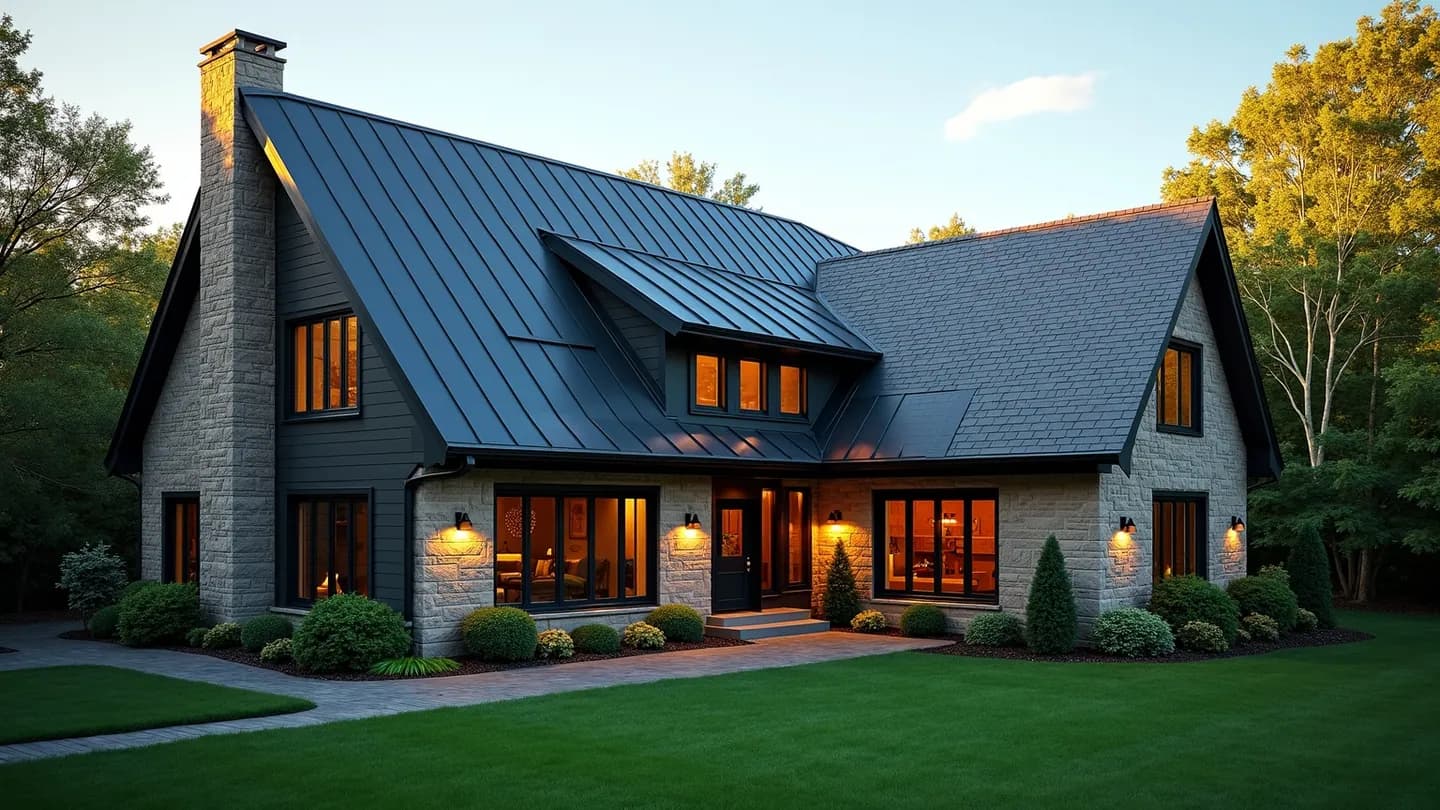
The first mild afternoon after a big snowfall, a metal roof does something a shingle roof rarely does: it lets go of everything at once. The snow the Building Code designs a Newmarket roof for weighs about 920 kg on every metre of eave on each side of a 12 m deep house, and on an 8:12 slope about 510 kg of that pushes down the roof. Snow guards for metal roofs exist to keep that slab where it is until it melts.
At Sherak, we install galvanized steel snow guards on new metal roofs and add them to existing ones, and wherever a door, walkway, driveway or deck sits under the slope they go into the quote from the start. This guide follows the slab in the order it moves: why it lets go, how hard it pushes, what it hits, and what holds it. Then it works out how many guards a roof needs, and whether yours needs any at all.
What Do Snow Guards Actually Do on a Metal Roof?
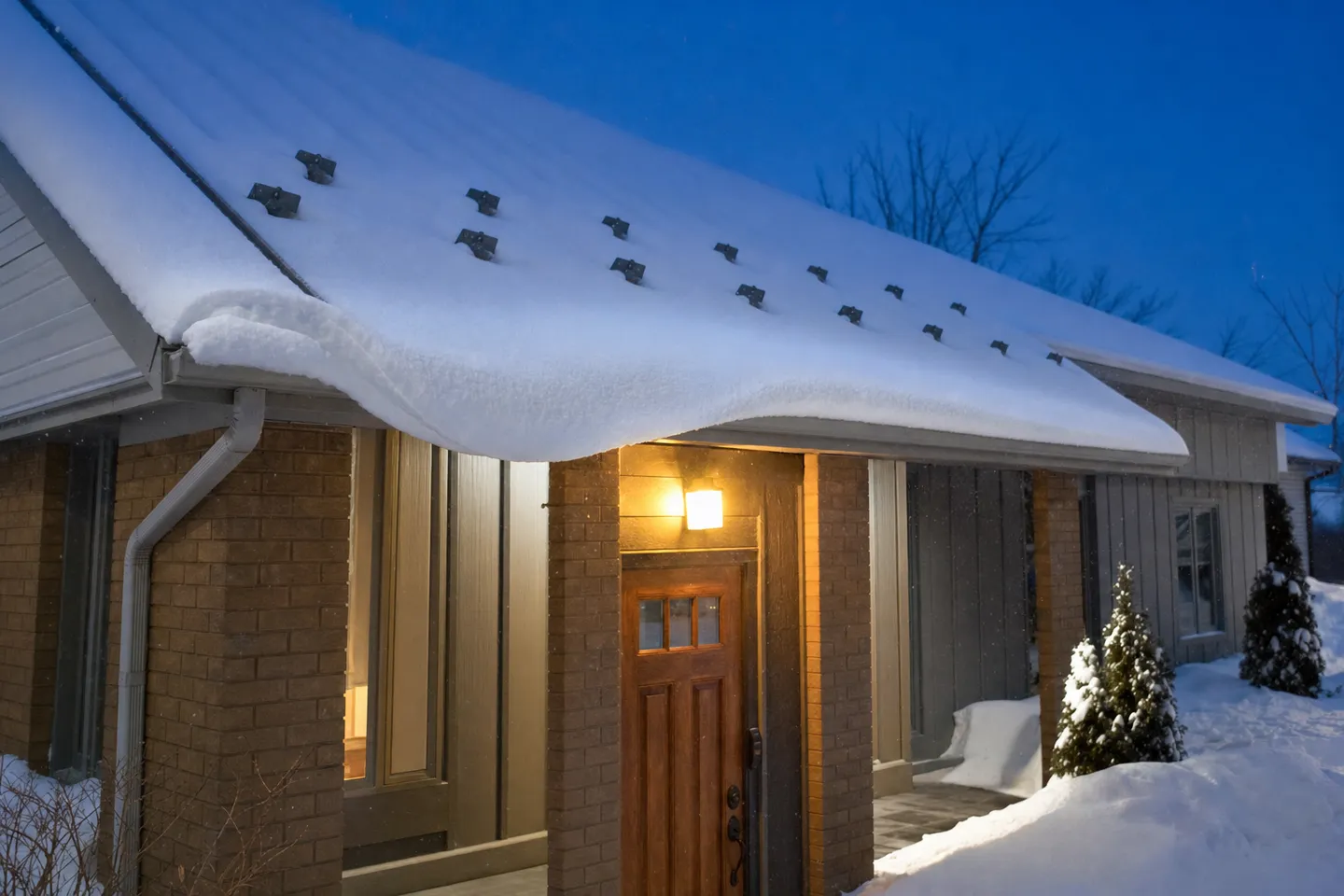
Snow guards are small barriers fixed to a metal roof that hold the snow in place, so it melts and drains off a little at a time instead of letting go as one heavy slab. They exist to protect what is under the eave: doorways, steps, walkways, driveways, decks, eavestroughs, lower roofs and the people who use them.
The installation sheets describe them more modestly than the name does. Amerimax's snow guard installation guidelines say a guard is there to help reduce a slide, not stop it, and that the aim is to hold the snow mass in place while it melts and breaks down into smaller pieces. That is the right picture. A row of guards is not a dam. It is a set of anchors that keeps a heavy blanket from ever getting moving.
The same sheet lists what guards protect: gutters, foundation plantings, parked vehicles, adjacent roofs and equipment, and pedestrians. Every item on that list is something a slab hits after it has left the roof, which is why the first question a roofer should ask about snow guards is not about the roof at all. It is about what sits under the eave.
Why Does Snow Slide Off a Metal Roof All at Once?
Painted steel is slick, and snow lying on it at 0°C with a little meltwater underneath has almost no grip. Once the bottom of the snowpack warms to freezing, nothing holds it but whatever sits in its way, so a metal roof tends to shed its whole load in a single release.
That is the finding of cold-regions engineers Wayne Tobiasson, James Buska and Alan Greatorex in Snow Guards for Metal Roofs, a study first published by the American Society of Civil Engineers in 1996. They take the friction between snow and metal as zero when sizing guards, because at the freezing point, with free water in the snow, it very nearly is. The same slipperiness is why metal roofs suffer fewer ice dams: snow that has left the roof cannot melt and refreeze at the eave. Our comparison of metal roofs and asphalt shingles counts that as one of metal's real advantages in an Ontario winter.
Canada's National Research Council described the moment of release in Sliding Snow on Sloping Roofs, Canadian Building Digest 228. Heat escaping through the roof melts the snow where it touches the panel, which lubricates the surface. A crack then opens in the snow, usually near the ridge, and the snow frozen to the cold eave is left holding back the whole mass above it until it gives way. The digest puts the friction of snow on painted steel or aluminum at about 0.05, close enough to zero that a released slab can land a considerable distance out from the eaves.
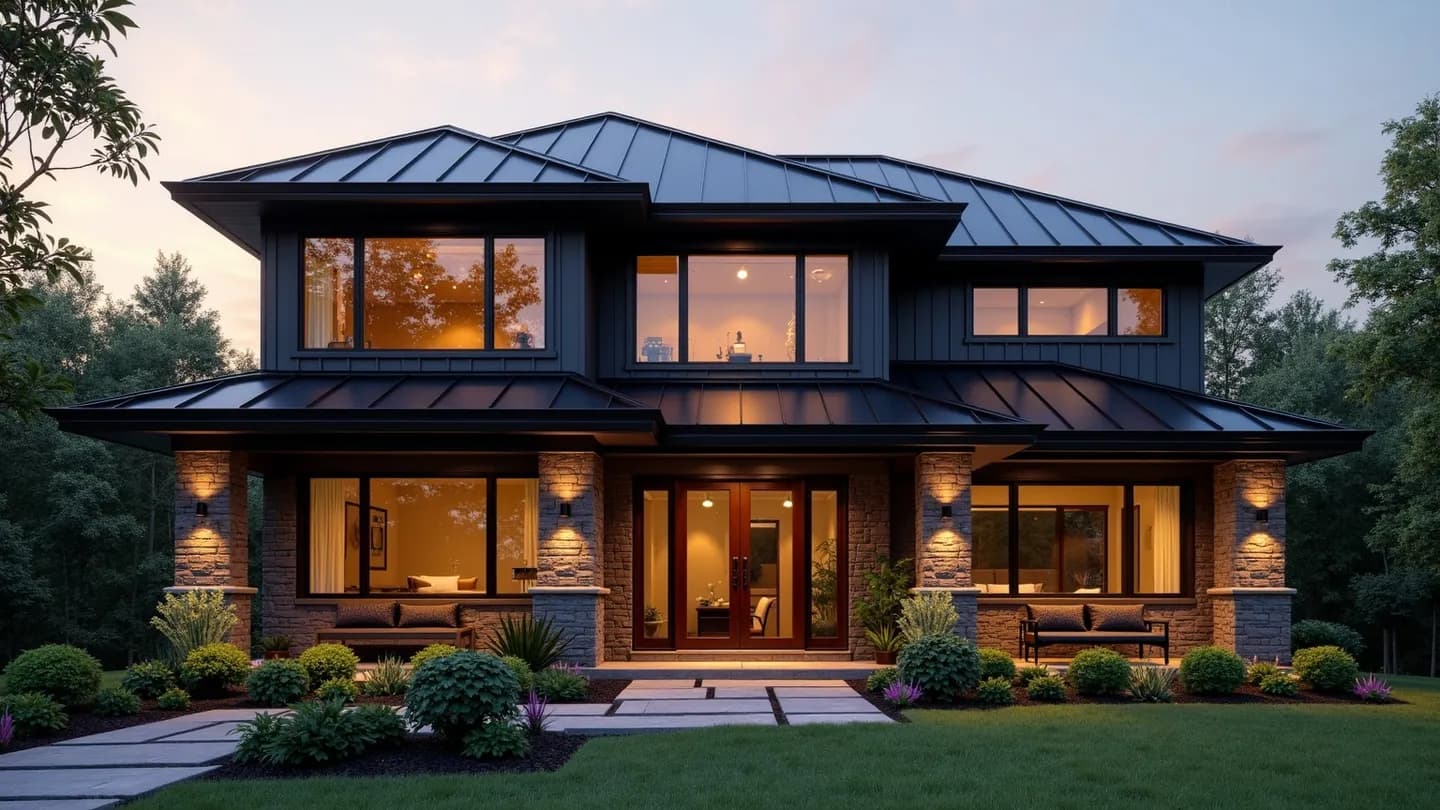
The surface matters. A smooth painted panel, like the standing seam roofs we price here, sheds readily. Stone-coated steel tile is a different surface, and its maker reads it differently: DECRA, now part of IKO, says many owners of its stone-coated roofs do not need snow guards, while noting that on steep roofs snow can slide more easily and guards can be added. The three metal roofs in our portfolio are all steel tile: a terracotta stone-coated roof on Saddle Tree Crescent in Woodbridge, a dark brown tile on Lake Ridge Road in Georgina, and a dark blue tile in Brechin. The Brechin roof carries rows of guards, and the reason is the front door, which we come back to below.
How Hard Does the Snow Push on the Guards?
Far harder than most homeowners picture. At the snow load the Building Code designs for, a 6:12 roof on a 12 m deep house pushes about 410 kg down every metre of eave in Newmarket, 275 kg in Toronto and 515 kg in Collingwood. Steeper roofs push harder still.
The method is Tobiasson's. Building codes give the snow load on the horizontal footprint of a roof, so the snow on a strip of roof one metre wide weighs the load times the horizontal run from eave to ridge. The share of that weight driving down the slope is the weight times the sine of the roof angle, and with friction taken as zero, the guards have to resist all of it.
The loads come from the National Building Code of Canada 2020, the model on which Ontario's 2024 Building Code is based. Article 9.4.2.2 sets a house roof wider than 4.3 m at 0.55 times the ground snow load plus the rain load, never less than 1 kPa, and Table C-2 gives those two inputs town by town. Our pre-winter roof inspection guide works through what they mean for the framing. Here they set the push. A 6 m run is half of a 12 m deep house with the ridge down the middle.
| Roof pitch | Angle | Toronto | Newmarket | Collingwood |
|---|---|---|---|---|
| 4:12 | 18° | 195 kg | 290 kg | 365 kg |
| 6:12 | 27° | 275 kg | 410 kg | 515 kg |
| 8:12 | 34° | 340 kg | 510 kg | 640 kg |
| 10:12 | 40° | 390 kg | 590 kg | 740 kg |
| 12:12 | 45° | 435 kg | 650 kg | 815 kg |
These are design figures, the load a roof is built to survive in a heavy winter, not what sits on it every February. They still settle two things. A guard in Newmarket works noticeably harder than the same guard in Toronto, and one in Collingwood harder again. And no single small guard holds a metre of eave by itself. Tobiasson's team reported glued guards failing at 180 to 320 kg each in the load tests on record, and advised trusting a guard with less than half its failure load. The red bar in the chart is that half: 90 to 160 kg.
| Roof pitch | Slope angle | Push on 1 m of eave, Newmarket (kg) | Push on 1 m of eave, Toronto (kg) | Push on 1 m of eave, Collingwood (kg) |
|---|---|---|---|---|
| 4:12 | 18° | 290 | 195 | 365 |
| 6:12 | 27° | 410 | 275 | 515 |
| 8:12 | 34° | 510 | 340 | 640 |
| 10:12 | 40° | 590 | 390 | 740 |
| 12:12 | 45° | 650 | 435 | 815 |
What Does a Sliding Slab Hit on the Way Down?
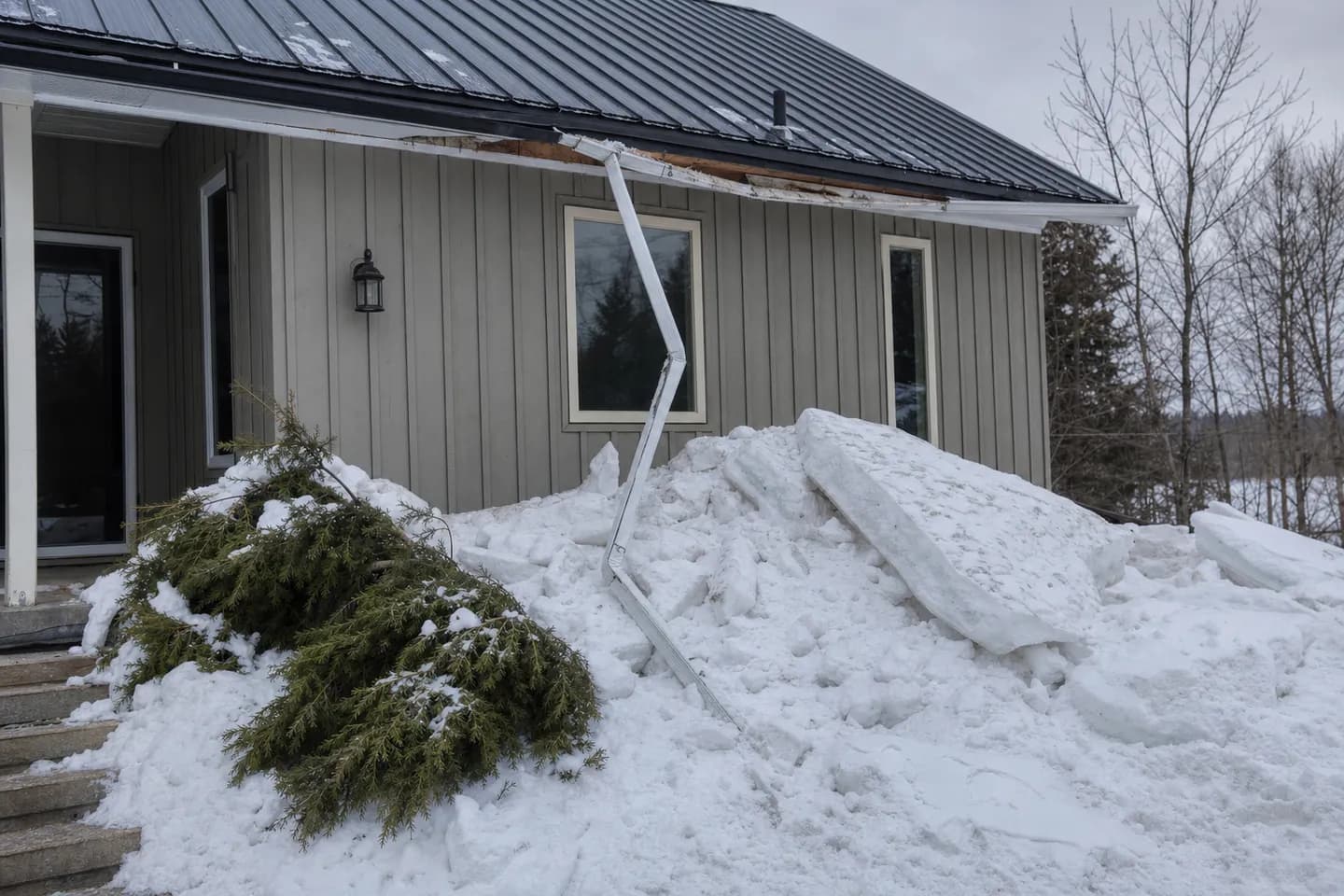
Everything under the eave, and a few things on the roof itself. A released slab can tear eavestroughs off the fascia, shear plumbing vents, damage lower roofs and land on steps, cars and people. Guards in the right place prevent most of it.
The damage in the engineering reports runs longer than most people expect, and some of it happens before the snow even leaves the roof.
On the roof itself
- Plumbing vents. Tobiasson's study records stacks displaced and sheared off by sliding snow. The vent pipe is the first joint our roof flashing guide walks through, and a slab that bends it can open that joint to the weather.
- Valleys. Moving snow rolled the standing seams in valleys onto their side and peeled them apart, breaking the watertight seal inside the seam.
- Heat cables. Tobiasson's team studied heat tapes on metal roofs and came away convinced that, without snow guards, they can be ripped loose as snow creeps or slides. If you rely on a roof heat cable, the guards protect the cable as well as the people below.
Below the eave
- Eavestroughs. Snow sliding off metal can tear a weak trough off the fascia. That is why we check how the troughs are fastened on every metal roof we quote, and why a slide so often ends in eavestrough repairs.
- Lower roofs. Snow landing on a lower roof keeps piling up there. In Part 4 of the National Building Code, the part engineers design to, a lower roof under a sloped upper roof has to carry extra snow equal to half of the upper roof's, unless the snow is held back by a parapet or other effective means (Article 4.1.6.11).
- Doors, steps, walkways, cars and decks. The slab lands exactly where people walk and park.
Glued, Screwed or Clamped: Choosing Snow Guards for Metal Roofs
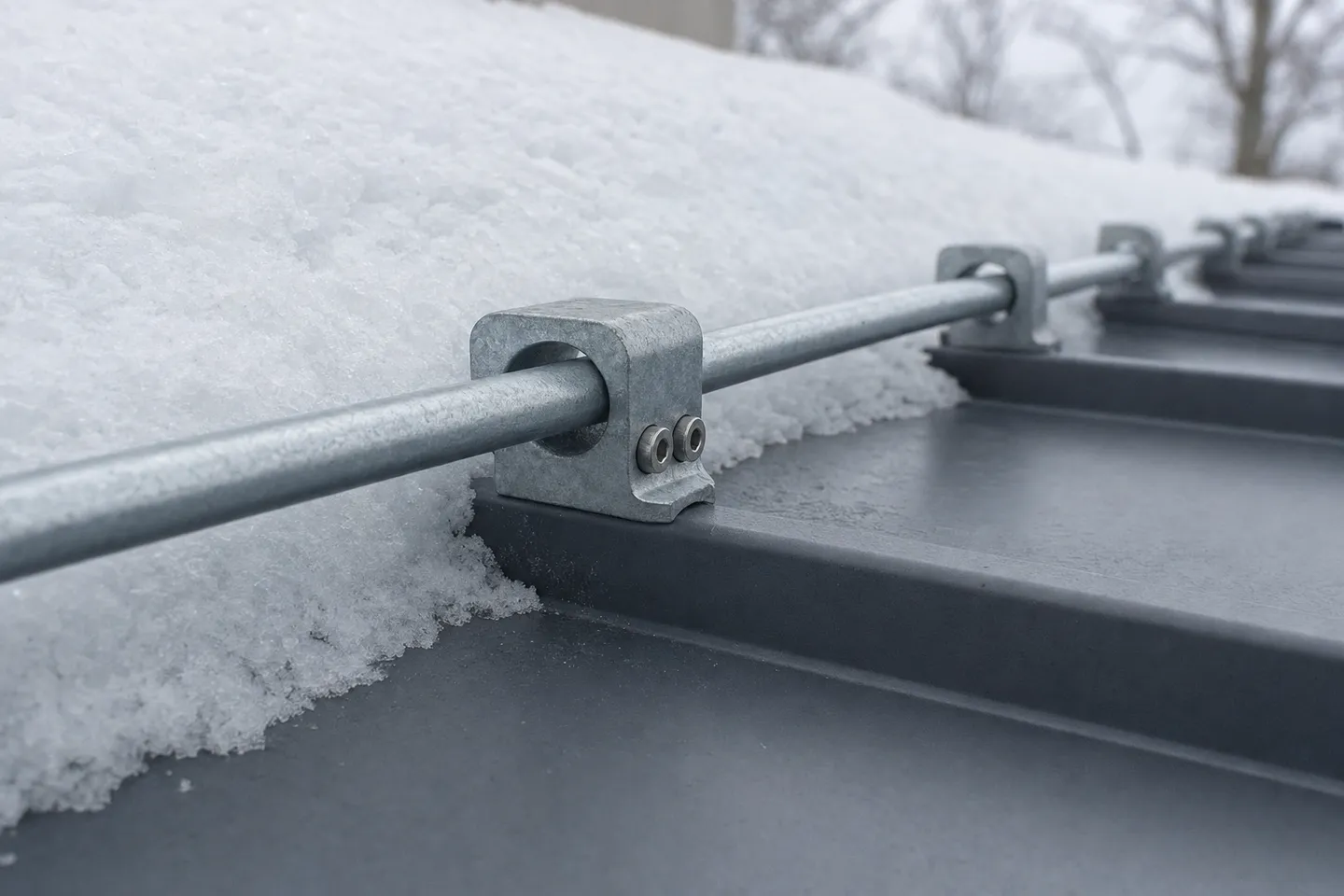
How a guard is attached matters more than its shape. Glued guards need weeks of warm weather to cure and fail at low loads, screws through the panel invite leaks, and clamps that grip the top of the standing seam hold the most without piercing the roof.
Tobiasson's team reviewed all three and tested the first two on standing seam roofs at Fort Drum, New York, through three winters:
| Attachment | How it holds | What the study found | The catch |
|---|---|---|---|
| Adhesive | Glued or taped to the panel | Failure loads of 180 to 320 kg per guard in the tests on record. Every guard stuck on with peel-and-stick butyl tape failed in its first winter, and hardware-store silicone did not last | The adhesive Amerimax lists needs 28 days in a row at 10°C or warmer to cure, which an Ontario fall will not give it |
| Screws or rivets through the panel | Fastened through the metal | Some held; others pulled up through the panel in the heavier third winter | Drilling through the panel into the framing stops it moving with the temperature, and leaks are highly likely |
| Seam clamp | Set screws grip the top of the standing seam, with no holes | Failure loads up to 1,800 kg reported | Clamps fit some seam profiles better than others, so the clamp has to suit the panel |
The 28 day figure is from the adhesive's own instructions: Surebond SB-190, the sealant Amerimax lists for its glued guards, needs four weeks of 10°C weather to fully cure. Amerimax also warns that fastening guards through the panel can void a metal roof's watertight warranty, and that dissimilar metals in contact corrode wherever water reaches them. Steel guards belong on a steel roof.
At Sherak, we install galvanized steel guards, matched to the panel we are putting on or the one already there. Steel tile has no standing seam to clamp, so on a tile roof the guard has to be one made for that profile, fixed the way the tile maker's installation sheet allows.
How Many Snow Guards Does a Metal Roof Need?
Enough rows to hold the snow where it lies, rather than one heavy row trying to catch it at the bottom. The layout depends on the pitch, the length of the slope and the town's snow load, and it follows the guard maker's pattern, but the same rules shape every good one.
Six rules come out of the engineering study and the manufacturer's sheet.
Where the rows go
- Several rows beat one. Tobiasson's team preferred multiple rows of reasonably strong guards over one very strong last line at the eaves, so the snow never moves far enough to hit them with a running start.
- Space the rows apart. Rows set close together share the load badly: the upper row takes nearly all of it.
- Keep the lowest row off the overhang. The study's rule of thumb puts it upslope of a line about 0.3 m inside the heated wall. Guards out on the overhang hold snow over the cold eave and help an ice dam form, which our ice damming guide explains from the attic up.
Where the load gathers, and where guards do not go
- Strengthen the ends. Where a row stops short of the edge of the roof, the load on its end guards can reach almost twice the average, so those guards matter most.
- Guarding one door still means holding a wedge. Where guards cover only part of a roof, the snow beside them is free to move and pushes on them too, so the study sizes them for all the snow within 45 degree lines running upslope from the guards.
- No guards under 3:12. Snow does not slide off a low slope the same way, and Amerimax advises letting it clear on its own or removing it by hand.
For a starting pattern, Amerimax's sheet for its Berger guards gives one guard every 40 inches over the whole roof, or two groups of three staggered rows on 30 inch centres, one group at the eave and one midway up the slope, with further groups no more than 6 feet apart on long slopes. The same sheet says never to place guards beyond the bearing wall. A real roof starts from a pattern like that and is set by a qualified installer for its pitch, the length of its runs and its features.
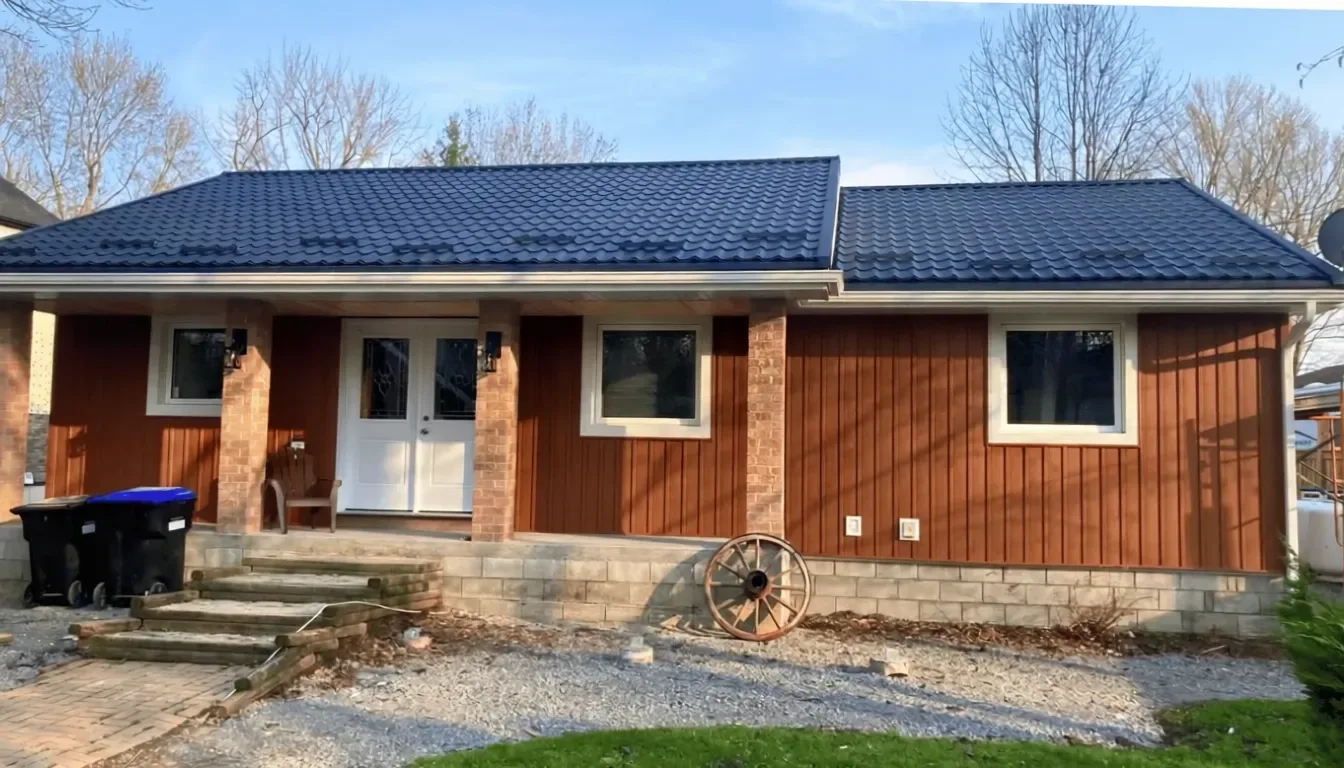
The Brechin bungalow shows the idea at house scale. When we installed its dark blue steel tile roof in October 2022, we set staggered rows of guards across the front slope over the porch and the double front door, where a release would land on whoever was coming home. The whole Brechin exterior renovation is in our portfolio.
Snow coming off your roof over a door?
We will walk your eaves, mark where a slide would land, and lay out the guard rows in galvanized steel to suit your panel. Free, and no obligation.
Does Every Metal Roof Need Snow Guards?
No. A metal roof needs snow guards wherever a slab would land on something that matters: a door, steps, a walkway, a driveway, a deck, a lower roof or an eavestrough that has to last the winter. Over open lawn, on a low slope, or on stone-coated tile with nothing below, the answer can be none.
The quick way to answer it for your own house is to walk the eaves and look down:
| What is under the eave | Snow guards? | Why |
|---|---|---|
| Front door, steps or porch | Yes | People stand there, and the slab arrives without warning |
| Walkway or driveway | Yes | Feet, cars and the snowblower all go there |
| Deck or patio | Yes | The slab lands on framing, railings and furniture |
| A lower roof | Yes | Falling snow strikes it and keeps piling up on it |
| Eavestroughs you want to keep | Usually | Sliding snow can tear a weak trough off the fascia |
| Open lawn or a garden bed | Optional | Nothing to protect but the plants |
| A pitch under 3:12 | No | Snow does not slide off a low slope the same way |
On our own metal roof jobs the rule is simple: doors, walkways, driveways and decks under a metal slope get snow guards, and they go into the quote from the start. Steel tile is where the answer changes most often, since its maker says many stone-coated roofs do not need guards. Over open ground a tile roof may shed nothing that matters, but over a front door it still gets them, as the Brechin roof does.
Adding Snow Guards to a Metal Roof You Already Have
Guards can go on an existing metal roof, and before the snow is the time to add them. Match the guard to the panel, check the roof warranty before anything goes through the metal, and remember that a roof which used to shed its snow will now hold it.
That last point is easy to miss. Tobiasson's team warned that adding guards to an existing roof will probably increase the snow it carries, and that a roof may need strengthening before it is asked to hold its snow. In Ontario, Part 9 of the Building Code sizes a house roof for the full snow load, with no reduction for a slippery surface, but a roof that sags, or an older one framed before today's Code, deserves a look before the guards go on.
Timing matters too. A glued guard needs weeks of warm weather it will not see between November and April, so a fall retrofit means a mechanical guard: clamped to the seam on standing seam, or the type made for the profile on tile. We add galvanized steel guards to existing metal roofs and fit them on new ones, and the work carries our 10 year workmanship warranty, with 10 percent of the price due only once you are satisfied. If snow is already coming off your roof over a door or a walkway, get a free quote and we will lay out where the rows should go before the next big storm.
We are based in Gormley and install and repair metal roofs across York Region, Simcoe, Kawartha and the GTA.
Sherak Ltd, Head Office
12275 Woodbine Avenue, Gormley, ON L0H 1G0
Phone: +1 905 490 8800
Email: info@sherak.ca
Get snow guards on before the next big snowfall
New metal roof or existing, we lay out the rows and install galvanized steel guards to suit your panel. 10 year workmanship warranty and $5 million liability insurance.
Get a Free QuoteFrequently asked questions
Do snow guards have to go all the way across a metal roof?
Can snow guards cause ice dams?
Can I install snow guards on a metal roof myself?
Do steel tile and stone-coated metal roofs need snow guards?
When is the best time to add snow guards?
Do I need snow guards if I have heat cables on my roof?
Written by
Emad Alikhanpour
Roofing & Exterior Specialist
Emad has 15 years of hands-on experience across roofing and every exterior service Sherak offers, from shingle and metal roofs to siding, eavestroughs, soffit and fascia, and custom flashing.
15 years in the trade · Roofing and exterior services
View profileReader reviews
Loading reviews...