On this page
- A Leak Is Not an Emergency. An Open Roof Is.
- The 4 Things That Actually Count as a Roof Emergency
- Should You Call at 2 a.m. or Wait Until Morning?
- Reading That Grid Before You Dial
- How Much Does Emergency Roof Repair Cost in Ontario?
- How a Roof Gets Tarped, and Why Yours Blew Off
- Does Insurance Cover Storm Damage to a Roof?
- What Ontario Weather Actually Does to a Roof
- After the Tarp: What Happens Next
- What 24/7 Means Here, and What It Does Not
- Frequently asked questions
- Reader reviews
Key takeaways
- A leak is not an emergency. An open roof is. If the covering is gone and the deck or underlayment is exposed with rain coming, that is a call tonight. A stain spreading slowly across a ceiling is a call on Monday.
- An Ontario emergency call-out adds roughly $150 to $300 on top of the repair, and after-hours labour runs 25 to 40 percent over the scheduled rate. An emergency tarp on a damaged section is $300 to $800.
- Only 45 of the week's 168 hours are scheduled-rate hours. Three quarters of the week is already out of hours, which is why the question is never really whether to pay a premium but whether the damage is still getting worse.
- Hail is not Ontario's roofing emergency. It takes a hailstone of roughly 40 to 45 mm before asphalt shingles start to suffer. The call that empties our truck here is ice at the roof edge in March.
- Insurance covers sudden and accidental damage and excludes gradual seepage and wear. Your policy also obliges you to limit further damage, which is why the emergency tarp is usually paid for even when the roof itself is not.
It is 11 at night, the wind has been up for an hour, and something on the roof let go. You can hear water hitting the attic insulation. The question you are actually asking is not how to fix a roof. It is whether this needs an emergency roof repair tonight or whether it can hold until somebody can see what they are doing.
We take that call across York Region, Simcoe, the Kawarthas and the GTA, and the honest answer most of the time is that it can hold. A roof that is leaking is a roof with a defect, and defects are best found in daylight. Our guide to finding and fixing a roof leak covers that job properly, from the first bucket to the permanent repair.
This article is about the other case: the roof that is open. Four situations are worth waking somebody for, and this is how we sort them on the phone, what the night premium actually costs in Ontario, how a tarp is supposed to be fastened, and what your policy will and will not pay for.
A Leak Is Not an Emergency. An Open Roof Is.
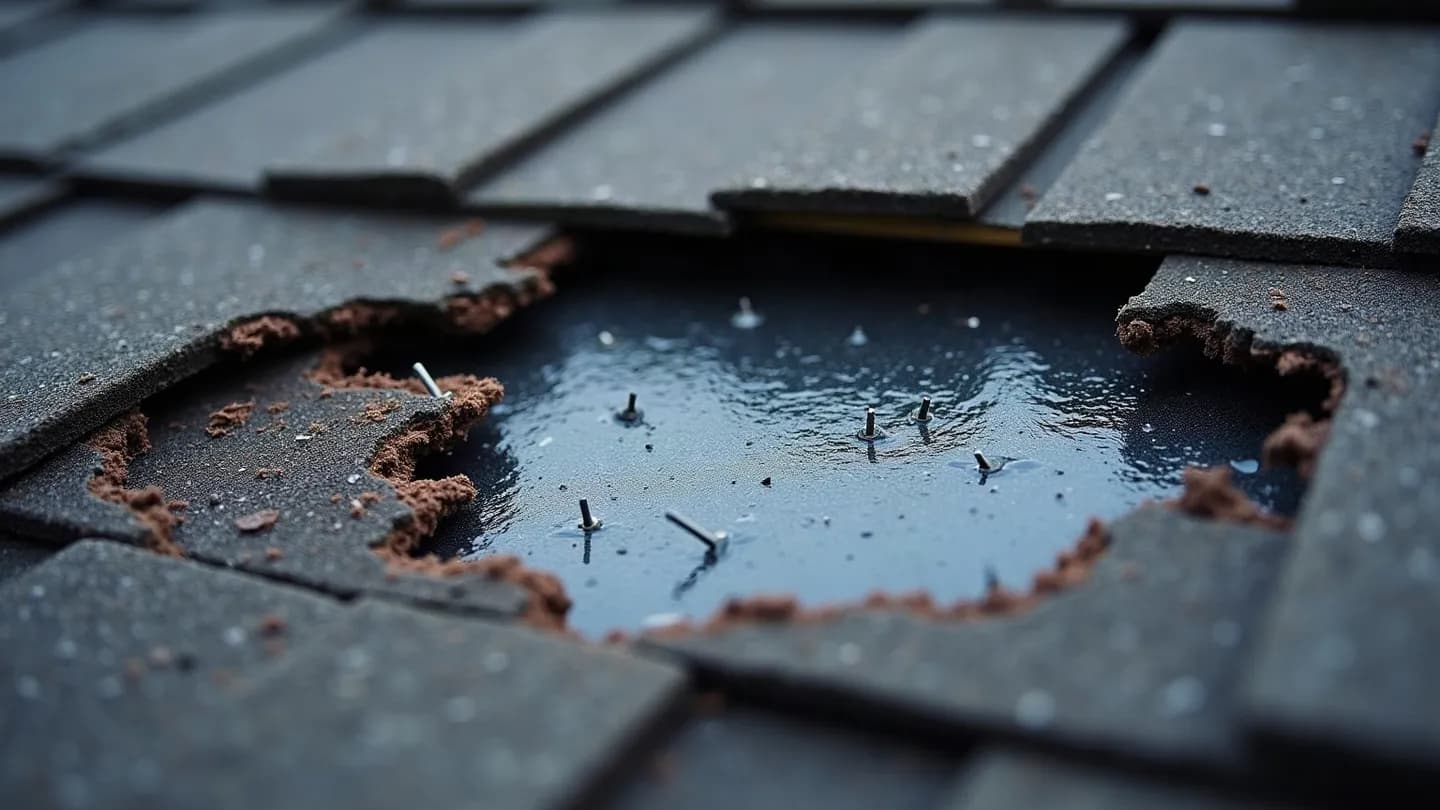
The difference is whether the roof still has a covering. A leak means water has found a fault in a roof that is otherwise intact, and the fault will still be there in the morning. An open roof means the covering is gone, the deck or the underlayment is bare, and every hour of rain goes straight into the house.
That distinction decides everything else, including the bill. A leak is a diagnosis job and diagnosis is slow, careful work that wants daylight and a dry deck. An open roof is a containment job, and containment is fast, crude and genuinely urgent.
Most people phone us with the first and describe it as the second, which is understandable at midnight with a bucket filling in the hallway. So the first thing we ask is not where the water is coming in. It is whether anything is missing from the roof, and whether the sky is visible from the attic.
If you are not sure, that is a fair answer at 11 p.m. and we would rather talk it through than have you up a ladder in the dark to find out.
The 4 Things That Actually Count as a Roof Emergency
Four situations are worth a night call: the roof covering is gone and rain is coming, water has reached something electrical, a ceiling is holding a bulge of water, or ice at the eave has taken the roof edge apart. Everything else on a roof waits for daylight and costs less for waiting.
| The situation | Why it will not wait | What happens tonight |
|---|---|---|
| Shingles or a section stripped off, deck or underlayment showing | Every hour of rain lands on bare wood and runs into the structure | Tarp the opening, fastened down properly |
| Water running near a light fixture, fan or panel | It is an electrical hazard before it is a roofing one | Power off at the breaker, then contain the water |
| A ceiling sagging with a wet bulge in it | Drywall holding water fails all at once, and it fails downward | Drain it deliberately into a bin before it lets go on its own |
| Ice at the eave has pulled the trough, fascia or roof edge open | Meltwater is running behind the wall, not down the outside of it | Clear the path, contain the water, make the edge safe |
The second row is the one to take literally. Ontario's Electrical Safety Authority warns that electricity moves through water and wet flooring, so if water is anywhere near a fixture or a panel the breaker goes off before a hand goes near it, and a licensed electrician clears it before the power goes back on.
Notice what is not on that list. A brown ring spreading slowly on a ceiling, a drip you can catch in a pot, a few tabs lifted on a windy afternoon with no rain forecast. All of those are real problems and none of them is improved by a crew arriving at 2 a.m. with a headlamp.
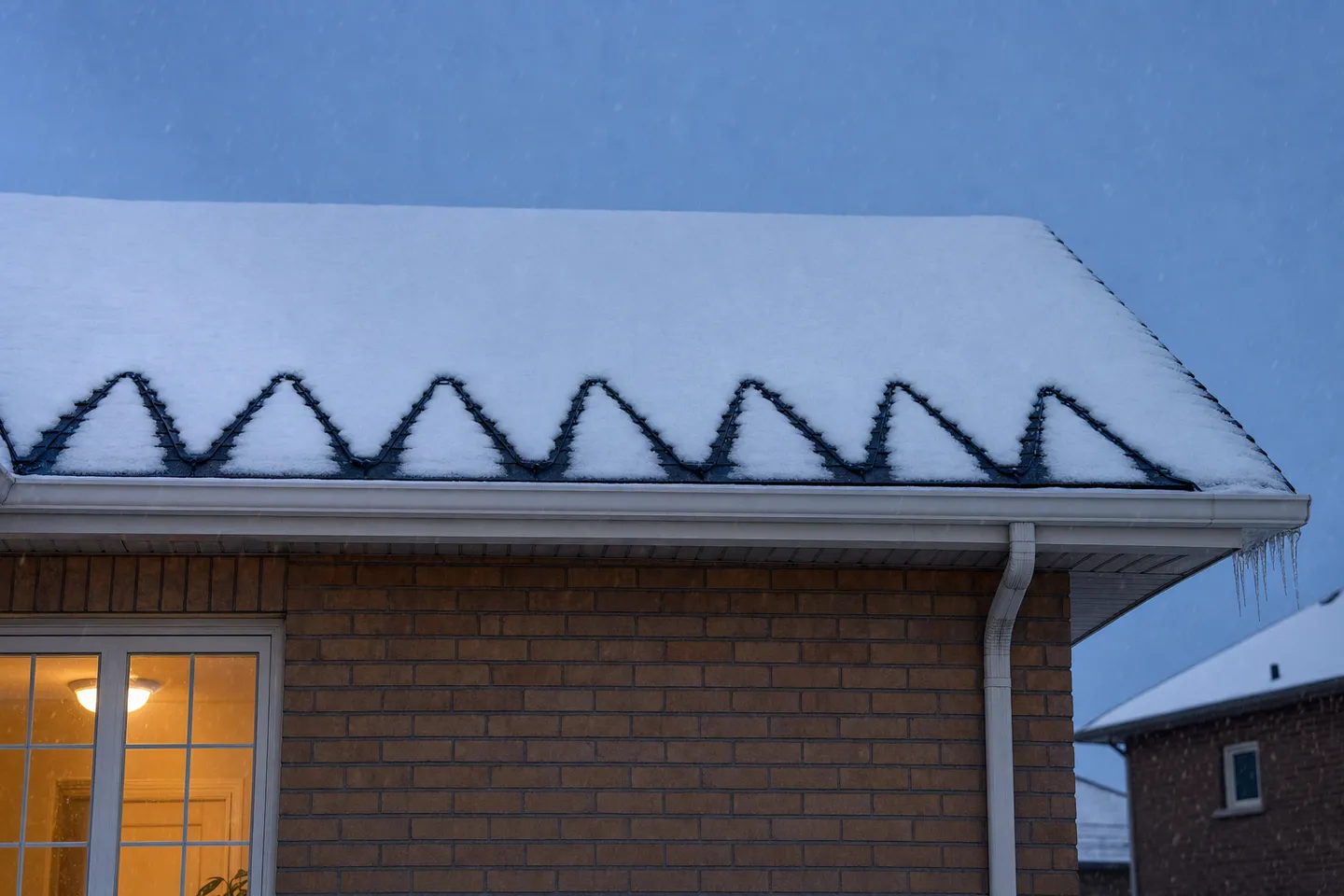
The fourth row is the Ontario one, and it is the one that catches homeowners out because it does not look like a roof problem at all. On Harvey Street in Orillia in March 2025 we found severe damage from an ice dam that had built up along the roofline until meltwater was seeping into the soffit and fascia. Nothing had blown off. The roof looked fine from the driveway.

Should You Call at 2 a.m. or Wait Until Morning?
Call now if water is still getting in and something is still getting worse. Wait if the water has stopped, or if you can contain it in a bin overnight. The premium is real but it is smaller than most people fear, and it is almost always smaller than another eight hours of water in a ceiling.
There is a wrinkle in that advice worth seeing drawn out, because it changes how the premium should feel. A scheduled rate is not most of the week. It is a narrow block in the middle of five days.
| Day | Scheduled rate hours | Emergency premium: call-out $150 to $300, plus 25 to 40 percent on labour hours |
|---|---|---|
| Mon | 08:00 to 17:00 | 00:00 to 08:00 and 17:00 to 24:00 |
| Tue | 08:00 to 17:00 | 00:00 to 08:00 and 17:00 to 24:00 |
| Wed | 08:00 to 17:00 | 00:00 to 08:00 and 17:00 to 24:00 |
| Thu | 08:00 to 17:00 | 00:00 to 08:00 and 17:00 to 24:00 |
| Fri | 08:00 to 17:00 | 00:00 to 08:00 and 17:00 to 24:00 |
| Sat | none | all 24 hours |
| Sun | none | all 24 hours |
| Whole week | 45 of 168 hours | 123 of 168 hours |
Reading That Grid Before You Dial
Three quarters of the week is already outside scheduled hours. A Saturday afternoon is out of hours. So is 7 p.m. on a Tuesday. If your roof opened at nine on a Friday night, waiting until Monday morning does not avoid the premium for very long and it does buy the water another sixty hours inside the house.
So the real question is not the clock. It is whether the damage is still progressing. Water that has stopped arriving costs nothing to leave until morning. Water still coming in through a bare deck compounds, and it compounds into insulation, drywall, and eventually the framing, none of which are roof repairs any more.
One honest exception runs the other way. If it is blowing hard enough to have taken your shingles off, it is usually blowing too hard for anybody to work safely on the slope. We will not put a crew on a roof in a live windstorm, and a contractor who promises to is telling you something about how they treat their people. The same applies to you and a ladder: CCOHS sets out how a portable ladder has to be footed and angled, and none of it is achievable on wet grass in the dark. In that case the work is containment from inside until the wind drops.
How Much Does Emergency Roof Repair Cost in Ontario?
An Ontario emergency call-out adds roughly $150 to $300 on top of whatever the repair itself costs, and after-hours labour runs about 25 to 40 percent above the scheduled rate. An emergency tarp over a damaged section is $300 to $800. The permanent repair afterwards is priced as ordinary work.
Those are market bands rather than our price list, published here so you can tell a fair quote from an opportunistic one while you are standing in a wet hallway at midnight.
| What you are paying for | Ontario market, 2026 |
|---|---|
| Emergency call-out, on top of the repair | $150 to $300 |
| After-hours labour, over the scheduled rate | 25 to 40 percent |
| Emergency tarp over a damaged section | $300 to $800 |
| The permanent repair, once it is dry | Priced as a scheduled repair |
Two things are worth understanding about that structure. The call-out is not a penalty, it is the cost of a truck, two people and a stocked trailer leaving at an hour when they were not scheduled to. And the tarp is a separate job from the repair, which surprises people who expect one bill. You are buying time, not a fix.
What we will not do is quote a permanent repair in the dark. If somebody arrives at midnight with a price for a whole roof, that is a sales call wearing an emergency jacket. Tarp it, sleep, and get a proper quote in daylight.
Roof open and water coming in?
We answer at any hour across York Region, Simcoe, the Kawarthas and the GTA. If it can wait until morning we will tell you that too.
How a Roof Gets Tarped, and Why Yours Blew Off
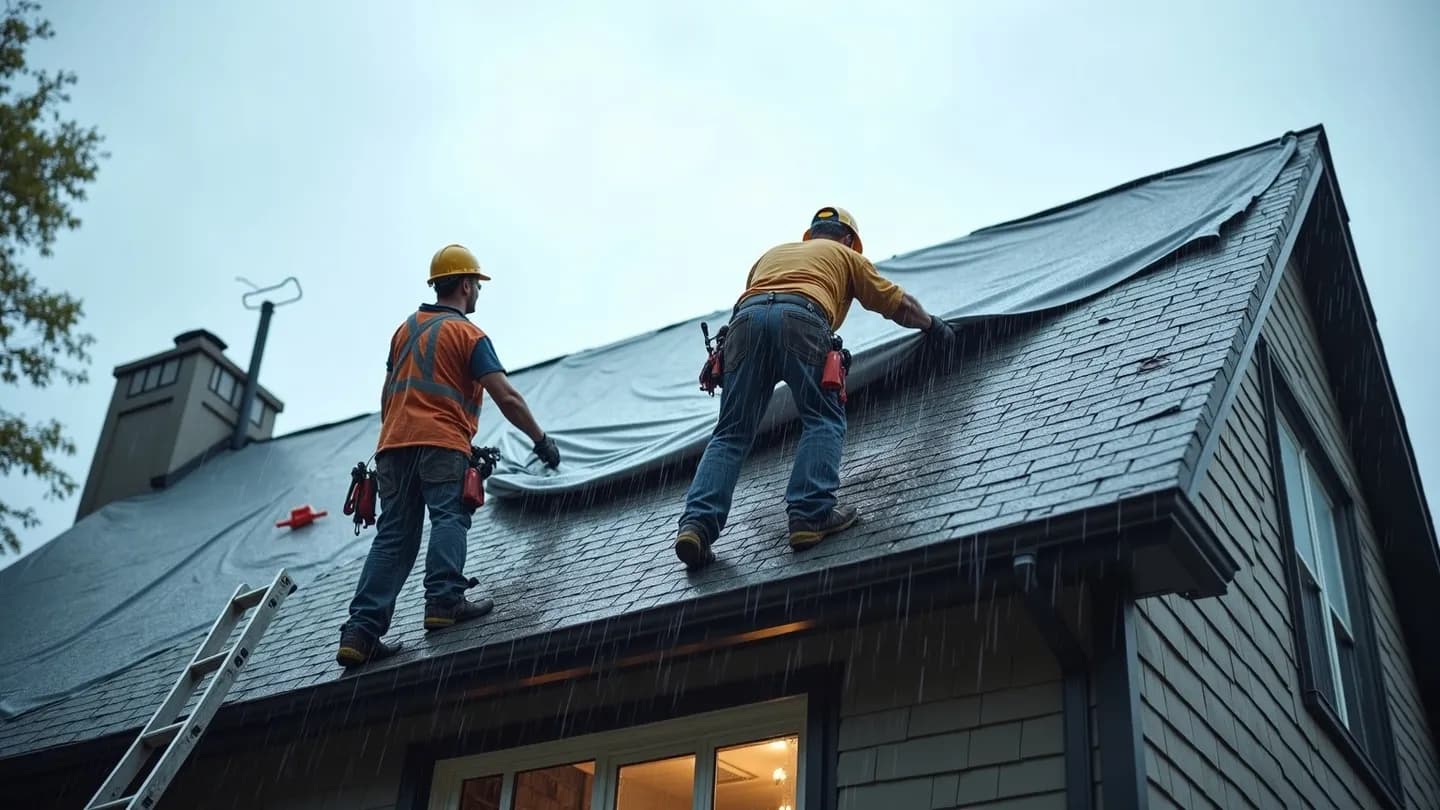
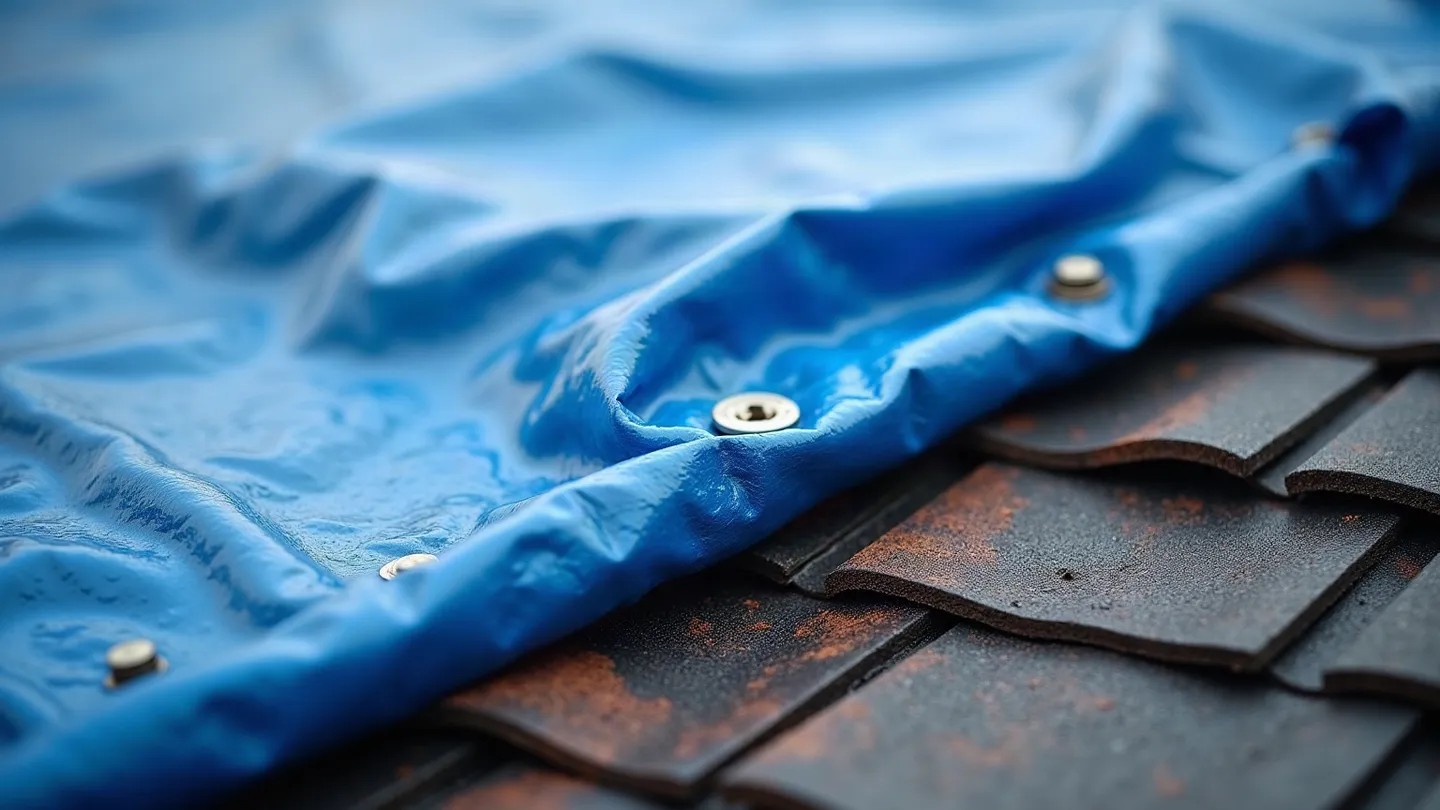
A tarp fails for one reason: the wind got underneath it. Everything about doing it properly is about denying the wind an edge to lift.
The hardware store version is a tarp thrown over the damage with bricks or lumber laid on top. It survives the calm after the storm and leaves on the next gust, usually taking a few more shingles with it. Weight does not hold a tarp down. Fastening does.
Done properly, the tarp runs from above the damage right over the ridge or well up under a course of sound shingles, so water cannot track in at the top edge. The edges are rolled around lengths of wood and screwed flat to the roof, which spreads the load and keeps the fabric from tearing at the fixings. It is pulled tight, because a loose tarp is a sail and a drumming tarp saws through itself in a night.
- Cover well past the damage on all four sides, never just the hole.
- Take the top edge over the ridge or under sound shingles, so water runs onto the tarp and not under it.
- Wrap and screw the edges down over battens rather than weighting them.
- Expect to fill the screw holes at the permanent repair. That is a known cost and a fair trade.
A properly fastened tarp will hold for weeks, which matters in Ontario because the permanent repair often waits for a dry stretch or for an adjuster. A weighted one is a single night of luck. Our roof repair and emergency crews carry battens on the truck for exactly this reason.
Does Insurance Cover Storm Damage to a Roof?
Home insurance in Canada covers sudden and accidental damage and excludes gradual deterioration. A windstorm stripping shingles is the first. Water that has been working through a worn roof for three winters is the second, and that is the line an adjuster is looking for when they get on your roof.
The part homeowners miss is that your policy also puts an obligation on you. You are required to take reasonable steps to prevent further damage once a loss has happened, which in roofing terms means containing the water and covering the opening. That duty is why an emergency tarp is usually paid for even where the underlying roof is not, and why the receipt matters.
So the sequence that protects you is fairly mechanical:
- Photograph everything before anybody touches it, from the ground and from inside.
- Contain the water and cover the opening. Do not wait for permission to stop the damage getting worse.
- Call your insurer or broker the same day, even if you are not sure you will claim.
- Keep every receipt, including the tarp, the fans and the hotel if the house is not habitable.
- Do not have the permanent repair done before the adjuster has seen it, unless they tell you to go ahead.
The Insurance Bureau of Canada's guidance on filing a home insurance claim is worth reading before you ever need it. Two details catch people out. You will be asked to complete a sworn proof of loss form, usually within 30 days, and you are expected to keep the damaged material rather than clearing it away, unless it has become a hazard.
Step one is the one people skip and regret. A tarp goes on, the crew clears the debris, and two days later there is no photographic record of what the roof looked like at the moment of the loss. Ten minutes with a phone from the driveway is worth more than any argument you can make later.
What Ontario Weather Actually Does to a Roof
Most emergency roofing content is written for a different climate. It is about hail, because in Alberta and much of the United States hail is the thing that empties a roofing truck. Here it is not.
The Institute for Catastrophic Loss Reduction, which was set up by the Canadian insurance industry to study exactly this, puts the threshold at roughly 40 to 45 mm of hailstone before asphalt shingles begin to suffer, and higher again on a roof that is not already aged. That is a golf ball. Ontario gets plenty of pea and marble sized hail that sounds alarming on a skylight and does nothing at all to a shingle. ICLR also estimates hail has caused $9.5 billion in insurable damage across Canada since 2008, and very little of that total is Ontario roofing.
What actually opens roofs here is wind, falling limbs, and above all ice. Look at our own call record and the pattern is unmistakable. On Lake Drive in Jackson's Point in March 2025, an ice dam had pulled the eavestrough to the ground and taken the roof edge with it. On River Street in Sutton the same month, ice had backed water up until it went through the soffit. Both of those begin as a ventilation problem behind the soffit and fascia rather than as a roof fault. The Ontario roofing emergency has a season, and the season is late winter.
That is also why the best emergency call is the one that never happens. Ice dams are made in the attic rather than on the roof, and our guide to preventing ice damming before winter sets out the work that stops the March phone call. If the storm has already taken the trough with it, the six faults behind an eavestrough repair covers what comes next at the roof edge.
After the Tarp: What Happens Next
The tarp buys a week or three. What follows depends on how much of the roof is involved and how old it was on the night.
A single stripped patch on a roof with life left in it is a repair, and a straightforward one: cut back to sound material, re-lay the underlayment, tie new shingles into the existing courses, and re-flash anything the wind got behind. Our guide to choosing asphalt shingles for Ontario explains why matching the existing product matters more than matching the colour.
Wind that has taken shingles off in more than one place is a different conversation. It usually means the sealant strips have let go across the whole slope, and a roof whose tabs are no longer bonded will keep shedding them every time it blows. At that point the honest recommendation is a replacement rather than a fifth patch, and our breakdown of what a new roof costs in Ontario gives you the range before anybody quotes you.
The thing nobody expects is the flashing. Wind rarely lifts a field of shingles first. It finds an edge, usually at a rake, a valley or a penetration where the metal was short or loose, and works from there. When we repair storm damage we look at the flashing around every penetration before we look at the shingles, because that is generally where the failure started.
What 24/7 Means Here, and What It Does Not
At Sherak we answer the phone at any hour, and we are straight about what that gets you. Overnight, it gets you a conversation, a triage and, if it is one of the four, a crew and a tarp. It does not get you a re-roof by breakfast and anybody promising one is selling.
What we will tell you on the phone:
- Whether what you are describing is actually an emergency, including when it is not.
- What we would do tonight, and what it will cost before we leave the shop.
- What is safe for you to do in the meantime, and what is not worth the ladder.
- When we can be there, honestly, including if there are three calls ahead of you after a storm.
We are based in Gormley and our crews work across York Region, Simcoe, the Kawarthas and the GTA, including the lakeshore towns where ice does most of this damage: Georgina, Whitchurch-Stouffville and Collingwood among them. Every job carries our 10 year workmanship warranty, $5 million liability insurance, and terms where the last 10 percent is due only once you are satisfied. More on leaks, storms and repairs in our roof repair guides.
Sherak Ltd, Head Office
12275 Woodbine Avenue, Gormley, ON L0H 1G0
Phone: +1 905 490 8800
Email: info@sherak.ca
Not sure whether it can wait until morning?
Describe what you are seeing and we will tell you honestly, including when the answer is that it can wait.
Get a Free QuoteFrequently asked questions
What counts as an emergency roof repair?
How much does emergency roof repair cost in Ontario?
Will my insurance cover a roof damaged in a storm?
Should I tarp the roof myself?
Does hail damage roofs in Ontario?
Can a roof be repaired at night?
How fast can someone get here after a storm?
Written by
Emad Alikhanpour
Roofing & Exterior Specialist
Emad has 15 years of hands-on experience across roofing and every exterior service Sherak offers, from shingle and metal roofs to siding, eavestroughs, soffit and fascia, and custom flashing.
15 years in the trade · Roofing and exterior services
View profileReader reviews
Loading reviews...