On this page
- Is Siding Repair Worth It, or Is the Wall Done?
- What Actually Breaks Siding on an Ontario House
- Test 1: Can You Still Get the Same Panel?
- Test 2: Will a New Vinyl Panel Match a Faded Wall?
- Where a Colour Mismatch Is Fine, and Where It Is Not
- Test 3: Is the Wall Behind the Siding Dry?
- How Much Does Siding Repair Cost in Ontario?
- Does Home Insurance Cover Siding Damage From Wind or Hail?
- Siding Repair Along Georgian Bay, Lake Simcoe and in Stouffville
- What a Siding Repair Quote Should Answer
- Frequently asked questions
- Reader reviews
Key takeaways
- A siding repair is worth doing when three things hold: the same profile can still be sourced, a new panel will blend closely enough for the wall it sits on, and the sheathing behind the damage is dry. Fail any one and the money is better spent on the wall.
- Kaycan's Canadian vinyl siding warranty treats a colour change of up to 4 Hunter units as normal weathering, not a defect. A new panel starts at zero, so a visible gap between it and a sun-faded wall is a gap the warranty expects.
- Vinyl can move half an inch or more along a 12 foot 6 inch panel through a normal year, according to the Vinyl Siding Institute. A replacement hung below 4.4 °C needs a 3/8 inch gap at the trim instead of the usual 1/4 inch.
- A small repair is priced as a minimum call-out plus material, with access deciding most of it. One 30 by 18 foot vinyl elevation runs about $2,200 to $4,300 at $4 to $8 per square foot, and a whole two-storey $10,000 to $32,000 depending on material.
- Kaycan excludes wind damage, and after severe hail it supplies panels for the damaged area only, with labour on you. Storm damage is usually an insurance matter, so photograph every wall before anything is touched.
A gust off the lake unhooks three courses of vinyl on the side of the house, or a sheet of ice slides off the roof in March and cracks a panel at the corner. Then comes the real question: is this a siding repair, or is the wall telling you it is finished? The damage itself is usually small. What decides the answer sits around it and behind it.
Our guide to siding in Ontario covers choosing and pricing a new wall. This piece is about the wall you already have. A patch has to pass three tests to be worth paying for: can the panel still be found, will it match, and is the wall behind it dry?
The second test is the one nobody warns you about. One Canadian manufacturer's own warranty explains, in a single clause, why a brand new panel so often looks wrong.
Is Siding Repair Worth It, or Is the Wall Done?
Siding repair is worth it when the damage is contained and three tests pass: the profile can still be sourced, a new panel will blend closely enough for the wall it sits on, and the sheathing behind it is dry. When any one of those fails, the cheaper looking repair usually turns into the expensive one.
The size of the damage is a weak guide on its own. Two cracked panels on a wall that is soft underneath can be a bigger job than twenty wind-stripped panels on a sound one. That is why the tests run in this order: the first two decide whether a repair can look right, and the third decides whether it can be right at all.
Our siding materials comparison sets vinyl, engineered wood and fiber cement side by side. Nearly everything below is written for vinyl, with Kaycan's Canadian warranty as the reference. The match problem is not vinyl's alone, though. James Hardie's ColorPlus finish warranty, which covers pre-finished fiber cement installed in Canada, also treats fading and chalking as normal weathering, and only steps in when the colour moves more than 4 delta E units within the first three years.
What Actually Breaks Siding on an Ontario House
Every siding repair starts with one of a handful of kinds of damage, and each one points toward an answer before anyone climbs a ladder.
| What you see | Usual cause | Where it tends to lead |
|---|---|---|
| A clean crack or hole in one or two panels | Impact: ice off the roof edge, a puck, a stone thrown by a mower, a ladder | A repair, if the profile and colour tests pass |
| Whole courses missing or hanging loose after a storm | Wind getting under a course whose lock let go | A repair on a sound wall, and an insurance claim either way |
| Wavy, bowed panels on a sunny wall | Panels nailed or trimmed too tight to move | Rehanging the affected courses, not new material |
| A melted or warped patch | A barbecue too close, or sunlight concentrated off glass | New panels, once the heat source has moved |
| Stains, soft spots, or paint peeling indoors | Water behind the siding, usually at a window, door or roof line | Opening the wall before anything is quoted |
The bowed wall is the one people misread. Vinyl siding can expand and contract half an inch or more along a 12 foot 6 inch panel during normal year-round temperature changes, according to the Vinyl Siding Institute's installation manual. That is why the manual wants each nail head left about a dime's thickness off the panel and a 1/4 inch gap at every corner post and channel. A panel nailed hard to the wall has nowhere to go on a hot afternoon, so it bows. Nothing is broken, and new material fixes nothing: the course comes off and goes back up hung properly.
The melted patch has a warranty angle too. Kaycan's Canadian vinyl siding warranty excludes warping or distortion from excessive heat sources and from unusual or excessive reflective heat, so that one never becomes a manufacturer's claim.
Test 1: Can You Still Get the Same Panel?
Vinyl comes in profiles as well as colours: how much of each course shows, whether it reads as one board or two, Dutch lap or plain clapboard, smooth or woodgrain. A replacement has to lock into the course below and tuck under the course above, so near enough is not good enough. A panel that never fully locks is the next one the wind takes.
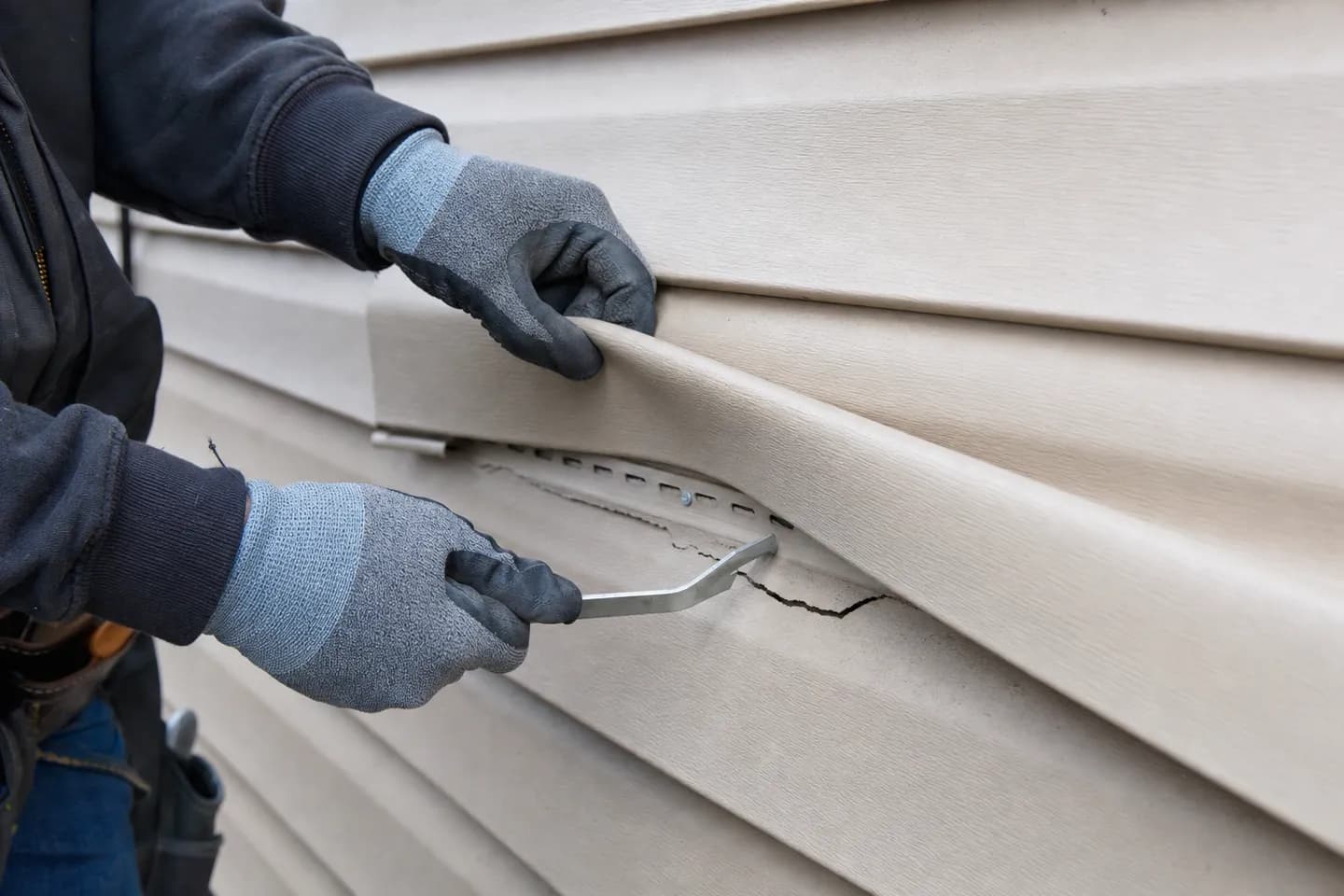
The vinyl siding repair itself is simple, which is exactly why it is worth doing when the panel exists. The Vinyl Siding Institute sets the whole procedure out in four steps:
- Slip a zip tool behind the bottom of the panel above the damaged one and unhook it from the lock.
- Bend the upper panel out gently, pull the nails from the damaged panel and lift it off.
- Lock the new panel into the course below and nail it up through its slots.
- Zip the upper panel back down over the new panel's lock.
Two details decide whether it lasts. New panels lap the old ones by about an inch, with the laps staggered so they never line up in neighbouring courses, and turned away from the door people walk through. Nails go in the centre of the slots rather than through the face, loose enough for the panel to slide. In cold weather the manual raises the clearance at the trim from 1/4 inch to 3/8 inch below 4.4 °C, because a panel cut to fit in January is longer by July.
When the profile has been discontinued, the trade answer is to borrow. Good panels come off a wall nobody sees, behind a deck or down a narrow side yard, go onto the damaged elevation, and new panels go where the borrowed ones came from. Spares from the original job help too, with one catch: a panel that spent fifteen years in a dark garage has not faded along with the wall. Which is the second test.
Test 2: Will a New Vinyl Panel Match a Faded Wall?
Often not closely enough, and the manufacturer says so in writing. Kaycan's Canadian vinyl siding warranty treats a colour change of up to 4 Hunter units, measured to ASTM D2244, as normal surface weathering rather than a defect. A new panel starts at zero, so a visible gap between it and the old wall is expected, not a fault.
The clause is worth reading closely. Kaycan defines normal weathering as sunlight and weather that "will cause any colored surface to unevenly fade, become dirty, or to stain", says the severity depends on where the house is and how clean the local air is, and draws its line at a change in colour in excess of 4 Hunter units. Below that line, fade is not a claim. The word "unevenly" matters as much as the number: a south or west wall in full sun can drift further than a north wall on the same house.
Hunter units measure the distance between two colours, combining lightness, red against green, and yellow against blue into one number. The drawing below runs that arithmetic rather than guessing at it. Each wall is an illustrative mid-tone moved toward white by the stated number of units, which is how chalky, sun-faded vinyl reads, and each carries one new panel in the original colour set into the middle course, the way a single-panel repair goes on. The figure beside each row is measured back off the colours as drawn.
| Wall condition | Weathered wall colour | New panel colour | Measured difference (Hunter units) |
|---|---|---|---|
| Wall as installed | #8a7a62 | #8a7a62 | 0.0 |
| Faded 1 unit | #8c7d65 | #8a7a62 | 1.1 |
| Faded 2 units | #8e7f68 | #8a7a62 | 1.9 |
| Faded 3 units | #91826c | #8a7a62 | 3.1 |
| Faded 4 units (Kaycan: normal weathering) | #93846f | #8a7a62 | 4.0 |
Where a Colour Mismatch Is Fine, and Where It Is Not
The bottom row of that drawing is not a disaster on every wall. What matters is where the new panel sits and what is beside it.
- On a back wall, behind a deck or low in a side yard, a slight mismatch disappears into shadow and nobody notices it but you.
- A corner post, a window or a door breaks a wall into sections, and ending the new material at one of those breaks hides most of the difference. A course replaced from trim to trim reads far better than one panel floating mid-wall.
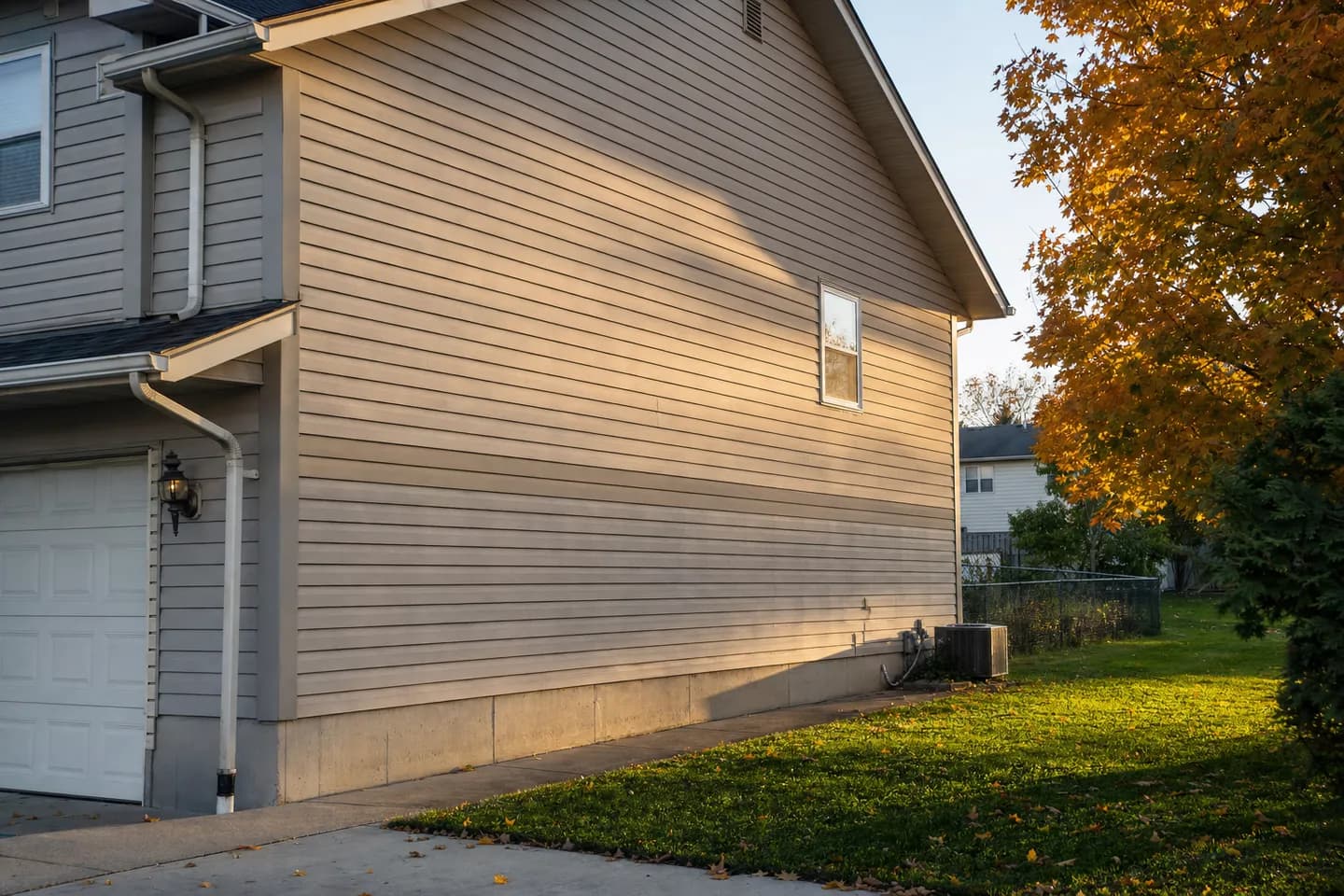
- On the front elevation, mid-wall, in full afternoon sun, the gap in that drawing is what the street sees.
That last case is where a siding repair quietly becomes something bigger. The honest options are to borrow panels from a hidden wall, to re-side that one elevation so the colour change happens at a corner, or to accept the mismatch where it genuinely does not matter. Painting the old vinyl to even it out carries a catch of its own: the same Kaycan warranty does not apply to siding that has been painted, varnished or similarly coated over the original finish.
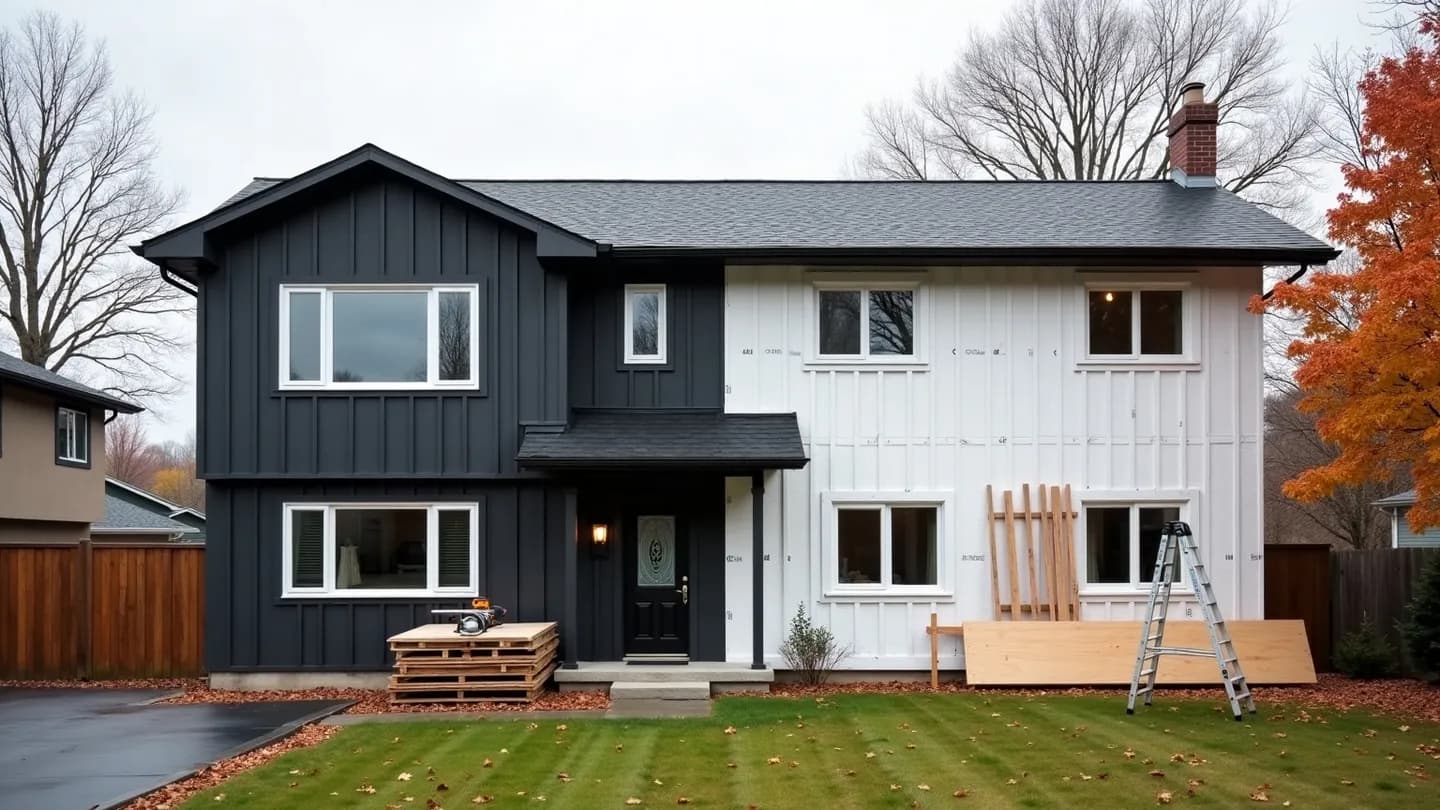
A house we re-sided in Oro-Medonte in October 2023 is the textbook case. The siding had gone old and faded, and it was letting moisture into the wall. Faded alone, a repair might have been arguable. Faded and wet, it failed two of the three tests, and the wall went to engineered wood.
Test 3: Is the Wall Behind the Siding Dry?
Vinyl is not the waterproof layer, and the Vinyl Siding Institute is blunt about it: vinyl siding is an exterior cladding, not a water-resistive barrier. It sheds most of the rain and lets the wall breathe, and it relies on the housewrap, the sheathing and the flashing at every window, door and roof line to deal with the water that gets past it. Some always does.
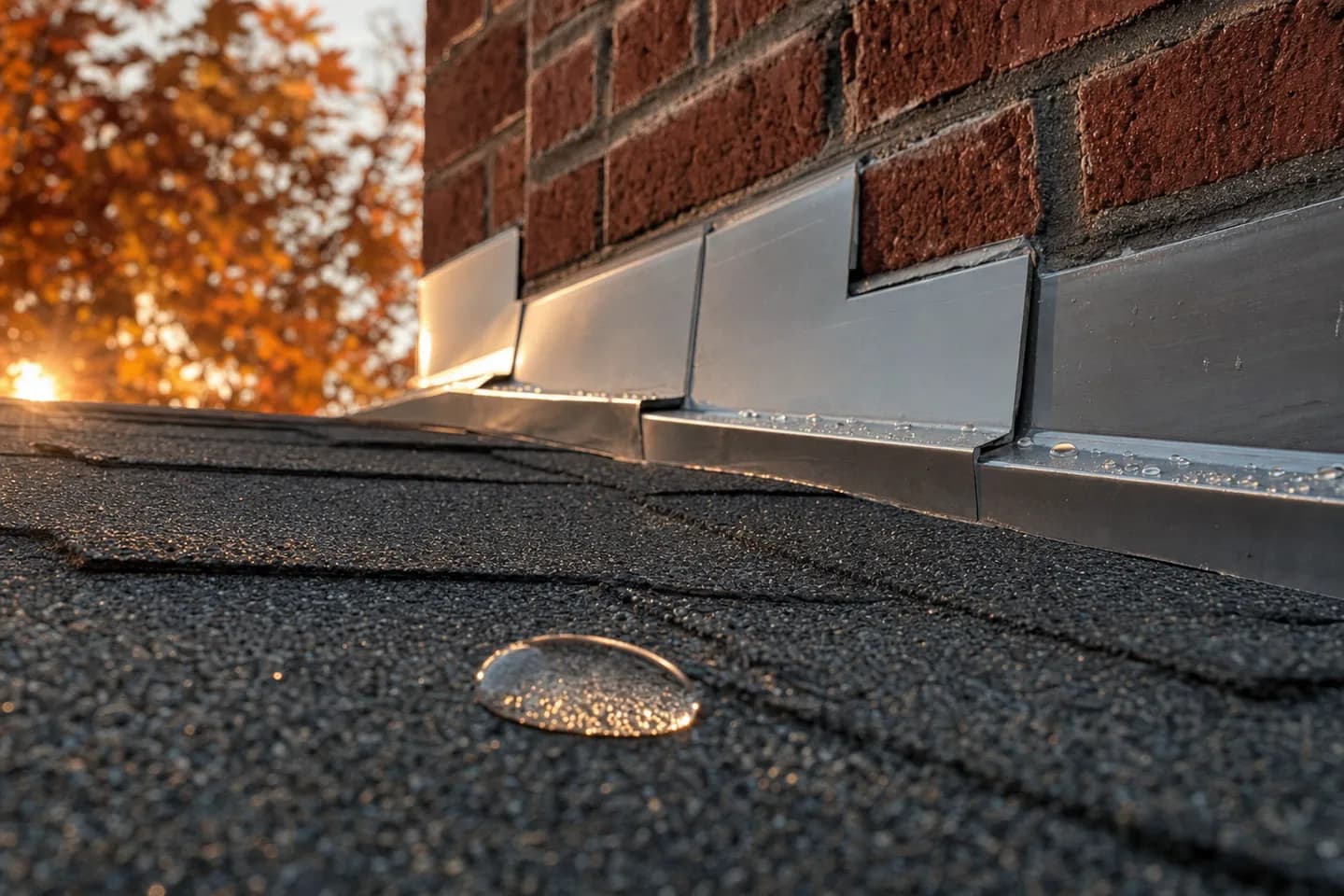
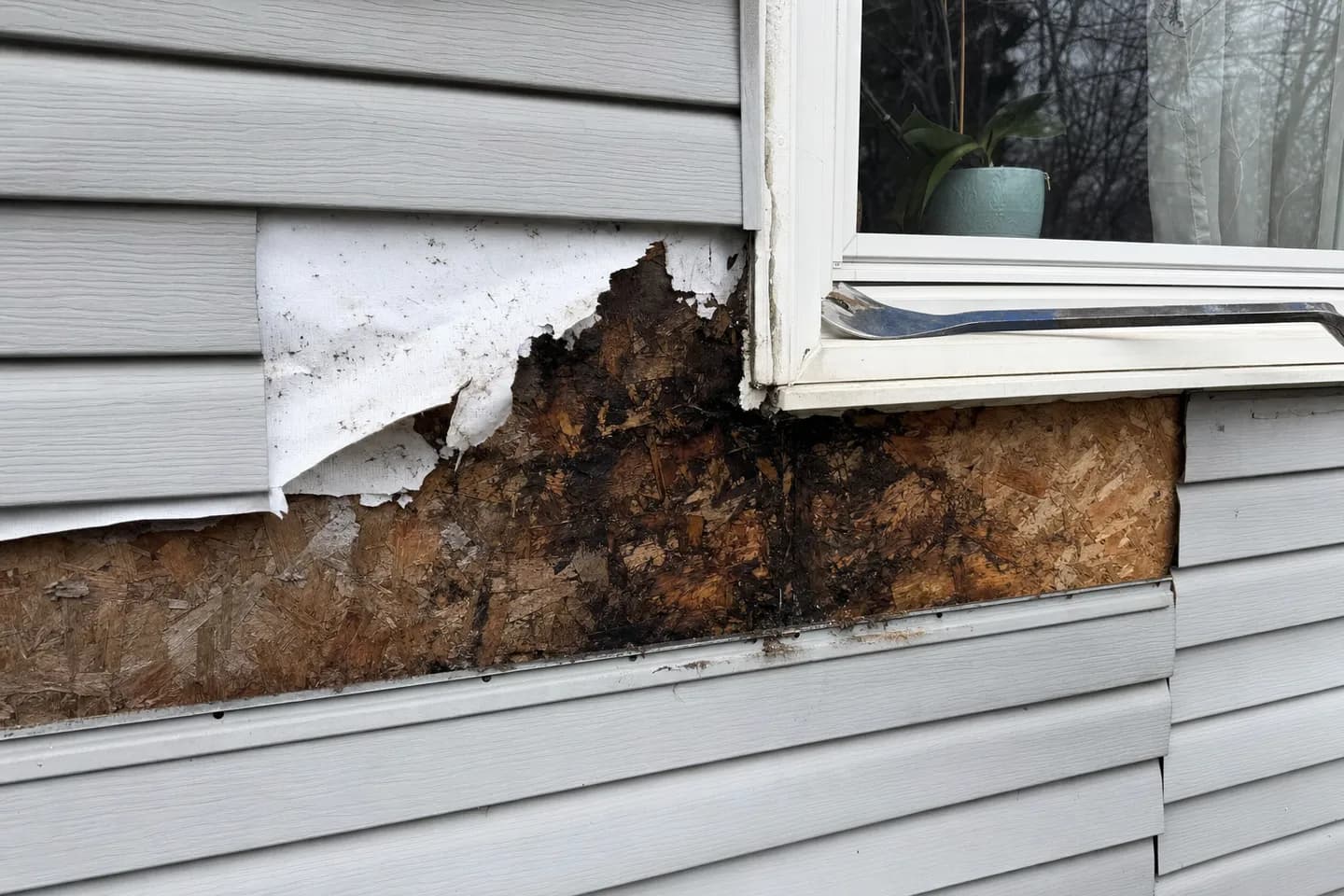
So a damaged panel is also an opening. When it comes off, look at what is behind it. The wrap should be intact and the sheathing hard and pale. Dark, soft or crumbling sheathing means the siding was only the symptom. The usual culprit is a window or door head with missing or reversed flashing, or a roof meeting a wall with nothing to kick the water out, and that is custom flashing work before it is siding work. Water pouring off a failed trough onto the same few feet of wall every winter does the same damage from outside, which is why an eavestrough repair is sometimes the real siding fix.
This is the test a siding repair quoted over the phone cannot pass. We open a section before pricing a repair rather than after, because patching over wet sheathing seals the problem in and charges you for the privilege.
Not sure which test your wall fails?
We will open the damaged section, check what is behind it, and tell you in writing whether a repair will hold.
How Much Does Siding Repair Cost in Ontario?
A small siding repair in Ontario is priced as a contractor's minimum call-out plus material, and access decides most of the number. Re-siding one 30 by 18 foot vinyl elevation runs about $2,200 to $4,300 at $4 to $8 per square foot, and a whole two-storey with roughly 2,500 square feet of wall runs $10,000 to $32,000 depending on material.
| Scope | How it is priced | What moves the number |
|---|---|---|
| A few panels at ground or ladder height | A minimum call-out plus material | Whether the profile is still sold, and access |
| A run of courses on one wall | Labour for every course removed and rehung, plus material | Height, staging, and how many courses come off to reach the damage |
| One full elevation | Per square foot of wall, vinyl about $4 to $8 installed | Windows and doors to trim around, gables, what sits behind the old siding |
| The whole house | Per square foot of wall: vinyl $4 to $8, engineered wood $6 to $11, fiber cement $7 to $13 | Material, and wall area, which is not floor area |
These are Ontario market figures for 2026, the same per square foot bands our siding service page publishes, not a fixed price list. The elevation figure is plain arithmetic: 30 feet by 18 feet is 540 square feet of wall, and 540 at $4 to $8 is $2,160 to $4,320 before anything turns up behind it.
Height is what pushes a small siding repair up fastest. A panel under a second-storey window needs a long ladder set properly or staging, and that time is the same whether the job is one panel or ten. Scope does not have to be all or nothing either. On a side-split in Bradford this summer, the brick ground floor stayed and everything above it came off: upper storey, gable ends, soffit, fascia and trim, with the sheathing wrapped before a single new course went up.
Does Home Insurance Cover Siding Damage From Wind or Hail?
Storm damage to siding is usually a home insurance matter, not a warranty one. Kaycan's Canadian vinyl warranty excludes damage caused by wind, and after a severe hail storm it supplies replacement material only for the damaged portion, leaving installation, labour and freight to the homeowner.
The hail clause is more specific than most people expect. Kaycan says its vinyl will resist a normal hail storm, and describes a severe one as a storm that damages roofs, windows and car windshields. After one of those it provides panels for the damaged area, and the homeowner pays for any additional panels to replace undamaged siding. That is the match problem again, written into a warranty. If new panels will not blend with the old wall, redoing the undamaged part is on you or your insurer.
Several US states have written matching rules into their insurance regulations. We are not aware of an Ontario equivalent, so how far an insurer goes on undamaged siding comes down to your policy wording and your adjuster. Three things help:
- Photograph every elevation before anything is removed or picked up, close in and from the lawn.
- Keep one damaged panel, so the profile can be identified.
- Ask for the colour comparison in writing, a new panel held against the old wall, before the claim settles.
If a claim stalls, the Insurance Bureau of Canada sets out the steps: your broker or adjuster first, then your insurer's own ombudsman, then the General Insurance OmbudService. And when wind has opened the house up at the roof edge as well, our emergency roof repair guide covers what gets secured first.
Siding Repair Along Georgian Bay, Lake Simcoe and in Stouffville
Three stretches of our service area each lean hardest on a different one of the three tests.
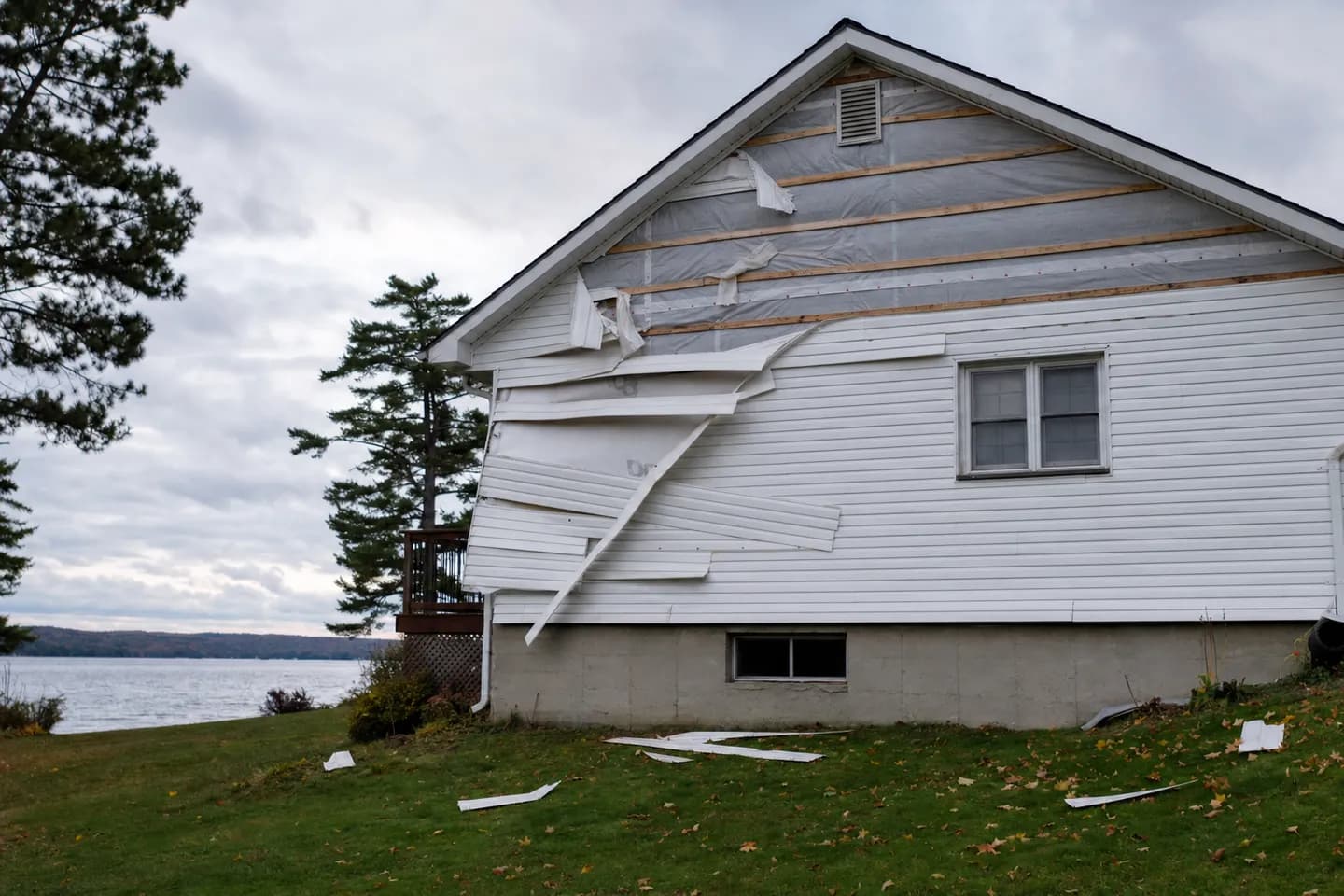
On the Georgian Bay shore, at Collingwood and Wasaga Beach, open water puts wind and sun on the same walls. Wind unlocks courses, and sun fades the wall a replacement has to match, so the first two tests get harder together on a lakefront elevation.
Around Lake Simcoe, Innisfil sees snow on twice as many days a year as York Region does. A wall that spends months with drifts against it puts its lowest courses, and the sheathing behind them, through the third test every spring. Bradford, right next door, is the closest comparable job we have photographed.
In Whitchurch-Stouffville, where our yard sits, a quarter of the housing went up between 2006 and 2010. On a wall that is now 16 to 20 years old, whether the original profile is still made is the first thing to check before anyone quotes a patch.
What a Siding Repair Quote Should Answer
Four answers belong on a siding repair quote before a price does:
- Whether the profile is still sold, and where the replacement panels are coming from.
- How close the colour will be, shown with a panel held against the wall rather than described.
- What was behind the damaged section when we opened it.
- Whether the cause has been dealt with: the flashing, the trough, the barbecue, the lock that let go.
The damage rarely stops at one material. A job on Lake Drive in Jackson's Point in March 2025 started with eavestroughs an ice dam had pulled to the ground and finished with new soffit, fascia and siding as well. Our soffit and fascia guide explains how the roofline above the siding works as one system.
At Sherak we are based in Gormley, and our crews work across York Region, Simcoe, the Kawarthas and the GTA. Every job carries our 10 year workmanship warranty and $5 million liability insurance, and the last 10 percent is due only once you are satisfied. Get a free quote and we will tell you which of the three tests your wall passes.
Sherak Ltd, Head Office
12275 Woodbine Avenue, Gormley, ON L0H 1G0
Phone: +1 905 490 8800
Email: info@sherak.ca
Find out if it is a repair or a re-side
We check the profile, the colour and the wall behind it, then put the answer in writing before you spend anything.
Get a Free QuoteFrequently asked questions
Can you replace just one piece of vinyl siding?
Why doesn't my new siding match the old siding?
Does home insurance cover siding damage in Ontario?
Can siding be repaired in winter?
Can I paint faded vinyl siding instead of replacing it?
How much does it cost to repair siding in Ontario?
Written by
Emad Alikhanpour
Roofing & Exterior Specialist
Emad has 15 years of hands-on experience across roofing and every exterior service Sherak offers, from shingle and metal roofs to siding, eavestroughs, soffit and fascia, and custom flashing.
15 years in the trade · Roofing and exterior services
View profileReader reviews
Loading reviews...